5 Common Causes of Construction Client Disputes (and How to Avoid Them)
Jessica Helms
Last update on:
November 18, 2025 12:24 PM
Published on:
TL;DR
Most construction client disputes don’t happen because of bad work — they happen because of unclear expectations, missing documentation, and lack of proof. With clear contracts, milestone-based communication, GPS-verified time tracking, written change approvals, and quality checklists with sign-offs, you can protect your business from unpaid invoices and costly rework.
Your construction crew was hired to renovate a building in an apartment complex. The project has taken three months to complete. Your crew has worked through several change orders to meet client expectations and feel confident in the work completed.
When you send your final invoice for payment, the client disagrees with the charges and refuses to pay.
“What is this extra $800 charge for a flooring replacement?”
“I just walked through and there is a smudge of paint on the ceiling.”
“I thought changing the light fixtures out was part of the contract.”
You’re upset your invoice is unpaid and your client is upset because they feel like they were blindsided with extra charges. Now you’re looking at spending more time on rework to fix the paint smudge, which the client expects you to perform free of charge.
Although they are inconvenient, client disputes happen in the construction world. The good news is, most of them can be avoided when the right processes are in place. Let’s take a look at why client disputes happen and how you can protect your business against unpaid work and damaged client relationships.
End Invoice Disputes with GPS Proof
Verify every hour and location to ensure you get paid in full.
When a client asks to change the original plans, whether that be adding an addition or moving an electrical outlet, if the project’s scope is not clearly defined, disputes are bound to happen.
The client assumes electrical work is included in the contract, but rewiring costs weren’t included in the original scope.
The same can be said of disputes that happen involving project timelines. Most clients understand that timelines aren’t set in stone. Material delays, weather, and inspector approvals can set projects back days, weeks, or even months. But that doesn’t keep clients from feeling frustrated and disappointed.
How can you prevent disagreements about contracts and the scope of work?
Make sure your contract is clear to protect both parties. You can do this by including the following information in your contract:
Be sure to list what is included and not included in the scope of work.
Don’t hold yourself to dates, but rather include timelines by milestones.
Describe in detail what the final project will include, noting materials used, changes to existing structures, etc.
Don’t rely on texting or verbal approval, get a digital signature when any change to the original plan is made.
Work with your client to determine what “finished” actually looks like to prevent costly rework.
2. Poor communication during projects
Nothing frustrates clients more than inconsistent communication from contractors.
If your client lives out of state and has hired your crew to renovate a rental property, they expect your company to stay in communication with them. A lack of clear communication can not only be extremely frustrating for your client, but ends up costing your business high-priced contracts in the future.
Regularly communicating with your clients in the form of email, text, photos, phone calls, and videos is appreciated. But when your client reaches out asking for an immediate update and you respond days later, they lose trust and confidence in your ability to complete the project, and may even second-guess the accuracy of your invoices.
How can you avoid disagreements and client disputes about communication?
Laying the foundation of structured communication from day one is the best way to prevent client disputes regarding your company’s communication practices.
Here are a few things you can do to establish consistent communication with your clients:
Schedule weekly or milestone meetings via Zoom, phone, or onsite.
Document written updates via email or within a shared software system.
Share photos, timelines, and status notes with both your crew and clients.
Include in your contract how and when communication should happen.
3. Inaccurate time tracking and billing
When it’s time to pay a contractor’s invoice, clients want to know they are being billed for the time actually worked.
Hand-written timesheets are a simple way to record employee time, but they don’t tell the full story – who worked where, which tasks were completed, and if the worker was actually present at the job site.
As a manager, you know your guys were honest when they filled out the time sheets. But your clients aren’t always on site to see the same things you do, which is where most billing disputes happen. Without detailed records, clients have very little to go on when it’s time to pay contractor invoices, which makes sense as to why they push back.
How can you prevent disputes over time tracking and billing?
Using a digital timekeeping system, preferably a GPS time tracking system that verifies clock-ins will help your crews prevent most client billing disputes.
When a client can see exactly when your crew arrived on site, how long each team member spent on specific tasks, and where they were when they clocked in and out, they feel more confident in your time tracking system and more apt to issue prompt payment.
4. Disagreements over quality or standards
As a general contractor, you are responsible for delivering a finished product that meets the client’s expectations. But “finished” work doesn’t always mean the same thing for everyone.
Even though the walls might be painted and the flooring is installed, one paint smear or slight bump pointed out by the client can undo all of the hard work your crew has completed.
Disputes don’t happen because the work was bad, per se, but generally because expectations were not met.
How can you prevent disagreements over quality or standards?
Create quality checklists that define what “finished” actually means: (e.g.: Is the flooring even with no visible bumps or raised areas?).
Include photos and examples of completed work to share with the client throughout the building process.
Encourage on-site walkthroughs at key milestones (e.g.: flooring installed, paint applied, lighting and appliances installed).
Require clients to digitally sign off on work completed, verifying on-site approval.
These suggestions can save your crew hours of costly rework and prevent run-ins with disgruntled clients.
5. Payment and change order disputes
Imagine a private client hires your company to build their new home. Half way through the build, they decide they want to change the lighting fixtures that have already been installed throughout the home. You order the new materials, tell your guys to demo the current fixtures, and prepare for rewiring. Your client loves the new lighting but doesn’t like the unexpected $4800 charge on their final invoice for lighting changes + labor.
Disputes involving payment and change orders can be frustrating for both parties. The client feels like they aren’t responsible for paying the charges, and the contractor feels like they did the work so they deserve to be paid.
How can you prevent disagreements over payment and change orders?
Communicating and documenting change details and costs upfront is the best way to avoid these disputes, along with the following best practices:
Every change order requires written documentation and a cost breakdown sent to the client for approval before work starts.
Avoid verbal agreements and approvals, as this doesn’t leave a documentation trail.
Require digital or handwritten signatures from the contractor and client when changes are presented, approved, and completed.
Don’t pick up materials or start working on the change order without written approval from the client and/or contractor.
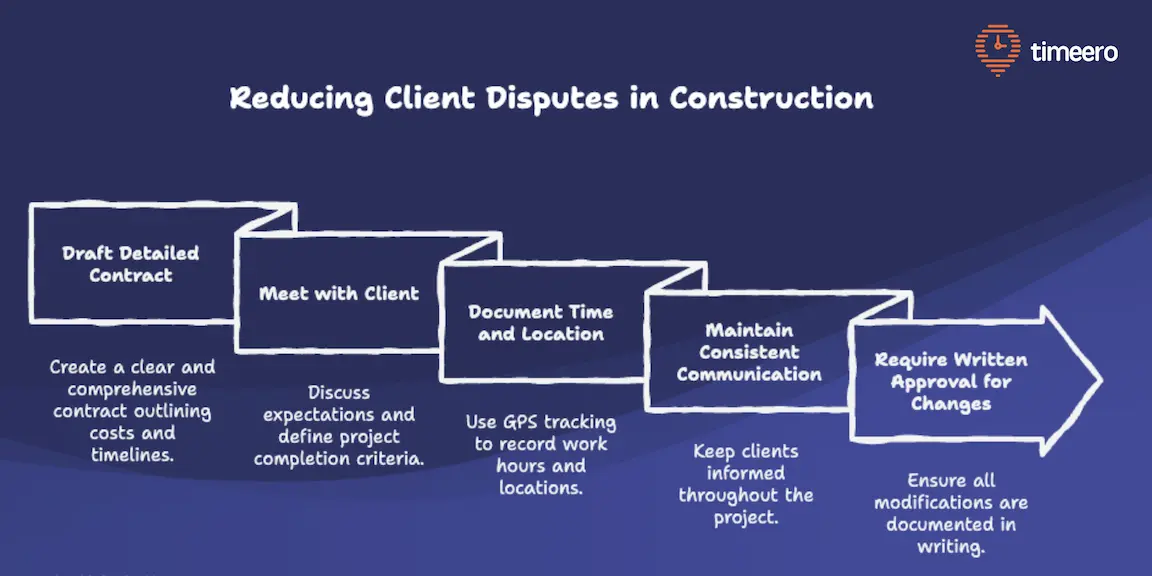
How to reduce client disputes before they happen
Below are the top 5 things you can do to reduce client disputes before they happen.
Make sure your contract is detailed and clear. State up front how much the products and materials cost as well as your labor rates. Include the estimated project timeline by milestone within the contract.
Meet with your client to go over expectations and define what “finished” work means. Request pictures of what they expect the final product to look like, and create a checklist together to be completed at the final walkthrough.
Document time and location with GPS-verified logs. Using a mobile GPS tracking app to record your crew’s time and whereabouts can prevent billing disputes.
Establish consistent communication with your client throughout the building process. This helps you avoid misunderstandings that could delay progress and payment.
Set the expectation that all changes require written approval. This creates a documentation trail that protects your business from billing related disputes.
How technology helps
Using technology like Timeero that incorporates GPS tracking can help you cut back on the time you spend running processes as well as help you avoid client disputes before they happen.
When clients second guess your crew’s time entries, a GPS time tracking system shows when your crew clocked in as well as where they clocked in. Location verification adds an extra layer of proof that work happened when and where you said it did.
Having GPS-verified records of employee time, mileage, and project progress within one system eliminates the need for costly rework, stalled invoices, and damaged client relationships.
Avoid client disputes with documentation
Client disputes are not only frustrating, they end up costing you time and money in the long run.
With the right processes in place, you can stop client disputes before they start. If clients question invoices or raise concerns about employees not showing up on site, a GPS-verified time and mileage tracking app like Timeero gives you the documentation you need to resolve client disputes fairly and quickly.
Most client disputes are caused by unmet expectations, unexpected charges, and lack of communication.
How can contractors avoid billing disputes with clients?
Using a transparent timekeeping system that tracks how much time your crew worked on each job or task is key to avoiding billing disputes with clients. Also, using a GPS time tracking system gives clients visibility into what is happening on site by verifying the clock in/out times and locations of crew members.
Do GPS logs help reduce disputes?
Yes. GPS-verified logs provide clients with increased visibility into onsite activities. Each clock in/out is tied to a specific GPS coordinate, eliminating costly instances of time theft that could raise concerns from clients.
What’s the best way to keep clients updated during a project?
Consistent communication plays a big part in the success of your business. To keep your clients updated, consider using a GPS tracking app that allows you to upload GPS tagged photos of project progress as well as add project notes to timecards. Establish a routine of regular Zoom calls or schedule frequent building walkthroughs.
Eliminate Billing Confusion
Verify time and location automatically. Timeero gives you proof that clients can’t question.
Jessica is a skilled writer and proofreader with a unique flair for crafting engaging and impactful content. Her work reflects her ability to connect with clients on a personal level while successfully addressing their most pressing concerns. Jessica's professional background includes: teaching, social media marketing, and e-commerce. She resides in Alabama and loves the Golden Girls sitcom.



.png)


%202.svg)


.png)
.png)



.png)


