How Timeero Helps Companies Navigate Washington Break Law and Simplify Compliance
Jessica Helms
Last update on:
June 23, 2026 5:55 AM
Published on:
TL;DR
Washington break law has undergone several changes within the last two years, mainly resulting from the Androckitis vs. Virginia Mason Medical Center case in 2024. Employers can avoid costly penalties and class action lawsuits by automating break compliance with mobile tools like Timeero.
If you’re an employer in Washington, recent changes to the state’s meal and rest break laws might have you asking questions you can’t find the answers to. Even more so if you oversee employees in the healthcare industry where changes are set to take effect in 2026.
Now in 2025, further changes have been made to Washington Break Laws, specifically impacting healthcare workers.
We know these changes are a lot to take in, and understanding Washington Break Laws doesn’t always come easy. We’ll talk in depth about these recent changes and the steps you can take to avoid violating Washington Break Laws in this article.
The easiest way to handle Washington break laws.
Get accurate, audit-ready logs for time, location, and breaks—without the manual paperwork.
What the Androckitis v. Virginia Mason decision actually changed
If you’re not familiar with the case, hourly employee Rheannon Androckitis filed a lawsuit against Virginia Mason Medical Center on behalf of current and former employees, claiming that the company failed to provide them with compliant 30- minute meal periods and the resulting penalty pay.
Virginia Mason had a policy in place that if the employee did not take their 30 minute meal break that day, the automatic 30-minute deduction was reversed in the timekeeping system. However, employees were not given the opportunity to take another 30 minute meal break or offered compensation for the missed break, which violated Washington law.
There were a few significant changes that took place as a result of this case.
1. Interrupted meal breaks must now be fully paid
If employees are given a 30-minute unpaid meal break and the employer asks them to work through their break or interferes with work-related tasks, the meal break must now be fully paid.
2. Penalty pay is 30 minutes + double damages for willfulness
If an employer wilfully refuses to pay wages for the missed meal period as well as the penalty pay, the employee is entitled to double damages on all unpaid wages.
3. One missed break can equal up to 120 minutes of pay
If an employee misses one 30-minute meal break, they receive 30 minutes of penalty pay as well as pay for the meal break. If the employer fails to pay out either of these wages, the damage is doubled (60 minutes), totaling 120 minutes of pay.
4. Applies to all WA employers with non-exempt workers
According to Washington state law, exempt workers are given rest breaks, but only non-exempt workers are given 30-minute unpaid meal breaks.
As stated previously, only non-exempt employees are to receive 30-minute unpaid meal breaks under Washington law.
But there are several industries that are at higher risk for encountering break violations:
Healthcare
Construction
Hospitality
Retail
Manufacturing
Agriculture
Mobile Teams
The reason being is that it’s difficult to verify that every employee took their required 30-minute meal break when teams are spread out or work in fast-paced environments with demanding workloads.
The most common Washington break law mistakes employers make
Interrupting an employee’s meal break is an obvious way to encounter noncompliance. But, everyday practices that employers don’t think about might be exposing them to more compliance risks than they realize.
Timeero’s Jessica Packard sat down with Colleen Massamari, an HR expert in Washington state, to discuss Washington break law, as well as some of the most common mistakes employers make.
1. Misclassifying employers as exempt
“One of the initial problems that I see is that employers have an employee incorrectly classified as exempt. Some employers are incorrectly basing their employees’ classifications off of too much overtime or they are only looking at the earning levels, and not the duties tests that are required by the FLSA”, says Colleen.
2. Auto-deducted breaks that don’t match reality
“The second most common mistake employers make”, says Colleen, “is not having sufficient systems in place to properly monitor and meet the compliance of the requirements of meal and rest break rules. And I'm referencing both manual and digital systems…”
Speaking of Virginia Mason’s timekeeping system, Colleen points out, “the failure by Virginia Mason in this case was to ensure that their digital systems were operating in alignment with the rules and regulations.”
If your timekeeping system automatically deducts 30-minutes for a meal break, the same system will need a way to reverse deductions and award penalty pay if the break was missed. If there are no checks in to verify an employee was paid, you risk paying out double damages.
3. Late breaks
There may be times when an employee takes a break late or skips it all together. This is bound to happen at some point.
But the problem isn’t that the break was taken late or involuntarily skipped, it’s when the employer has no process in place to verify breaks were or were not taken.
4. Weak documentation and unclear timecards
Without clear documentation and detailed records, when an employee claims they weren’t given all of their meal breaks, you won’t have any evidence to back you up in court.
“Payroll records are the ultimate source of support to defend why an employer did or did not pay an employee during the pay period”, says Colleen.
5. Supervisors unaware of break rules
It’s also important for supervisors to be aware of meal break rules, especially for those employees that work extended shifts of 10 hours or more that are given a second meal break.
Employers should make sure all supervisors are well-versed in Washington break law, and that the rules are being applied consistently across shifts.
The real cost of Washington break law non-compliance
On the surface, non-compliance involves financial consequences. But the costs of non-compliance stretch far beyond penalties and legal fees.
Let’s take a look at some of the ways your business can be impacted by non-compliance with Washington break law.
Penalties and financial consequences
When an employee is denied a compliant 30-minute meal period, they receive 30 minutes of paid wages, as well as 30 minutes of penalty pay. If neither of these wages are paid, they are entitled to double damages.
Class action impact
If an employee files a class action lawsuit against your company, you end up paying out thousands in court fees and legal damages, not to mention the wages for potentially hundreds or thousands of employees.
Time spent on Labor & Industry (L&I) claims
After working with clients who have L&I claims filed against them, Collen reflects, “These claims took a significant amount of time and energy from the business owners throughout the summer and early fall, which is definitely not the best use of resources for a small to medium sized business to have to go through these types of claims.”
Loss of trust with employees
Employees have earned the right to receive a 30-minute meal break. If their meal breaks are continuously interrupted or denied, and they do not receive compensatory wages, their level of trust in the company will decrease. Not only will employees believe that their employers don’t care about their well being, they will question the accuracy of their paychecks as well.
What employers should do now: A checklist
✅ Update break policies to match current rules
Once your break policy has been updated to reflect current Washington break rules, you should clearly communicate the rules to employees as well as the procedures for meal breaks. These rules should be available in handbooks and training materials, readily accessible by all employees.
✅ Audit timekeeping systems (manual + digital)
Does your current timekeeping system meet the new standards? What documentation do you have in place to support interrupted and waived meal breaks?
✅ Train supervisors on break protection
Your supervisors and managers must be adequately trained on Washington break law. Supervisors should focus on facilitating uninterrupted break times. As an employer, your supervisors and managers are responsible for seeing that all hourly staff are given their legally required meal breaks, and that all instances of noncompliance are thoroughly documented.
✅ Strengthen documentation for 3-year audits
The statute of limitations for filing a Labor & Industries claim is three years in Washington. You will want to keep detailed records of employee meal breaks, including their starting and ending times, employee attestations, and break waivers.
✅ Use digital tools with oversight
Digital tools can be used to help companies monitor break compliance. With scheduling capabilities and break alerts, modern technology can help you avoid costly mistakes that lead to noncompliance.
How Timeero supports Washington break law compliance
Timeero is a mobile timekeeping system that uses GPS technology to verify time entries for accurate record keeping and payroll reporting. But Timeero can also be used by businesses that want to automate break tracking for compliance.
The following break tracking features will help your company better follow Washington break law and avoid noncompliance.
Break scheduling
One way employers can make sure employees never miss a break is to use Timeero’s scheduling feature to assign employees breaks.
Automatic breaks can be inserted into an employee’s timesheet after a specific number of hours worked. See our guide on how to configure automatic breaks.
Even if you use paper schedules, using the app to schedule breaks can help you ensure all employees are receiving their required meal breaks.
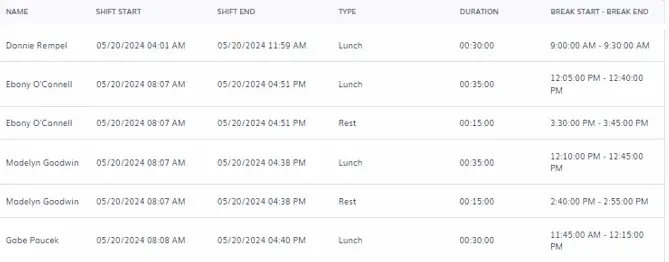
Detailed break reports
Timeero allows you to view break reports for specific employees, as well as view breaks by date. Break reports show the type of break taken, as well as the duration and start and end times.
With this report you can easily spot whether an employee returned from their break early or skipped their break entirely, allowing you ample time to follow up with the employee to discuss the break violation.
Offline time tracking
Mobile teams in the agricultural, sales, or construction industry know that sometimes internet connection is spotty. In the event an employee’s mobile device loses internet connection, Timeero’s offline time tracking still allows employees to record their break times without leaving gaps in timecards. The data is stored locally on the device and syncs with the cloud once connection is restored.
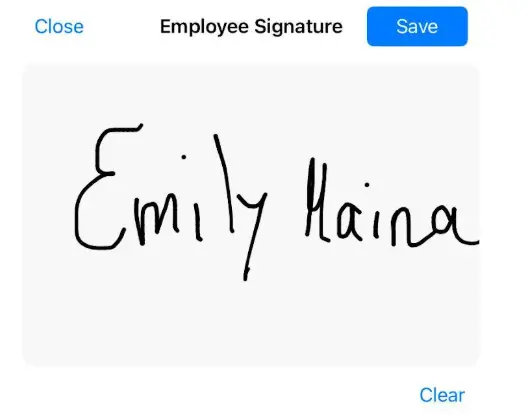
Employee signatures
Employee signature on mobile device
Employees have the ability to sign off on their timecards directly from their mobile device. When employees add their written signature, they verify that their timecard is correct. This can also serve as written attestation that meal breaks were taken.
Automate break compliance and avoid costly penalties with Timeero
Navigating Washington break law can be confusing, especially when there are so many changes. Automating your break tracking process with Timeero can help you reduce costly mistakes and avoid lengthy lawsuits and disputes.
FAQs
What counts as an “interrupted” meal break?
An interrupted meal break is when an employer interferes with an employee’s 30-minute meal break. Either asking them to work through their break, not leave the premises, return to work early, or remain on call.
How far back can Washington investigate break violations?
The statute of limitations for filing claims against break violations is currently three years in Washington.
What’s the best app to track meal and rest breaks for compliance?
Timeero is one of the best apps to track meal and rest breaks for compliance in Washington. With break scheduling, automated reminders, detailed break reports, and offline time tracking capabilities, Timeero is a great fit for mobile teams and industries at high-risk of noncompliance.
Jessica is a skilled writer and proofreader with a unique flair for crafting engaging and impactful content. Her work reflects her ability to connect with clients on a personal level while successfully addressing their most pressing concerns. Jessica's professional background includes: teaching, social media marketing, and e-commerce. She resides in Alabama and loves the Golden Girls sitcom.




%202.svg)


.png)
.png)



.png)


