For this review, I used Jibble to create and manage two organizations for two weeks in August 2026. One organization stayed on the free plan, while the other went through a paid trial and then dropped back to Free.
I tested the web app and iOS across multiple devices and user setups.
What features and capabilities did I test?
Clocking in and out
Creating locations and schedules
Changing time-tracking settings
Geofence automation
Breaks
Overtime
Time off management
Live Location tracking
Jibble AI
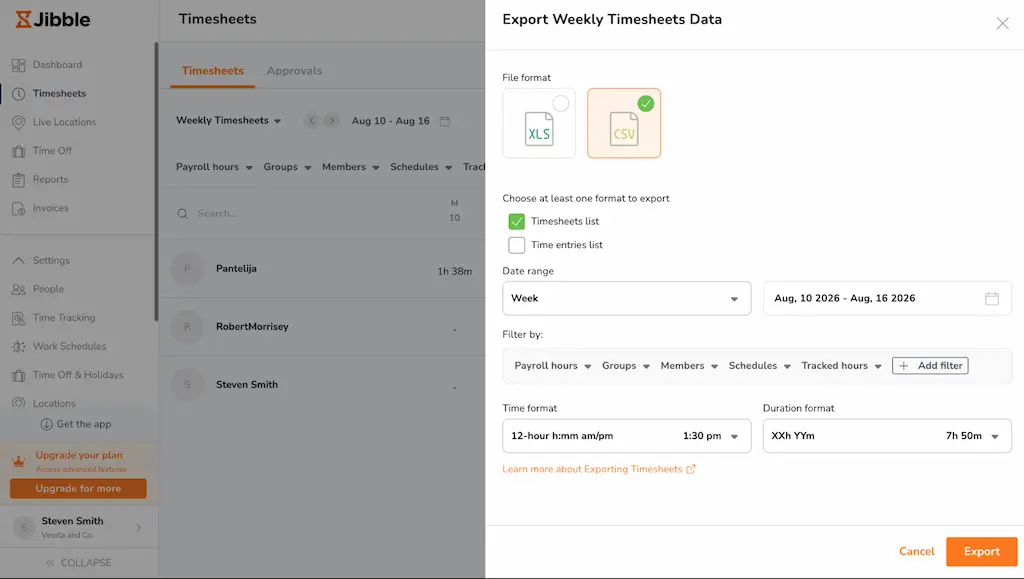
Payroll exports
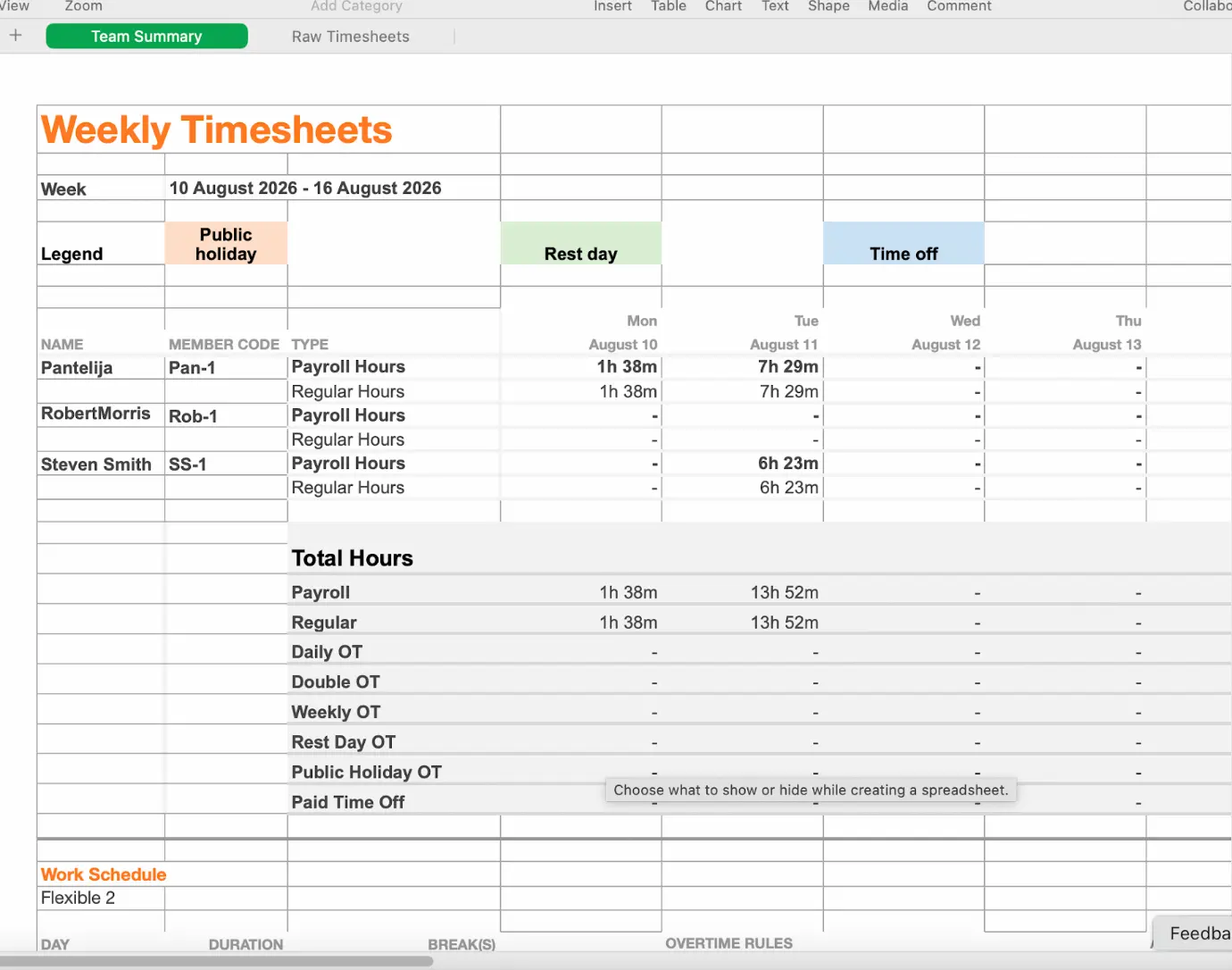
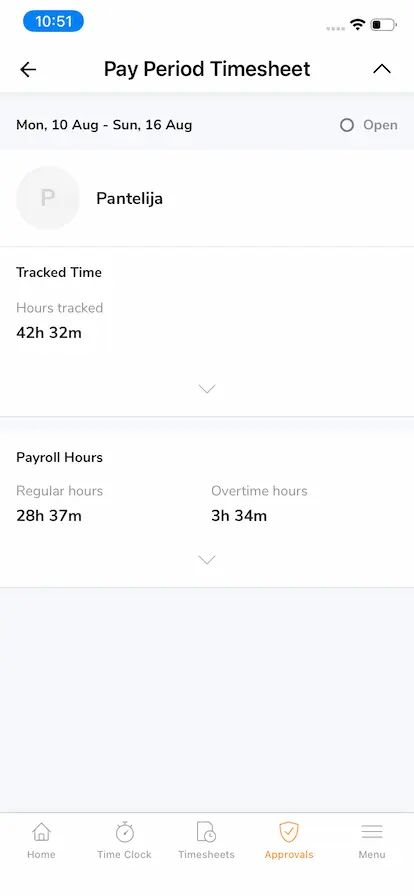
I also opened the exports in a spreadsheet and checked the results against what Jibble showed in the app.
Test conditions: August 2026 · Jibble web app and iOS · two organizations · free plan and paid trial · multiple devices and user setups · U.S.-locale pricing captured August 17, 2026 · Jibble documentation checked during the same period
The main reason I wanted to test Jibble was to see its free plan in action. On paper, Jibble gives small teams a surprising amount without charging per employee, and much of that held up in practice.
However, the app’s limitations became clearer as I added more realistic settings and tested its location features. The ability to add a second schedule, another job site, or another admin is usually of higher priority than adding additional users. And while Jibble has both automatic geofence clocking and Live Location, they solve different problems and don’t work together for the same employees.
Jibble’s free plan is generous, but complexity has limits
Jibble’s free tier includes much more than basic clock-in and clock-out. Its plan comparison lists GPS-stamped time entries, facial recognition, PIN and NFC verification, one shared kiosk, offline mode, screen capturing, project and client tracking, automatic deductions, overtime calculations, automatic clock-in/out, and timesheet and report exports.
I tested Jibble’s break and overtime settings on the free plan, creating several named breaks where I set breaks as paid and unpaid, added allowed time windows, and enabled daily overtime with a custom threshold. None of these actions required an upgrade.
The free tier became restrictive when the organization itself became more complex:
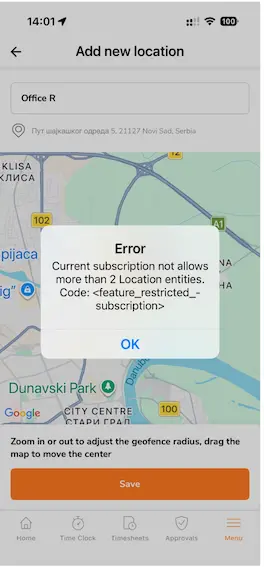
Two locations. Jibble lists a maximum of two locations on the Free plan. When I tried to add a third location, the app prevented the action.
One work schedule. Only one work schedule is allowed on the Free plan.
One admin. You can have unlimited members, but only one person can be the organization’s administrator.
One kiosk. The Free plan supports one kiosk on one device at a time.
You can only add two locations on Jibble’s Free plan. Trying to add a third results in the above error.
The claim of “unlimited users” is true, but this does not mean unlimited locations, schedules, or management roles.
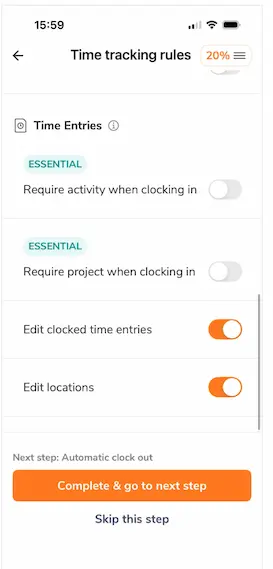
Requiring a worker to tag time to an activity or project needs Jibble's Essential plan. Captured before the trial was upgraded, so this is what a free organization sees.
Timesheet approvals, group management and required job tagging all need Essential. Time off is stricter still: employees can't request their own leave or see their balance below the Growth plan, which we watched happen. During the paid trial our test employee could request leave and check her balance. When the trial ended, both disappeared from her app.
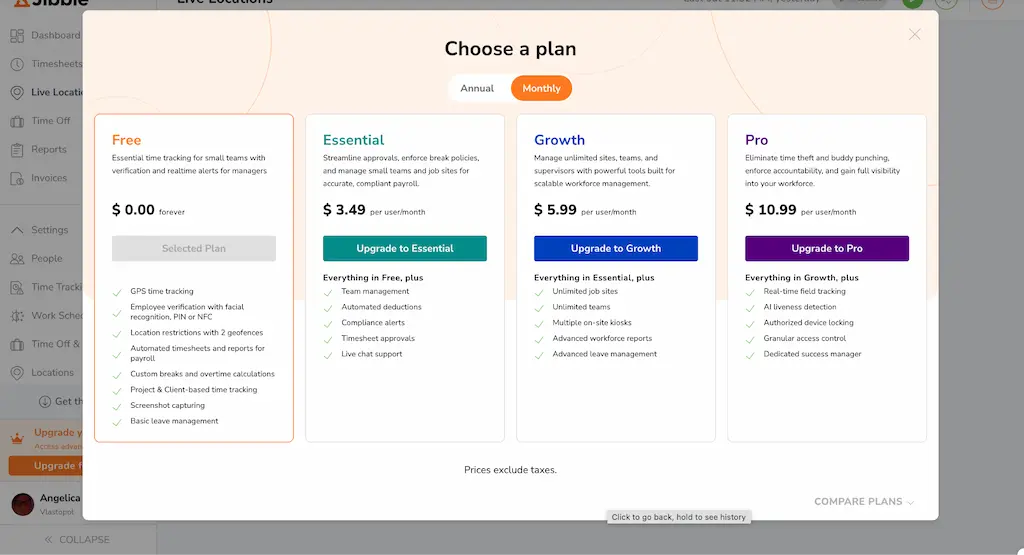
Jibble pricing in 2026
When I checked in August 2026, Jibble did not have a current public pricing page. Its pricing URL redirected to the homepage, while another page still showed older plans.
Inside the app, my U.S.-based organization was quoted the following:
Essential: $3.49/user/month, or $1.99 with annual billing
Growth: $5.99/user/month, or $4.49 with annual billing
Pro: $10.99/user/month, or $7.99 with annual billing
A second organization for the same account, in the same city, was shown euro pricing instead. Jibble says its localized pricing can vary depending on where most users in the organization are based.
I didn’t see a platform fee or minimum charge mentioned when reviewing Jibble’s pricing.
However, watch for changes that take place when your free trial ends. If you downgrade to the Free plan, Jibble warns that some settings and features created during your trial period may be reset or permanently deleted, so you may have to customize your company’s setup again if you choose to upgrade later.
Jibble’s key features
Automatic clock-in and out
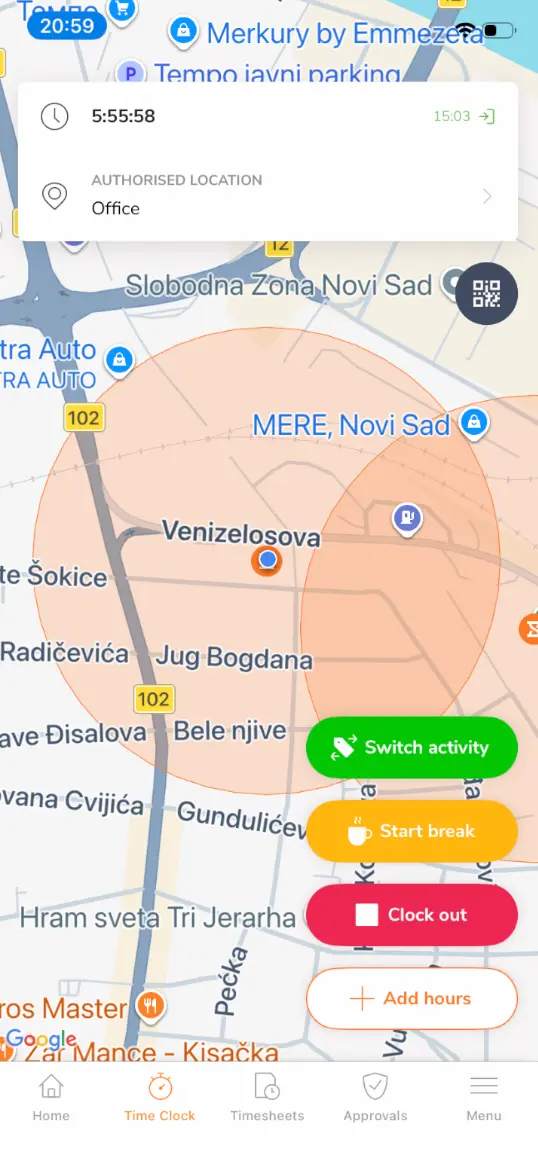
Jibble’s Auto Clock-In/Out feature is available to users on the Free plan. Employees are automatically clocked-in when they enter a geofenced job-site and are clocked-out when they leave.
Jibble requires a geofence radius of at least 300 meters.
For automation to work, Jibble requires a geofence radius of at least 300 meters. When I tested the accuracy of Jibble’s Auto Clock-In/Out, I found that the radius covered several blocks, which can impact the accuracy of clock-in and out times.
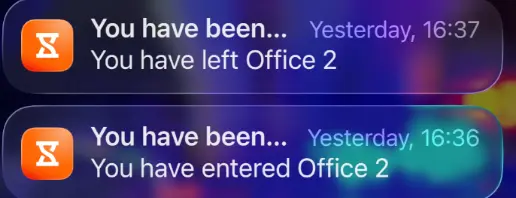
When I passed the pinned location, the app clocked me in at 4:36 pm and out at 4:37 pm.
A push notification shows I was clocked in for a total of 1 minute while passing the geofenced location
If an employee was not scheduled to work at the location, but was driving past as I was, Jibble would clock them in for 1 minute, which would be paid as company time. For field teams that frequently drive past geofenced job sites, the 300 meter radius minimum is worth noting.
I did notice that Jibble prevents an employee from being automatically clocked-in a second time if they are already clocked in.
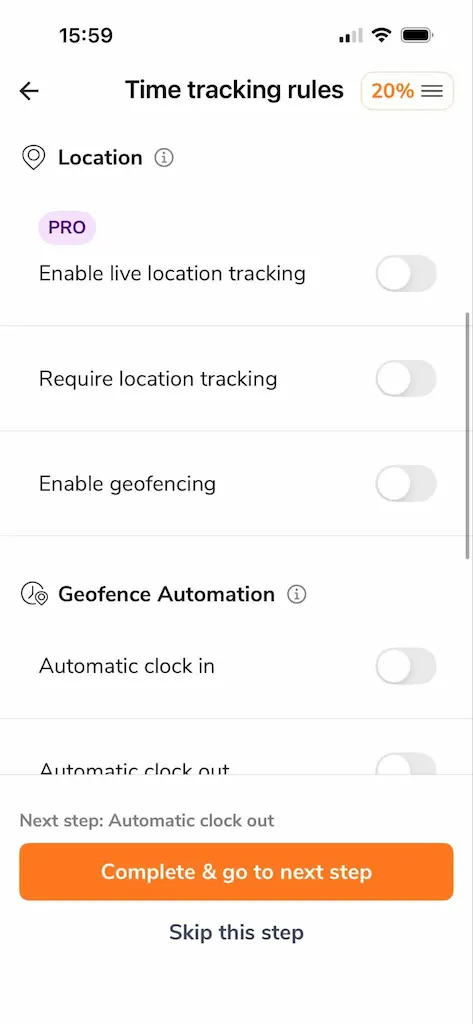
The accuracy of Jibble’s automatic time tracking also depends on the employee’s phone being set up correctly. The employee must allow location access, enable notifications, and potentially adjust some device settings depending on the operating system.
Live Location
Jibble’s Live Location feature can record where an employee moves while they are clocked in through the mobile app. Managers can see an employee’s current location, a timeline of recorded locations, and their driving route. Historical routes can also be opened from an employee’s timesheet.
Jibble says location points are recorded when there is significant movement and that Live Location data is kept for up to 90 days.
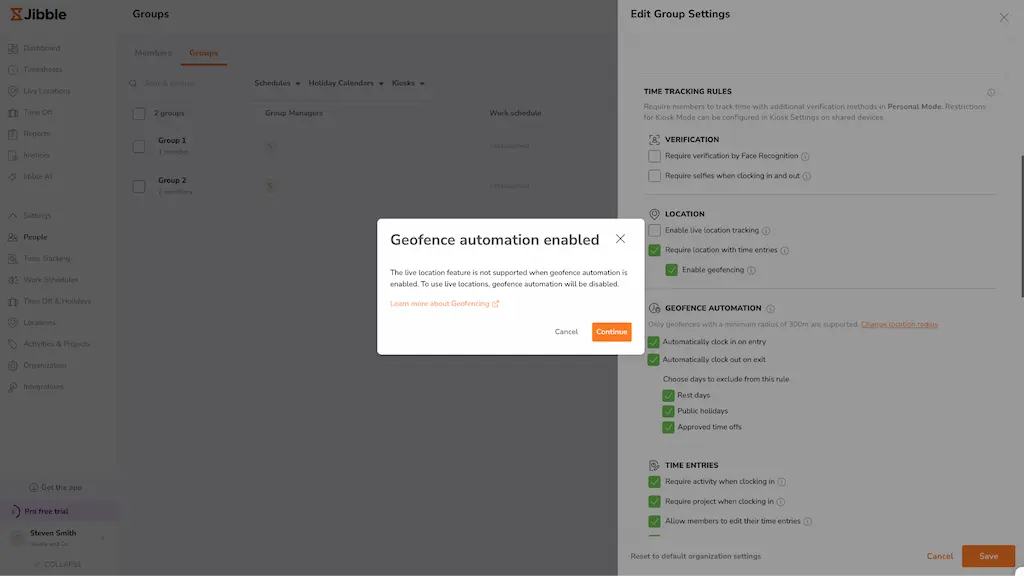
What’s important to mention is how Jibble’s Live Location interacts with automation. Apparently, Jibble says Live Location is not recorded when geofence automation is enabled for an employee.
Live Location and Geofence automation can not work at the same time
Jibble allows you to define different time-tracking rules for specific groups, so a fixed-site group could use automatic geofence clocking while another group uses Live Location. What you cannot do is give an employee continuous Live Location tracking as well as geofence automation for their punches.
Live location tracking is available on Jibble's Pro plan.
Attendance verification
Jibble can require facial recognition, selfies, projects, or activities for manual clock-ins. Those controls help with attendance verification and with assigning hours to the right work.
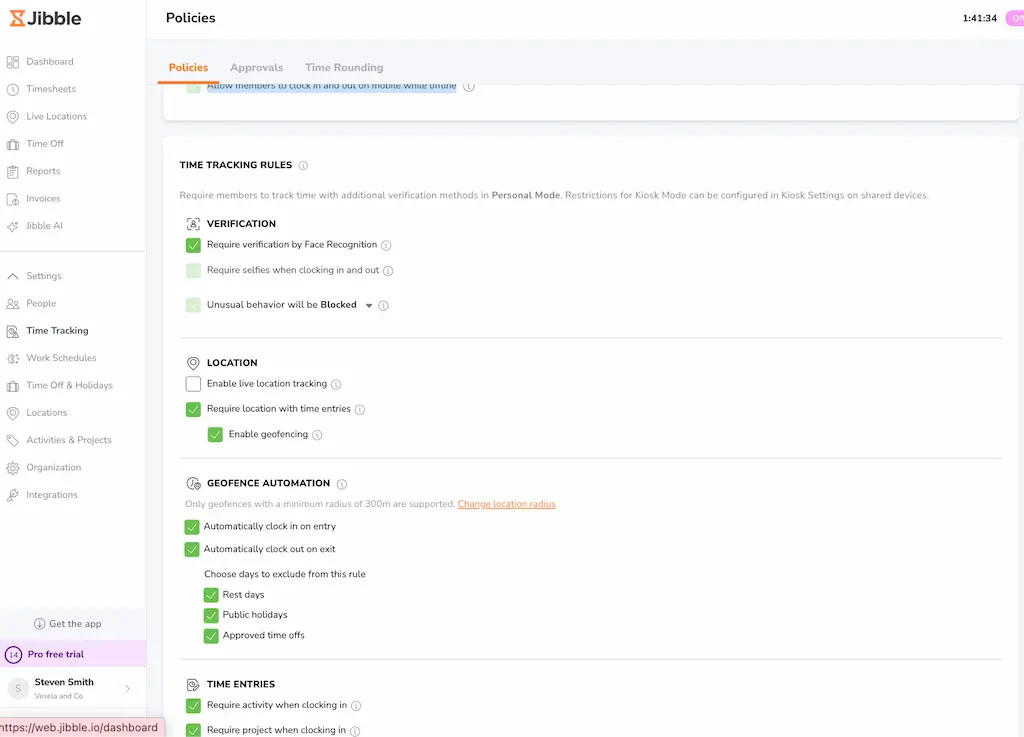
Geofence-created entries work differently. According to Jibble’s documentation, they bypass facial recognition, selfies, required projects, required activities, and some schedule restrictions.
Geofence automation is on. All four verification requirements still display as enforced, and no warning appears anywhere on the page.
I saw this happen during exports. Automated entries had empty project and activity fields, while manually created entries in the same file contained that information.
This matters if projects or activities feed into job costing or billing. A manual clock-in can be blocked until an employee selects the required project, while an automatic entry can still be created without it.
Jibble does label how each entry was created, which makes those entries easier to identify during review.
Payroll export
Jibble has a basic report export and a more detailed timesheet export intended for payroll.
The payroll report included regular hours, overtime categories, paid time off, break information, deductions, and clock-in and clock-out details. It also showed some of the rules that produced the totals, such as work schedules and overtime settings.
That context is useful because it makes it easier to understand why a payroll number came out the way it did.
I also tested a break that crossed midnight. Jibble split it correctly between the two dates, and the totals in the spreadsheet matched what the app displayed.
For teams primarily concerned with hours and payroll, this part of Jibble worked well.
Overtime tracking
Jibble’s default work schedule does not include overtime. This makes sense because the software cannot know which jurisdiction or company policy applies to every organization.
Someone will need to configure overtime rules for accurate payroll calculations.
During testing, an employee worked 11 hours and 34 minutes on a rest day. Because rest-day overtime had not been enabled, the full shift appeared as regular time. The export showed that the relevant overtime rule was disabled, so the result matched the configuration.
If you use Jibble for payroll, overtime setup should be part of implementation rather than something left until after the first pay period.
Jibble AI
Jibble’s AI assistant can do more than answer support questions. I asked it to create a work schedule, and it successfully created one and was able to make it the organization's default schedule.
These capabilities mean that Jibble’s AI assistant can change settings that affect recorded time. During the same interaction, Jibble noted that changes to schedules could recalculate affected timesheets.
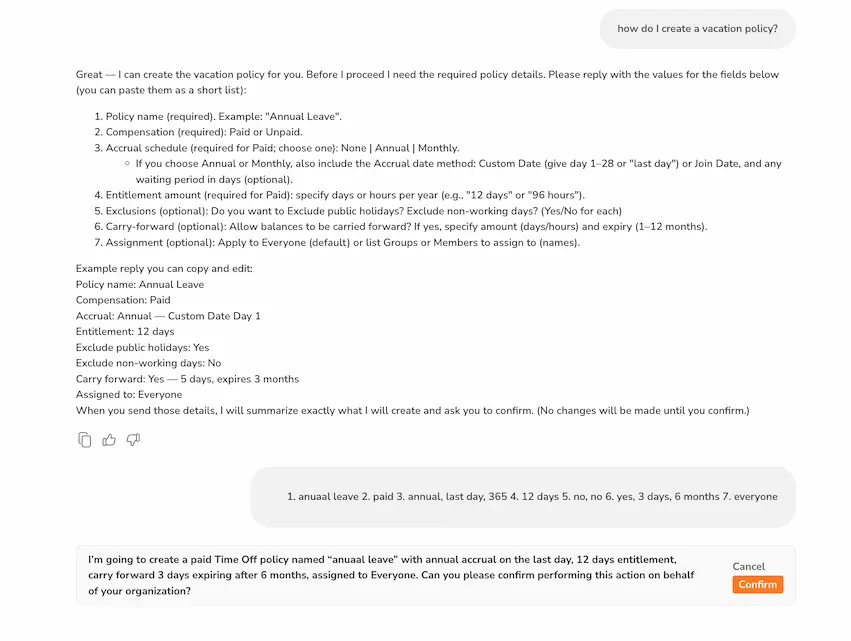
The limits became clearer when I asked the AI asistant how to create a time-off policy.
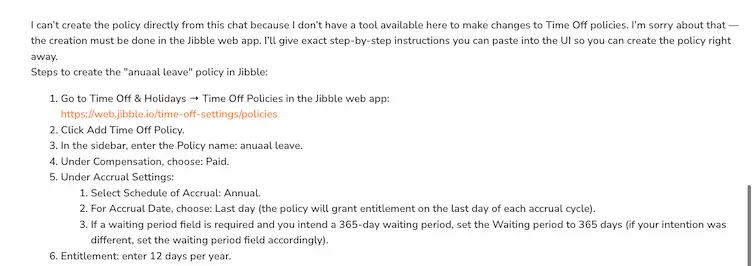
My conversation with Jibble AI
The assistant offered to do it for me, collected the information it needed and asked for confirmation. But then Jibble AI reported that it did not have the tool required to create the policy. It provided the correct manual steps instead.
Jibble AI Assistant cites a limitation
So the assistant can make some configuration changes directly, but its capabilities are still uneven.
Integrations
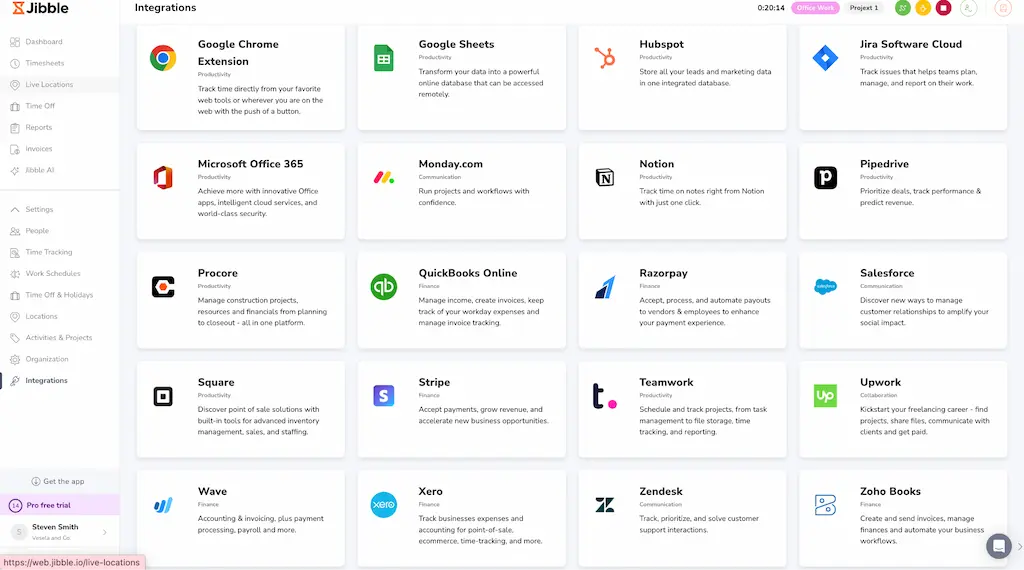
Jibble also connects with a useful range of payroll, accounting, and productivity tools. Its direct integrations include QuickBooks Online, Xero, and Deel, while employees can use Slack or Microsoft Teams to clock in and out without opening Jibble separately.
Jibble’s integration’s page
The QuickBooks Online integration goes beyond a basic file export. Jibble can send timesheet data to QuickBooks Online, and you can match Jibble activities with QuickBooks customers when you want tracked hours treated as billable.
With Deel, timesheets can be sent manually or automatically every 24 hours.
Xero is supported too, although some of the payroll functionality depends on where you use it. For tools without a direct connection, Jibble supports Zapier.
Overall, the integration options are solid, particularly if your main goal is getting employee hours into payroll or connecting time tracking with tools your office team already uses.
As for the payroll export itself, I would still check exactly which fields are passed to the system you use rather than assuming every piece of Jibble data will sync.
Mileage and drive time are the bigger gap for mobile teams
Jibble’s Live Location can show where an employee traveled but I did not find a feature within the app that turns that movement into a mileage or drive-time record.
That distinction matters. A route on a map can tell a manager where someone went, but it does not automatically:
Show mileage traveled between jobs
Generate an accurate mileage reimbursement record
Separate drive time from time spent at a job site
Assign mileage or travel time to a customer or job
For an office or fixed-site team, none of this may matter. For plumbing, landscaping, home healthcare, construction service crews, and other mobile teams, travel between jobs can be part of payroll, reimbursement, or job costing.
Jibble pros and cons
Pros
Unlimited users on the free plan
Facial recognition can help prevent buddy punching
GPS clock-ins, PIN, NFC, and kiosk mode available for free
Automatic clock-in and out available for free
Live Location includes route history
Break and overtime settings available for free
Detailed payroll export
Cons
Free tier limits locations, schedules, admins, and kiosks
Automated entries bypass facial recognition and some required fields
Geofence automation requires at least a 300-meter radius
Live Location is not recorded for employees using geofence automation
No mileage or drive-time calculation
Project/activity fields can be blank on automated entries
Pricing varies by region
Who Jibble is best for
Jibble is a strong fit for teams whose main problem is accurately recording attendance and work hours. Single-site businesses, office and hybrid teams, and companies concerned about buddy punching can get a lot from the free tier.
It can also work for mobile teams when live route visibility is more important than automatic geofence punches
Where Timeero differs for mobile teams
The main difference between Jibble and Timeero is not which app can show GPS movement. Both can. The bigger difference is what they do with that movement.
Jibble’s Live Location can show where an employee traveled, but it does not turn that route into mileage or drive-time records. Having a full picture of where field teams traveled during the work day is crucial for tracking productivity and job costs, something that Jibble lacks.
On the other hand, Timeero does track workers’ mileage automatically while they are on the clock. For teams that make multiple stops during the work day, Timeero’s Segmented Tracking shows every stop made, how long the workers spent at the location, the miles and time traveled between locations, as well as the location addresses.
A manager can view historical driving data through Route Replay, which retraces a worker’s driving route to see where they have been, while Drive Time distinguishes the time workers spent on the road vs time spent working at a location.
Timeero also offers Auto Clock In/Out as a separate workflow. While Jibble’s geofences require a minimum radius of 300 meters, Timeero’s minimum radius is 100 meters. Timeero reduces accidental auto clock-ins by requiring the system to wait about a minute before completing an automatic clock-in. If the employee leaves the geofenced area before the minute is up, no clock-in is recorded.
The only caveat for mobile teams is that Segmented Tracking and Auto Clock-In/Out can not run at the same time. Teams will need to decide if they primarily want hands-off attendance at individual sites or a continuous record of the full workday, including mileage and drive time.
Final verdict
Jibble’s free plan is one of its biggest strengths. It covers the core time-tracking needs of many small teams without charging by headcount, and its payroll export held up well in testing.
Jibble has real route-history functionality through Live Location, but that mode does not run alongside geofence automation for the same employees, and the route itself is not converted into mileage or drive-time records.
While this does not make Jibble a poor choice for field teams, you need to really consider what you need GPS to do. If attendance and basic location visibility are the priority, Jibble is a strong option. If driving between jobs is part of the work record itself, you’ll want to consider an app with time and mileage tracking capabilities.
Frequently asked questions
Is Jibble really free?
Yes. Jibble’s free plan supports unlimited users and includes GPS-stamped clock-ins, facial recognition, kiosk mode, offline mode, break and overtime settings, automatic geofence clocking, and exports. The main limits are two locations, one work schedule, one admin, and one kiosk.
Can Jibble prevent buddy punching?
Jibble supports facial recognition and other verification methods that can help prevent one employee from clocking in for another. Geofence-created automatic entries are an exception because Jibble says they bypass facial recognition and selfies.
Can Jibble show where an employee traveled?
Yes. With Live Location enabled, Jibble can show current locations and the route traveled while an employee is clocked in through the mobile app. Historical routes can also be reviewed from timesheets.
Can Jibble calculate mileage reimbursement?
I did not find a Jibble feature that converts route history into tracked mileage or a mileage reimbursement record during my August 2026 testing.
Can Jibble use Live Location and automatic geofence clocking together?
Not for the same employees. Jibble says Live Location is not recorded when geofence automation is enabled.Different groups can use different time-tracking settings, so one group can use Live Location while another uses geofence automation.
Does Jibble’s automatic clock-in use facial recognition?
No. Jibble says geofence-created entries bypass facial recognition, selfies, required projects, required activities, and some schedule restrictions.
What happens when a Jibble trial ends?
You can choose a paid plan or return to Free. Jibble warns that some settings and features may be reset or deleted when you downgrade, so upgrading again later may require reconfiguration.
Andjelka is a researcher and writer with 7+ years in digital marketing. Her background in social work and journalism has sharpened her skill in connecting with people from all walks of life. For the past 4 years, she’s specialized in time, location, and mileage tracking. Outside work, she enjoys yoga, swimming, and unwinding with her cats while listening to Leonard Cohen’s music.