Doing the Right Thing Isn’t Enough: Why California Employers Still Lose Meal & Rest Break Claims
Judyann Sonido
Last update on:
February 24, 2026 6:16 AM
Published on:
TL;DR
Even employers with compliant policies lose meal and rest break claims in California, not because they are breaking the law, but because of inconsistent implementation and insufficient proof. The strongest legal defense is consistent, reliable documentation that clearly shows breaks were provided, taken on time, and properly paid when exceptions happened.
Your company has a clear meal and rest break policy. Your supervisors know the rules. Your team takes their breaks. It’s clear that nobody's trying to cheat the system or cut corners because you're doing everything right.
Then one day, you get hit with a Private Attorneys General Act (PAGA) claim over missed breaks. And suddenly, you're scrambling to prove what you already know – that your employees got their breaks.
The problem? Your records don't show it. Maybe someone forgot to punch out for lunch. Perhaps your construction team worked through a break to finish a job on time, and the premium pay wasn't documented. Or maybe the records are there, but they're inconsistent.
Whatever the reason, you're left trying to defend yourself with incomplete documentation. And here's the hard truth: in California, good intentions don't matter if you can't back them up.
The gap between being compliant vs. proving it later is where many employers get caught off guard. Most are genuinely trying to follow the rules.
This article explains why meal and rest break claims happen in California, despite employers' strict break policies and good intentions.
See your real break-violation exposure
Estimate how missed meal and rest breaks could impact your business — and what better tracking could save.
Why meal and rest break compliance is harder than it looks
On paper, California rest break laws seem straightforward, and most employers get the policy language right. But applying those rules consistently across different shifts, job sites, and work scenarios? That's where things get messy.
Emilio Rodriguez, a California employment litigator with extensive experience handling wage-and-hour and PAGA meal break claims, explains it this way:
"Meal and rest breaks are so easy to make mistakes, but they're not intentional. The nuances are so specific that an employer could easily just misapply the policy or just have some inconsistency."
In other words, it’s not confusion about the law that leads to noncompliance. It’s what happens during day-to-day execution.
David clocks in at 6 a.m., but the job runs long, and breaks get delayed.
Jane, one of your supervisors, approves a meal break waiver but forgets to document it.
On Tuesday, Jonathan, your HVAC technician, takes his break like he’s supposed to. He just forgets to punch out before stepping away.
These aren't intentional violations, they're small, everyday operational hiccups. The kind of thing you'd fix if you caught it in real time. The problem is, you usually don't catch it until months later, when a PAGA meal break claim is filed. And by then, those small hiccups look like a pattern of non-compliance.
One PAGA meal break claim can affect your whole team
Under the PAGA, "...one mistake or one inconsistency in your meal break or rest break policy could trigger one of these lawsuits that carry a lot of penalties”, says Emilio Rodriguez.
Let’s use David’s case as an example. David works on a busy team where schedules run tight, and lunch breaks often start a few minutes late. It’s never treated as a big issue, and no one complains during the day. But after leaving the company, David filed a PAGA meal break claim with the California Labor & Workforce Development Agency (LWDA).
At that point, the claim isn’t just about David. It becomes a question of whether the company’s scheduling made it hard for the whole team to take breaks on time, opening the door to thousands in premium pay and penalties tied to multiple employees instead of one.
Compliance vs. proof: Two very different things
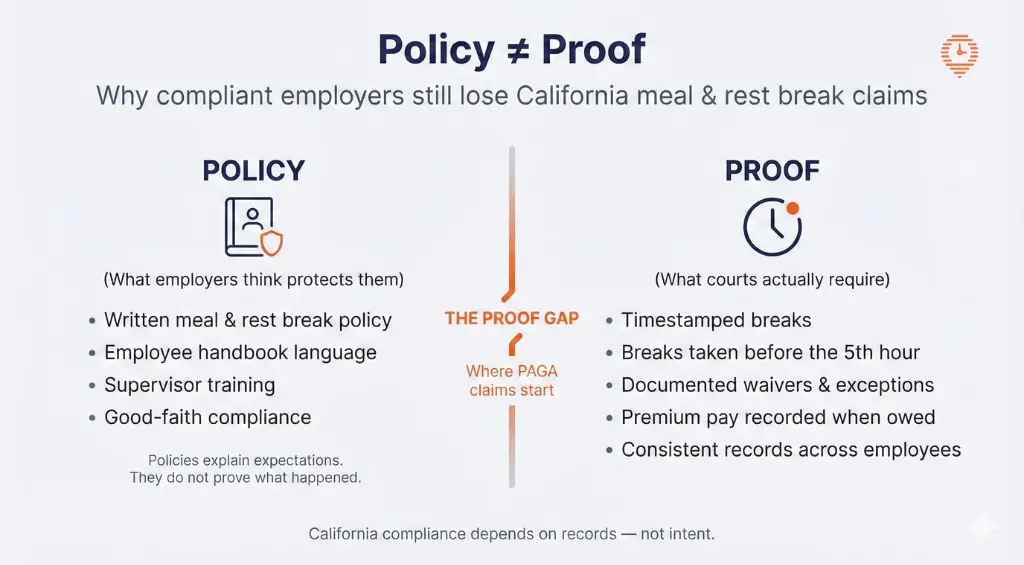
Having a compliant policy is necessary — but it’s not enough without documented proof.
Many HR admins feel safe because their handbook is bulletproof. Their policy clearly outlines the specifics around meal and rest breaks, and managers are trained on proper break compliance. On paper, everything checks out.
However, there is a fundamental "proof gap" that catches employers off guard:
California meal break compliancemeans you allow employees to take a break.
Proof is the verifiable, timestamped record that shows your employees actually took the required break on time.
Why written policies aren’t enough
You can do everything by the book, but if you don’t have proper meal and rest break documentation, none of that matters. Rodriguez puts it perfectly:
"There's a difference between doing the right thing and following the law, and then proving that you follow the law. Those are two different things.
Employers don't do things on purpose. They don't want to take away the meal break of the employee. But the problem is having the right record or document to prove and defend yourself if one of these lawsuits does arise."
Here's why this matters: when a claim is filed, the burden of proof falls on you. Courts don't care about your intentions. They care about meal and rest break documentation. If an employee says they missed a break and your records are incomplete or inconsistent, you're already on the defensive.
Think of it this way. You wouldn't tell the IRS, "Trust me, I paid my taxes" without receipts. The same logic applies here. California's labor laws require proof, not explanations. You can do everything right and still be unable to prove it later.
Where employers assume they’re protected (but aren’t)
Many businesses operate under a false sense of security based on three common assumptions:
1. “Our policy is compliant.”
Remember, a handbook is a set of rules, not a record of what actually happened. Having a rule that says, “Take a 30-minute meal break,” does nothing to prove that your employees actually took it.
2. “Our supervisors know the rules.”
Even the best supervisors get busy. Without a system that alerts them to missed breaks in real time, they cannot possibly police every minute of every shift.
3. “We’d fix it if there was a problem.”
Most employers only realize there is a problem during a PAGA audit or when a former employee files a claim. At that point, it’s too late to fix the records.
"Sometimes, depending on what your recording method is,” says Rodriguez, “if you're using the old punch card clock, when you still use a piece of paper and you walk up to the wall and you punch in, you punch out – well, if an employee forgets to do that one day, then there's going to be an inconsistency there."
No one meant for it to happen. But now it exists in black and white.
Why most meal and rest break claims aren’t about bad actors
Here's something important to understand: most PAGA meal break claims are not because employers are trying to cheat the system. They stem from operational gaps that pile up over time.
You have probably dealt with situations like these:
Missed punches
In a busy environment, employees often forget to clock in or out for their lunch. While it may seem like a minor administrative headache, California rest break laws assume it didn’t happen if there’s no record of it.
Scenario: Missed punches
The scenario: Jules meant to clock out for lunch, but his phone rang as he was heading to his truck. The job needed him back right away. He eats later and forgets to punch.
The risk: Without a clear record, his attorney will argue that Jules worked through his lunch. If this happens across 50 employees over three years, those missed punches become a massive liability.
Late breaks
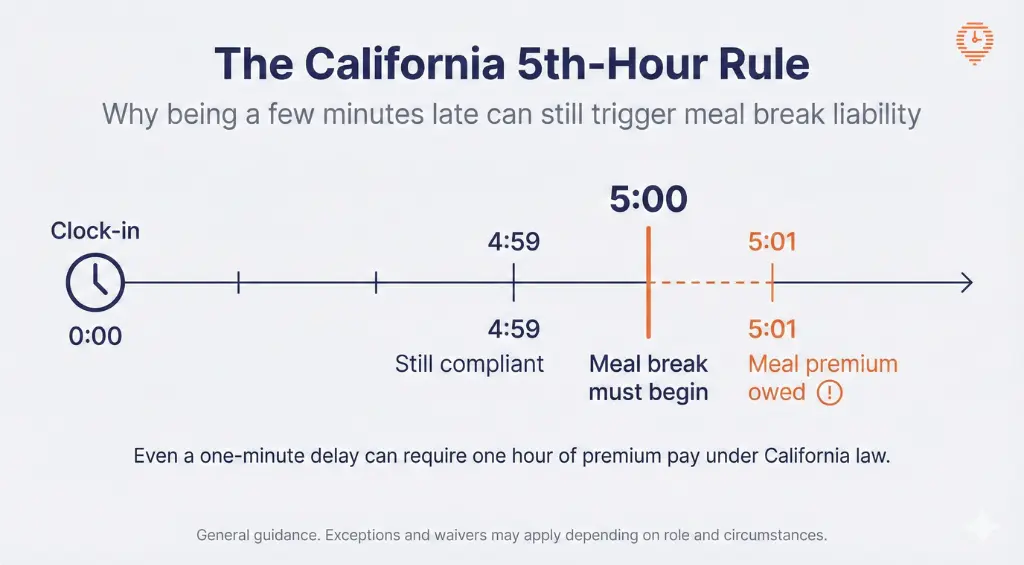
California’s 5th-hour rule is strict — intent doesn’t change the timestamp.
In California, a meal break must begin before the end of the fifth hour of work. If it starts even one minute late, the employer typically owes one hour of premium pay.
Scenario: Late breaks
The scenario: Megan is 10 minutes away from finishing her route. Instead of pulling over at 4 hours and 55 minutes, she finishes the last drop-off and starts her lunch at 5 hours and 5 minutes.
The risk: Even if Megan wanted to finish the route first, the law is strict. The timecard now signals a violation, and if the employer doesn't proactively pay the "meal premium" on the next paycheck, it becomes a PAGA target.
Inconsistent enforcement
There’s a big difference between having a break policy and enforcing it the same way every day, with every manager, across every team. If one manager says, "Take your break whenever you want," but then calls the employee on their radio during that time, the break is legally void.
Scenario: Inconsistent enforcement
The scenario: Justine tells her team to take their 10-minute rest breaks "when it’s slow." Because it’s a high-volume day, it’s never "slow," and the team implicitly feels they shouldn't leave the floor.
The risk: Employees must be relieved of all duties during breaks. If they are on call or feel pressured to stay, those breaks are noncompliant, regardless of what the company handbook says.
Manual corrections
Manual corrections often start with good intentions. They’re meant to fix small issues and keep payroll moving. But over time, they create some of the biggest red flags in California meal break compliance claims.
Scenario: Manual corrections
The scenario: Your payroll admin notices that Daniel forgot to clock out for lunch on Wednesday. To keep payroll moving, he manually inserts a standard 30-minute break so the hours “look right.” By Friday, several records had been cleaned up.
The risk: If Daniel actually worked until 12:15 p.m. that day, your payroll admin has technically falsified a time record. In a PAGA audit, a high volume of perfect 30-minute manual entries looks suspicious and often suggests that breaks are being auto-deducted or covered up.
Why good intentions don’t survive a meal and rest break documentation review
None of these mistakes is intentional. It’s just the reality of a business’s day-to-day: schedules shift, customers interrupt, and managers try to keep things moving.
But here’s where the risk creeps in. When one employee’s time records show missed or late breaks, it doesn’t stay isolated. It raises bigger questions like:
“Was this a one-time issue or something that happens often?”
“Did other employees miss breaks too?”
“Can you prove who took what and when?”
That’s how one person’s timesheet turns into a deeper review. And that’s how a single claim can quickly grow into 10. Or 20. Or more. Not because anyone acted in bad faith. But because small gaps, left unchecked, tend to stack up.
The real risk: Gaps between policy and practice
Here's the bottom line: risk doesn't live in your policy language. It lives in execution. You can have the cleanest meal and rest break policy in California, but if your team isn't consistently documenting breaks or if your tracking process leaves room for missed punches, late entries, or quiet workarounds, that’s where California meal break compliance issues begin.
The gap between what you intend to do and what you can prove you did is where most California employers get burned.
And the frustrating part? You're probably doing things right most of the time. But "most of the time" doesn't cut it when you're facing a PAGA claim that reviews every timesheet, every break, and every shift for the last few years.
What employers should take away
If there's one thing to remember, it's this: compliance is necessary, but it's not sufficient.
Following California rest break laws is step one. But if you can't prove you followed them, you're still at risk. Rodriguez's advice for employers is straightforward:
👉 First, know what system you're using.
Without a digital system like Timeero to capture GPS-verified timestamps and automate geofenced reminders, maintaining a perfect record is nearly impossible for mobile teams.
"Software is very helpful because it takes a lot of work off the shoulders of one person,” says Rodriguez. “The software is going to do most of the tracking, and you can trust the software to know that it's tracking correctly."
But don't just set it and forget it. Even with software, you still need that human element.
👉 Second, make sure your supervisors are applying your policies correctly.
You can have the best policy in the world, but if your supervisors aren't trained to apply it consistently, you have a gap. And that gap is where liability lives.
“If you have good software, a good system, and you have a good supervisor or good employees that follow your policies, you can rest assured that you're going to be okay."
So ask yourself:
Do we have accurate, consistent records for every break, shift, and employee?
Can we prove compliance if we're audited or face a claim?
Are our supervisors trained to apply our policies correctly?
Are we regularly auditing our own records to catch issues before they become claims?
If you're not sure, you're not alone. Most California employers struggle with this exact issue. The good news is that this is a solvable problem. It's not about working harder or being more compliant. It's about closing the gap between policy and proof and making sure your records match reality.
See how much you could save in premium pay and potential PAGA lawsuit settlement with our free interactive calculator.
FAQs
Why do California employers lose meal and rest break claims even when they try to comply?
Many employers lose because PAGA meal break claims depend on documentation. Missing or inconsistent records weaken defenses.
What’s the difference between following break law and proving compliance?
Following the law means you're giving employees their required meal and rest breaks. Proving compliance means you have accurate, timestamped records that show every break was taken on time, every time.
What should employers focus on first to reduce break compliance risk in California?
Start with two things: first, know which system you're using to track breaks, and make sure it's actually tracking correctly and consistently. Second, ensure your supervisors are trained to apply your policies correctly in real-world situations, not just understand them on paper.
Use a California break tracker built for proof, not assumptions
Create clear, reliable break records for California compliance.
Judyann is a content specialist with nearly a decade of experience in digital marketing. When she's not building brands and strategies, you'll find her exploring new destinations, embarking on spontaneous adventures, hunting down the best local eats, and spoiling her two fur babies. She believes the best content, like the best trips, comes from curiosity, creativity, and never playing it safe.




%202.svg)


.png)
.png)



.png)


