IRS Mileage Rates 2025: What Employers Need to Know
Emman Velos
Last update on:
April 16, 2026 6:08 AM
Published on:
TL;DR
The IRS standard mileage rate for business use in 2025 is 70 cents per mile, up from 67 cents in 2024. You’re not legally required to reimburse your employees at this rate (or at all), but doing so keeps reimbursements tax-free and deductible for your business. Without proper mileage tracking, you risk turning reimbursements into taxable wages, triggering payroll tax headaches and compliance issues that cost more than just paying the correct rate in the first place. The fix is simple: consistent documentation. And the easiest way to get there is automated mileage tracking with tools like Timeero that capture every required detail without relying on manual logs.
When your team is on the road most days, they’re going to ask what your reimbursement rate covers— and you can’t blame them. The cost of tolls, wear-and-tear, and maintenance add up fast, whether they are on your budget spreadsheet or not.
This is where the IRS standard mileage rate can help. It gives you a simple, widely used benchmark for reimbursing employees for business-related travel without needing to play detective for every single trip.
The IRS reviews the rate each year and adjusts it based on real-world vehicle operating costs. Even small annual changes can make a noticeable difference. Across a team of field staff, sales reps, or regional managers, a few extra cents per mile can add up to a budget line worth paying attention to.
Here’s what that means for your reimbursement policy, tax obligations, and compliance requirements.
Is your reimbursement policy audit-ready?
See how Timeero automates your compliance and protects your bottom line.
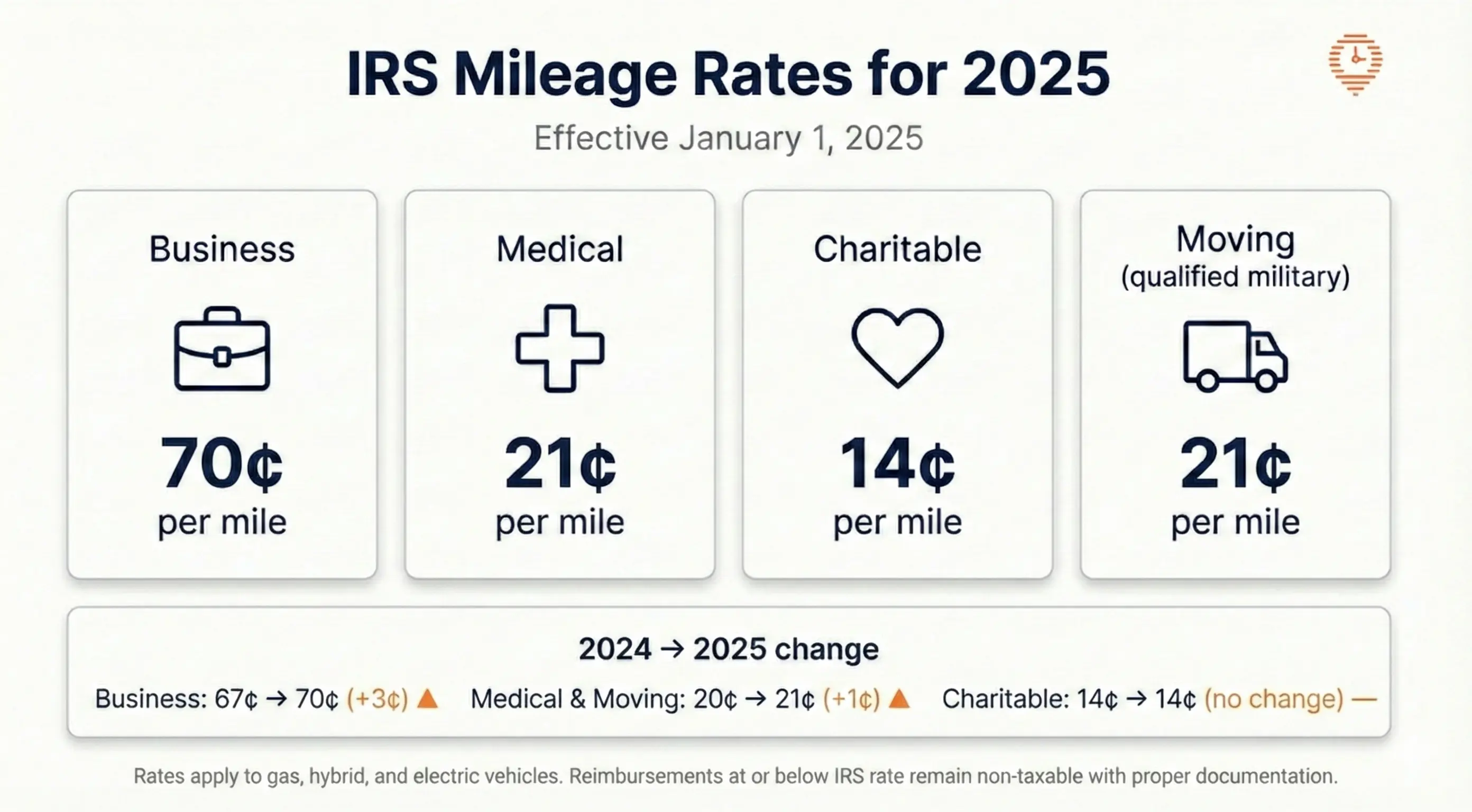
The IRS standard mileage rate for business use is 70 cents per mile for 2025. This rate applies to miles driven between January 1, 2025, and December 31, 2025.
The IRS announced the 2025 rate in December 2024, giving employers a clean window to update their reimbursement policies and payroll settings before the calendar flips.
Here’s the full breakdown for 2025:
Business use: 70¢ per mile
Medical or moving purposes (for active-duty military): 21¢ per mile
Charitable organizations: 14¢ per mile (set by statute, not adjusted annually)
For most employers, the business rate is the one that matters. It’s the number your team will reference in mileage requests, the number finance plugs into reimbursements, and the number that helps determine whether payments remain non-taxable reimbursements or are treated as taxable wages.
Just a quick note: you’re not required to use this rate. The IRS doesn’t mandate that employers reimburse mileage at all, let alone at a specific amount. But if you reimburse at or below the IRS rate, those reimbursements can be treated as taxable income for your employees and are fully deductible as a business expense for you.
What changed from 2024?
The federal mileage rate in 2025 for businesses increased by 3 cents from 2024, when it was 67 cents per mile.
That might seem minor, but it compounds quickly across your workforce. If you have ten employees each driving 5,000 business miles a year, that’s an extra $1,500 in annual reimbursement costs. For a sales team covering regional territories or a service business with technicians on the road daily, the increase becomes a line item worth planning for.
The medical and moving rate stayed flat at 21 cents per mile. The charitable rate remains locked at 14 cents, unchanged because it’s set by federal statute rather than adjusted annually based on vehicle costs.
Why the increase? The IRS recalculates the business rate each year using data on fixed and variable vehicle costs, including fuel, maintenance, insurance, registration, and depreciation. When those costs rise, the rate typically follows. Gas prices, vehicle prices, and insurance premiums all climbed in recent years, and the 2025 rate reflects that reality.
If you haven’t updated your reimbursement policy since 2024, now’s the time. Employees notice when they’re being reimbursed at last year’s rate while paying this year’s gas prices.
Before you set a business reimbursement rate for 2025 taxes or cut your first mileage check, you need to understand the IRS rules that determine whether those payments stay tax-free or become taxable income.
Get these wrong, and your reimbursement program falls apart under audit, turning what should be tax-free payments into taxable wages.
Business vs. personal mileage
The IRS only allows tax-free reimbursement for business mileage. That includes trips to any work-related destination, including meetings, job sites, vendor locations, or any location that isn’t the employee’s regular workplace.
What doesn’t count: commuting. The drive from home to the office is personal mileage, even if the employee is thinking about work the whole way. The same goes for the drive home at the end of the day. Running personal errands between business stops doesn’t count either.
Mixing personal and business miles while using the 2025 rate for tax filing without clear separation can invalidate your reimbursement program and create tax liability for both you and your employees. Make sure your policy defines what qualifies as business mileage and train your team to track trips accurately.
Here’s how it breaks down:
Driving from the office to a client site = business mileage
Driving from home to the office = personal mileage (commuting)
Driving from Client A to Client B = business mileage
Stopping at the grocery store between job sites = personal mileage
If an employee makes a business stop and a personal stop in the same trip, only the business portion is reimbursable. Your policy should address how to handle these mixed-purpose trips to avoid confusion at reimbursement time.
Documentation requirements
Every tax-free reimbursement must be backed by accurate, audit-ready mileage logs. The IRS doesn’t accept rough estimates or “trust me” spreadsheets. Logs need to include:
Date of the trip
Starting point and destination
Total miles driven
Business purpose of the trip
Any related trip-specific expenses like tolls or parking (which can be reimbursed separately)
The IRS generally requires these records to be kept for at least 3 years in case of an audit. Paper logs are technically allowed, but they’re easy to lose, hard to verify, and don’t hold up well under scrutiny. Employees who try to reconstruct mileage from memory months later rarely produce documentation that meets IRS standards.
Mileage tracking apps simplify compliance by automatically capturing all the required information, without relying on handwritten logs that may or may not exist when you need them. These include GPS routes, timestamps, odometer readings, and trip notes.
Accountable plan rules
To keep reimbursements tax-free, your program must follow the IRS’s accountable plan standards. Miss any of these requirements, and every dollar you reimburse becomes taxable wages.
An accountable plan requires three things:
Business connection: The expenses must be directly related to the employee’s job. You can’t reimburse personal mileage and call it business.
Substantiation: Employees must provide adequate documentation within a reasonable time, typically 30 to 60 days. “I drove a bunch this month” doesn’t cut it.
Return of excess: If you overpay, the employee must return the excess. Any reimbursement above actual documented miles becomes taxable income.
Programs that fail to meet all three conditions get treated as supplemental wages by the IRS. That means income tax withholding, Social Security, Medicare, and unemployment taxes for both you and your employees.
IRS standard mileage rate limits and reimbursement options
If you want mileage reimbursements to remain tax-free, the cleanest path is to reimburse at or below the IRS standard rate for the year and retain the documentation to support it. The IRS publishes an updated rate each year (usually in December), and in rare cases, it adjusts the number midyear when operating costs swing sharply.
The rate fluctuates with real-world costs like gas, insurance, maintenance, and vehicle depreciation, so you can’t set your policy once and forget about it. Make it a habit to check for rate updates every December and adjust your policy for the new year.
You can choose to reimburse at the IRS rate, above it, below it, or not at all. Each choice has different tax consequences.
Reimbursing at or below the IRS rate:
This is the most straightforward setup for most employers. With an accountable plan and solid mileage logs, reimbursements can stay non-taxable for employees and deductible for the business. You’re not adding mileage to wages, you’re not calculating extra withholding, and you’re not creating extra work for payroll.
It also keeps expectations clear. Employees know what to submit, finance knows what to approve, and payroll isn’t stuck cleaning up exceptions after the fact.
Reimbursing above the IRS rate:
You can reimburse above the IRS rate, but the part over the standard rate typically needs to be treated as taxable income. That means more tracking and more payroll handling: separating the “standard” portion from the excess, withholding the right taxes, and reporting it correctly.
Some employers choose this route intentionally, usually because of special circumstances like unusually high operating costs or job requirements. The key is to make it a deliberate decision, not an accidental one, because the reporting rules change once you go over the standard rate.
Reimbursing below the IRS rate or not at all:
If you reimburse below the IRS rate (say, 50 or 60 cents per mile), the payment will still be tax-free as long as you meet accountable plan rules. However, your employees will end up covering the gap themselves, which can become a morale issue.
Not reimbursing at all pushes the full cost of business driving onto employees. And in many cases, W-2 employees can’t rely on a federal deduction to make up the difference. So if your team uses personal vehicles regularly, it’s worth thinking through what “no reimbursement” looks like in reality, not just on paper.
Automatic mileage tracking made simple
Capture mileage automatically when employees clock in and reduce manual logging across your team.
“Being able to track employee’s mileage allows us to help save money and always know where our team is.”
Is there a mileage limit in 2025?
One question that often comes up after employers review the IRS rules is whether there’s a limit on how many miles they can reimburse. Here’s the straight answer: there is no cap on business mileage reimbursement in 2025.
If an employee drives 5,000 miles for business, you can reimburse them for those miles. If they drive 50,000, you can reimburse that too. Even higher mileage isn’t automatically a problem. What matters is whether the miles are legitimate business travel and whether you can support them with solid records.
In practice, the IRS looks for a few basics:
The miles were ordinary and necessary for the job
They were business miles, not commuting or personal driving
The trips were documented (date, destination, business purpose, and mileage)
This is especially relevant for high-mileage roles. Sales reps covering large territories, field service teams running multiple stops a day, and regional managers traveling between locations can rack up serious miles without doing anything unusual. The issue here lies in the paper trail, not the mileage.
If the trips make sense for the role and the documentation is consistent, you can reimburse every business mile without running into an IRS ceiling.
Common misconceptions about mileage caps
The belief that a mileage cap exists is widespread, but it’s completely false. Here’s where the confusion comes from and what you need to know:
“The IRS limits how much mileage I can deduct or reimburse.”
False. There is no annual limit on business mileage reimbursement or deduction. The IRS doesn’t say “you can only reimburse 20,000 miles per year” or impose any kind of threshold. What the IRS does care about is whether the miles are legitimate business expenses and whether they’re properly documented.
“High mileage will automatically trigger an audit.”
Not exactly. Unusually high mileage claims relative to the employee’s job duties can draw IRS attention, but that’s not the same as a legal cap. If an administrative assistant who works at a desk is claiming 40,000 business miles a year, that’s going to raise questions. If a field sales rep covering a six-state territory claims 40,000 miles, that’s reasonable.
The IRS looks at whether the mileage makes sense for the role. A pattern of excessive claims that don’t align with job responsibilities is a red flag. However, legitimate high mileage backed by solid documentation isn’t a problem.
“There’s a cap on tax-free reimbursements.”
False. As long as you reimburse at or below the IRS standard rate (70 cents per mile for 2025) and meet accountable plan requirements, you can reimburse unlimited business miles tax-free. The cap doesn’t apply to volume but rather to the rate. Go above 70 cents per mile, and the excess becomes taxable. Stay at or below, and there’s no taxable income regardless of how many miles are reimbursed.
“I should cap reimbursements to avoid compliance issues.”
This is a misguided approach. Some employers set arbitrary limits (like “we’ll only reimburse up to 15,000 miles per year”), thinking it reduces their audit risk. What it actually does is shift legitimate business costs onto employees who exceed that cap. If your sales rep drives 25,000 business miles and you only reimburse 15,000, that employee is subsidizing your business by $7,000 (at 70 cents per mile). That’s not a compliance strategy. That’s a retention problem.
The way to avoid compliance issues isn’t to cap mileage. It’s to require proper documentation, clearly define business vs. personal mileage, and ensure your reimbursement program follows accountable plan rules.
What happens if mileage tracking isn’t tracked?
Understanding the rules is one thing; following them consistently is another.
The IRS doesn’t give you credit for good intentions. If you can’t produce adequate records when asked, your reimbursement program falls apart, and the tax consequences hit both you and your employees.
Incomplete records create audit risk
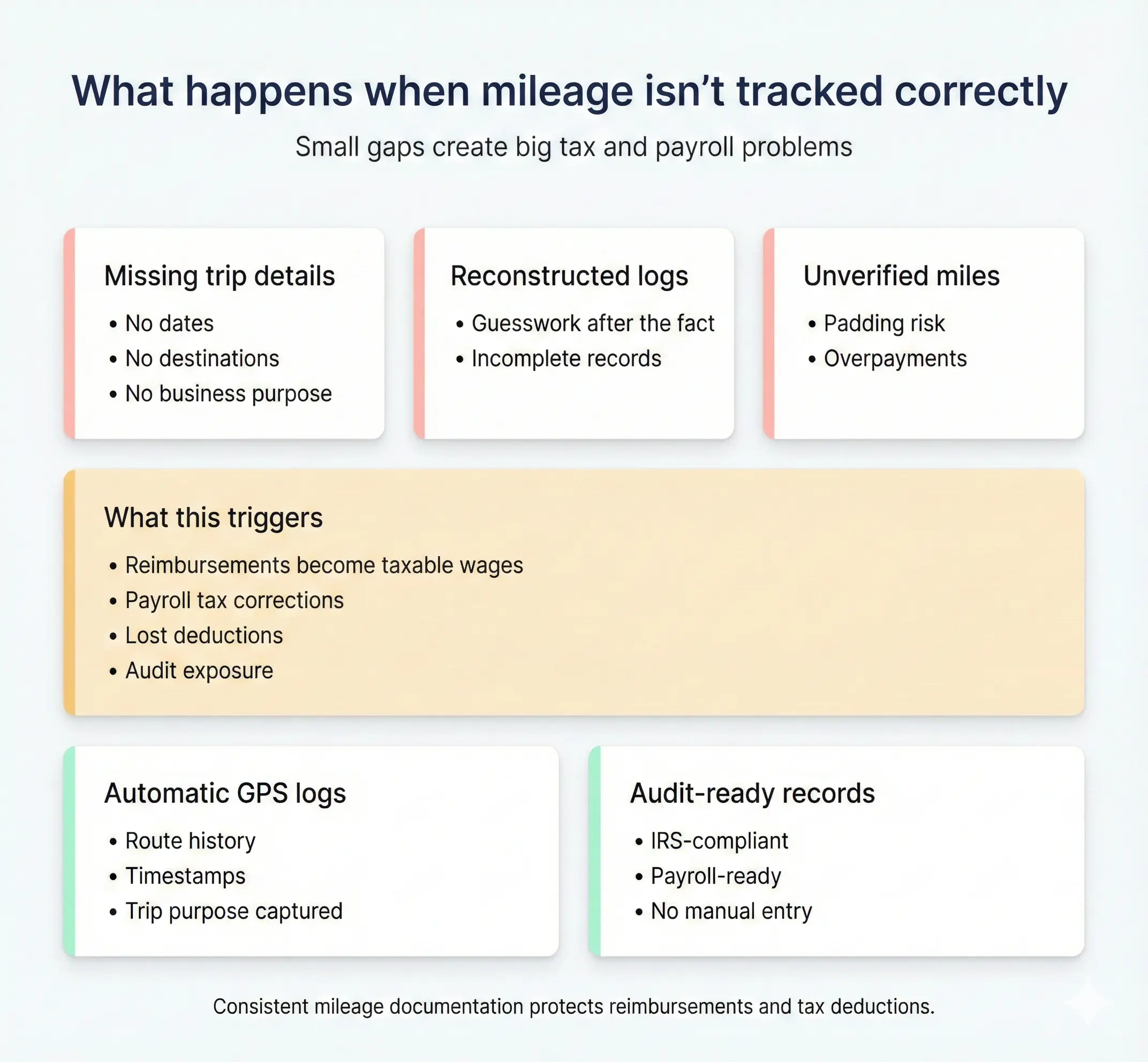
When mileage goes untracked, you end up with incomplete records. That’s a problem because the IRS has a specific definition of what counts as adequate documentation, and incomplete records don’t meet it. During an audit, that gap becomes a liability.
The IRS requires your mileage logs to include:
The mileage for each business trip
The total mileage for the year (both business and personal combined)
The date, destination, and business purpose of each trip
Odometer readings at the start and end of the year
The IRS also requires that mileage logs be kept in a timely manner. That means you need to record trips at or near the time they happen. Weekly updates are generally considered acceptable. Trying to reconstruct three months of driving from memory at the end of a quarter doesn’t meet the standard.
Any missing element creates gaps that auditors will challenge. A log that says “client meetings, 150 miles” without dates or destinations won’t hold up. A spreadsheet with miles for personal use won’t hold up. Odometer photos from January, but nothing from December won’t hold up.
The IRS expects to see records that show tracked mileage as it happened, not paperwork you created after the fact to justify a reimbursement request or tax deduction. When you can’t produce those records during an audit, your deductions get disallowed, your reimbursements get reclassified as taxable wages, and the penalties start piling up.
Missing logs put deductions and reimbursements at risk
When mileage tracking falls through the cracks, the consequences affect both sides of the employment relationship.
For employers:
Loss of tax deductions: Without accurate mileage logs, you can’t substantiate business deductions for vehicle expenses. That means you’re missing out on significant tax savings. At 70 cents per mile, even moderate mileage adds up to real money you’re leaving on the table.
IRS audit risk: The IRS scrutinizes reconstructed logs and incomplete records. If you can’t back up your reimbursements with proper documentation, you’re looking at potential audits, penalties for underreporting wages, and interest on unpaid taxes.
Expense fraud exposure: Without a tracking system, you have no way to verify that reported mileage is accurate. Employees can (and sometimes do) pad their numbers. It’s one of the most common forms of expense fraud, and it’s nearly impossible to catch without verification.
Taxable fringe benefit reclassification: If you provide company vehicles and don’t track personal vs. business use, the IRS may treat the entire vehicle benefit as personal income. That turns what should be a business expense into taxable compensation, creating surprise tax bills for both you and your employees.
For employees:
No reimbursement: Without a log showing the date, destination, business purpose, and mileage, you can’t substantiate a reimbursement claim. Even if you legitimately drove for work, you’re not going to get reimbursed without documentation.
Increased taxable income: If your employer provides a flat car allowance instead of tracking actual miles, that allowance is generally taxable income to you. You’re paying taxes on money that’s supposed to cover vehicle costs, which means you’re netting less than the full amount.
Lost deductions: Under the current tax law (the Tax Cuts and Jobs Act), W-2 employees can’t deduct unreimbursed business expenses on their federal tax returns. If your employer doesn’t reimburse you and you don’t have documentation to push back, you’ve lost that money entirely.
How to track mileage properly every time
The best way to satisfy IRS mileage tracking requirements and ensure your records hold up in any audit is to be consistent. The easiest way to do that is to automate the process entirely.
Timeero handles mileage tracking automatically, so you stop losing money to incomplete logs, rejected reimbursements, and payroll corrections.
Here’s what that means for your business:
You save time and eliminate payroll errors. Instead of chasing down missing logs or manually entering mileage data, you get complete records that export directly to QuickBooks and other payroll systems.
Your records survive audits. Every trip is logged with the date, destination, business purpose, and exact mileage. That’s everything the IRS requires, captured automatically. If you get audited, you’re not scrambling to piece together documentation after the fact. You have audit-ready logs from day one.
You catch fraud before it costs you. GPS verification shows exactly where employees drove, with timestamps and route playback, so you’re reimbursing what was actually driven. Employees know the system keeps everyone honest.
You stay compliant without the admin burden. Employees don’t need to remember to log trips or fill out spreadsheets. The system captures everything in real time. You don’t need to train people on IRS documentation rules or follow up on incomplete logs. Compliance work runs in the background while you focus on running your business.
With Timeero, you get accurate reimbursements, audit protection, and zero disputes over who drove where. More importantly, you stop subsidizing sloppy record-keeping with your own time and money.
Make sure every mile you reimburse holds up
The IRS gave you a clear rate for 2025, clear documentation rules, and clear consequences for getting it wrong. The question isn’t whether you should properly track mileage, but whether your current system actually does. Manual logs fail under audit, employees forget trips, and you end up reimbursing inflated numbers or shortchanging legitimate miles.
Timeero automatically captures every required detail, so your reimbursements stay tax-free, and your records withstand scrutiny. That saves you time on admin work, reduces payroll mistakes, and eliminates the audit risk that manual logs pose. You stop losing money to a process that never worked well to begin with.
Want to see what that’s actually worth? Use Timeero's Mileage Reimbursement ROI Calculator to see how much you can save when you switch to automatic mileage tracking that works from day one.
Frequently asked questions (FAQs)
What is the IRS mileage rate for 2025?
The IRS standard mileage rate for business use in 2025 is 70 cents per mile. This rate applies to miles driven between January 1, 2025, and December 31, 2025.
Does the mileage rate include gas?
Yes. The 70-cent rate covers all vehicle operating costs, including gas, maintenance, insurance, registration, and depreciation. Employees shouldn’t expect separate reimbursement for fuel if they’re using the standard mileage rate.
Mileage reimbursement vs. deduction: are they the same?
No. Mileage reimbursement is when you pay employees back for business miles. A mileage deduction is when a taxpayer reduces their taxable income by claiming business miles on their tax return. W-2 employees generally can’t deduct unreimbursed mileage anymore, so reimbursement is the only way they benefit from the IRS rate.
Can employers reimburse mileage at a different rate than the IRS rate?
Yes. You can reimburse at any rate you choose. If the rate is at or below the IRS rate and properly documented, it’s tax-free to the employee and deductible for your business. If it’s above the IRS rate, the excess is taxable income to the employee.
Tired of chasing manual mileage logs?
Capture every mile automatically and eliminate paperwork errors overnight.
Emman is a passionate writer with more than 6 years of digital marketing experience under his belt. As a licensed chemical engineer with a passion for writing, he marries the technical with the creative to create engaging copy that converts. He is also a certified #girldad who spends most of his day playing with his three girls when he's not busy writing.



.webp)

%202.svg)


.png)
.png)



.png)


