GPS tracking is widely accepted across industries — especially construction, delivery, logistics, field services, healthcare and security services. Our 2026 survey of 1,000 field workers found that comfort with GPS tracking is already high across all major industries, with workers in high-dispute fields like HVAC, security, and construction showing the strongest acceptance. This article shows how Timeero supports each industry with the tools field workers and managers actually need.
The business arena has experienced the proliferation and broader adoption of Global Positioning System (GPS) technology over the last decades. GPS technology has become indispensable for asset management, employee tracking, fleet coordination, and claims dispute. But what industries benefit most from GPS tracking?
In this guide, we’ll delve into industries that use GPS tracking. We’ll shed light on how these industries use GPS tracking to keep their operations sailing along. Don’t worry; we’ll not leave you guessing which GPS tracking app providers are best. Instead, we'll tell you how Timeero solves the most pressing issues in your industry.
Whether in construction, healthcare, property management, delivery, or the sales industry, your business can use a GPS tracking app.
Watch this video to learn how companies in your industry use Timeero.
And what do workers in these industries actually think about GPS tracking?
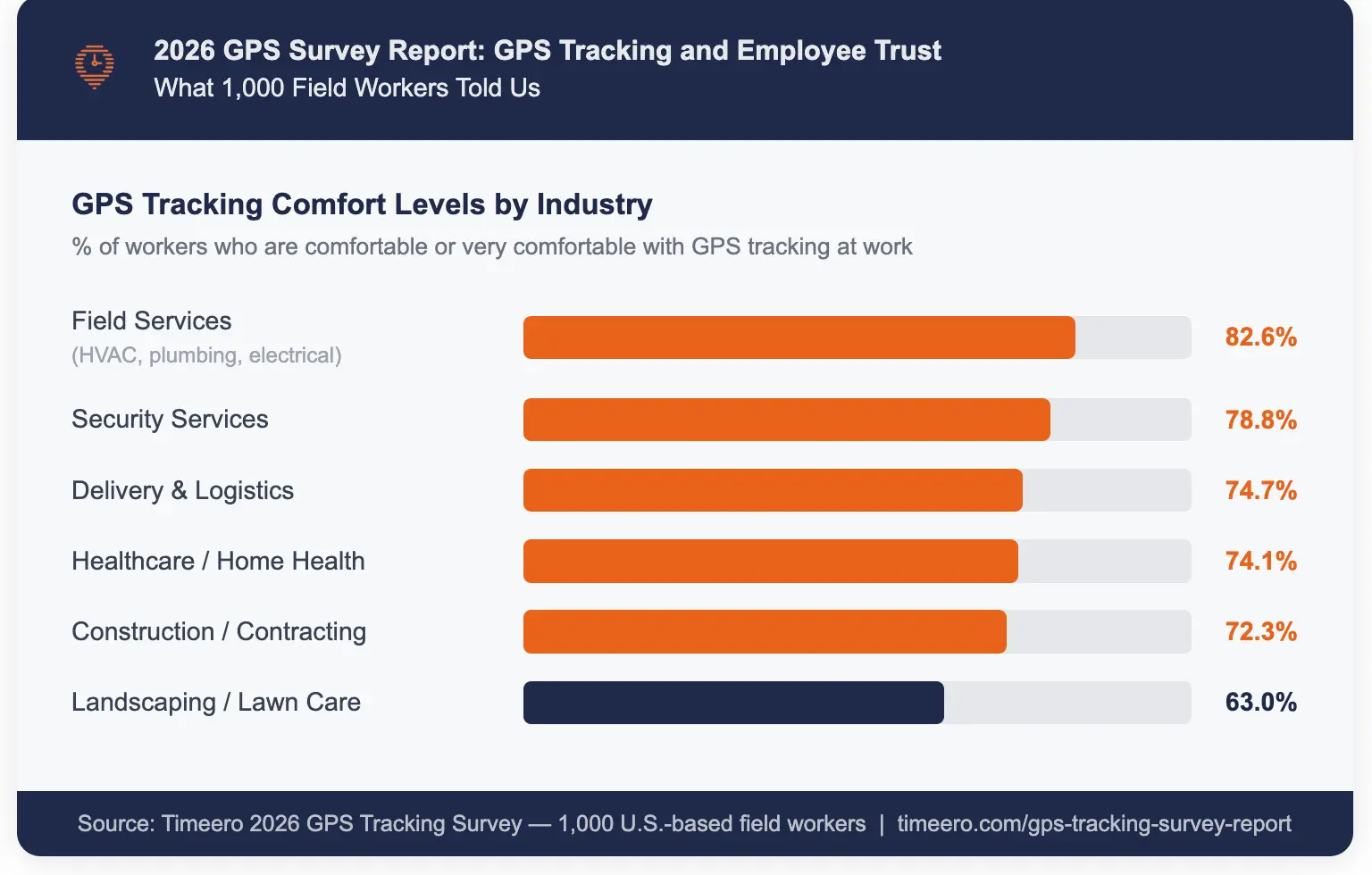
According to Timeero's 2026 GPS Tracking Survey, which surveyed 1,000 U.S.-based field workers, 75.5% report being comfortable or very comfortable with GPS tracking during work hours — with acceptance rates varying by industry depending on the nature of the work and the frequency of workplace disputes.
What is GPS tracking?
Global Positioning System (GPS) system comprises a series of satellites and a receiver or tracking device. The receiver is the tracking device installed in a smartphone or vehicle.
The receiver’s algorithm uses a process called trilateration. The process entails comparing the position of at least three satellites from the Global Navigation Satellite System (GNSS) and their distance from the GPS tracker to determine the location.
A GPS tracker compares the positions of at least three satellites to determine the position.
Today's receivers are so advanced that they can use satellite data processing algorithms to determine their longitude, latitude, elevation, and time. As a result, they provide precise location and subsequent changes, enabling real-time location tracking.
How accurate is GPS tracking?
In optimal conditions, a GPS tracker can be accurate to within a few meters, allowing you to accurately track vehicle or employee locations. However, some conditions can impact the accuracy of a GPS tracking device.
Remember that GPS trackers use the frequency of radio signals from GNSS satellites to determine the precise location. This means the accuracy may be slightly compromised if the tracker enters an area with no clear line of sight to the sky. Some sites where location accuracy may be altered include:
● Deep in wooded areas
● Below tall buildings
● Inside tunnels
● Inside underground parking garages
● In valleys or below mountains
The good thing is that GPS location accuracy isn’t dependent on weather conditions. So, whether the tracker is inside a storm, heavy rains, or gusty winds, it will still send reasonably accurate location data.
Difference between GPS tracking devices and GPS tracking mobile apps
GPS trackers installed on vehicles and mobile apps serve the same purpose: determining the exact location. Hence they are ideal for real-time tracking.
Companies, especially those managing vehicle fleets, preferred GPS tracking devices over GPS mobile apps for various reasons. The tracking devices provide real-time location data and monitor vital vehicle information such as idle time and speed.
However, with the technological advancement of GPS tracking, mobile apps have added benefits exclusive to GPS systems. GPS mobile apps such as Timeero now offer all these functions and more.
You can tell when your vehicle leaves a predefined area using geofencing. Not to mention, the ability to track all drivers in real time helps adjust when business demands change unexpectedly.
Now let’s dive into the crux of our discussion. We’ll discuss the top six industries that benefit the most from using GPS tracking apps. We’ll also mention the key Timeero GPS tracking features and how they help players in these industries.
1. Construction
The latest statistics show that 77% of businesses in the construction industry use a GPS tracking system. So it's easy to understand why technology is already more commonplace in the construction industry.
Employee tracking
GPS tracking is particularly well-received in construction. According to the Timeero 2026 GPS Tracking Survey, 72.3% of construction workers are comfortable with GPS tracking at work — and it's easy to understand why.
Construction workers are among those most likely to encounter workplace disputes: 58.4% of construction workers surveyed have experienced at least one dispute where GPS data could have changed the outcome. For workers who've been through billing or hours disputes before, GPS tracking isn't an imposition — it's documentation they can rely on. That protection starts with knowing where your team actually is.
Construction businesses pay employees to be on the job site, working on assigned tasks. If an employee is on the clock but not at the designated job site, you’ll pay them for work they didn’t do. As a result, your company will bleed money and grapple with dwindling profits, which could ultimately send it to its deathbed.
Companies in the construction industry, such as Crest Contracting and Atterholt Construction, use Timeero to ensure employees are where they need to be during work hours.
The ‘Who’s Working’ feature shows the location of clocked-in employees. You can spot employees wandering outside the job site when they should be working and ping them to get back to work with the team messaging tool.
Timeero ‘Who’s working’ gives you the real-time location of clocked-in employees.
The geofencing-enabled time tracker ensures that employees are clocking in and out within their job site, effectively thwarting off-site punching. In addition, when employees forget to clock in, Timeero sends them timely notifications, prompting them to clock in for accurate time tracking.
Another great addition for construction companies is the facial recognition feature. With this feature, you can rest assured that your company will not lose money through buddy punching.
Consider your expensive construction machinery: excavators, backhoes, cranes, and dozers. If you don’t track where each machine is, you expose it to theft and misuse, which can cripple your operation in one way or another.
If a driver takes a longer, unsafe route when transporting materials from site to site, wear and tear will catch up quickly with the equipment. As a result, the equipment will require servicing more frequently than need be. Also, longer routes eat away at your fuel budget and profitability.
GPS tracking software improves asset tracking, curtailing equipment misuse and theft. In addition, if drivers know the equipment comes with GPS tracking, they will restrain themselves from wasting time and prioritize proper safety procedures to keep the machine in perfect condition.
On the other hand, if you know where each vehicle is, it’s easy to determine their proximity to a worksite where it’s needed most. This promotes the smart deployment of equipment and helps ease bottlenecks that derail projects.
2.Sales
If you have a field sales team, you need each member to spend quality time with assigned customers to boost conversion. Unfortunately, business owners often swim in a sea of worries when sales reps head out to the field.
Many questions linger in the manager's mind. For example, are my reps effectively combing through the assigned territory for potential customers? Are they spending enough time with customers to win them over?
The route replay is a nice feature to monitor driver performance, location during the day, and vehicle speed.
There’s another problem. Are reps taking the more scenic routes to log more miles and get higher mileage reimbursement than they should be getting?
If sales reps don’t take optimal routes between customer locations, they spend more than 14% of their work time driving. As a result, you might compensate them for miles driven more than you should. Plus, if reps spend a chunk of their time on the road, they will have less time for customer meetings.
Timeero provides features to improve sales rep management. Again, the “Who’s Working” tab displays the real-time location of each sales rep — no more guessing where sales reps are.
In addition, the route replay tool helps determine where the sales rep has been when on the clock. It shows all their routes and can help pinpoint sales reps taking longer, scenic roads.
The route replay is also a helpful territory planning feature. You can combine route replay data from all reps to determine where they have and haven't been during the day. If you spot a customer-rich zone your representatives didn't visit, add it to the team’s to-do list.
Beyond rep tracking, route replay helps you estimate how much time a rep spends at a customer's location. For example, you can click "show breadcrumbs” and then compute the time difference between the two most-proximate breadcrumbs to the customer location.
Timeero breadcrumbs provide detailed timestamps to see the employee's location at a particular time of the day.
In addition, Timeero tracks mileage when the rep’s vehicle exceeds a predefined speed threshold — say, 4mph. For this reason, the app doesn’t track the time when the representative is in a traffic jam or stops at a customer's location.
The suggested mileage is handy if a rep has to visit the same customer multiple times. The tool will analyze the initial trip and recommend the shortest route for the rep’s subsequent visits — no more paying for unnecessary miles.
3. Delivery & courier services
The reputation and profitability of delivery companies are at stake every time the package leaves your warehouse or pick-up zone.
Consider food delivery businesses, for example. If a customer orders food online, timely delivery is critical. The food could arrive cold if the driver is unusually slow or takes a longer, unnecessary route.
On the other hand, a shipment of biological agents should be delivered on time. A delay could cause the agents to pass their prime, rendering the entire load useless. Plus, if a driver has to deliver drugs to a hospital, a missed delivery (even by minutes) could mean loss of life.
Moreover, uncertainty about parcel or package delivery could ruin the customer experience for courier services. For example, 70% of today's customers want visibility into granular shipment tracking. If you keep giving vague ETA, such as “package will arrive soon,” the customer will be frustrated and won’t use your services again.
A GPS tracking app for delivery ensures accountability on the driver's part. It goes a long way towards ensuring a high quality of service.
It's worth noting that logistics workers show strong GPS acceptance: 74.7% of workers in delivery and logistics report being comfortable with GPS tracking during work hours. In an industry where on-time delivery and route efficiency are constantly under scrutiny, GPS data gives both managers and drivers a shared, objective record to work from.
Timeero for delivery & courier services
The suggested mileage feature recommends the shortest route to a destination. This way, if a driver is delivering a time-sensitive package, they can easily manage their time to deliver it on time.
If your business receives a bad review for late delivery, but the driver denies any wrongdoing, fret not. You only need to open the route replay and click a breadcrumb proximate to the customer's location to see when the driver arrived. Then, compare that with the ETA given to the customer to settle the dispute.
4. Logistics
These days, logistic companies with large fleets of vehicles can't solely depend on telephone calls or radio communication to monitor vehicle locations. Moreover, such systems are dated and will only leave your business reputation and driver's safety at stake.
Timeero for logistic businesses
Timeero should be part of your telematics if you need to improve fleet management and customer service. The real-time GPS tracking keeps you on top of every vehicle's location. In addition, you can monitor driver behavior and performance.
For example, if a vehicle has been stationary longer than usual, you can check in with the driver to find out why. That enhances driver safety, helps relay accurate ETA to customers, and prepares them for delays.
GPS fleet tracking keeps you clued in on available vehicles. It can quickly determine where to deploy which car to cut costs while maximizing profits. In addition, dispatching drivers to jobs near them reduces customer wait times and boosts customer service.
Most importantly, GPS vehicle tracking helps enforce work policies and safety procedures. For example, when drivers maintain speeds of 55mph and not 65mph, their gas mileage improves by up to 15%.
A feature such as a route replay helps monitor vehicle speeds. If drivers know you’re monitoring their vehicle speeds, they will strive to drive within the sweet spot.
The suggested mileage is a fuel and time saver for delivery, Uber, truck, and other drivers.
You can reduce fuel consumption further with the suggested mileage feature. Better still, if truck drivers know you will recreate their route at the end of a trip, they will take the best routes and avoid unnecessary stops.
5. Health care
Healthcare businesses such as home health services (HHCS) and Medicaid personal care services (PCS) also benefit from GPS tracking apps.
Secondly, healthcare businesses have to track the location of home health aides for effective deployment. Knowing the real-time location of home caregivers means you can deploy them to the nearest patient. And that could mean the difference between life and death for your patients.
Workers in healthcare and home health also show strong GPS acceptance: 74.1% report feeling comfortable with GPS tracking at work, according to the Timeero 2026 GPS Survey. In a field where caregiver location and visit times must meet compliance requirements, GPS tracking shifts from a monitoring tool to a record of care delivered — something that protects both the caregiver and the patient.
Timeero for health care businesses
Timeero is a GPS-enabled time tracker, and it uses geofencing. You can set patient homes as geofenced locations to restrict caregivers from clocking in or out outside these locations. This helps gather accurate time and EVV data for proper remuneration and compliance with the Care Act.
The ‘Who’s Working’ tab displays the real-time location of clocked-in caregivers. Timeero saves caregivers the time-consuming and tedious data input tasks.
For example, caregivers don’t have to log their routes and report the steps they take. If you need to confirm where a caregiver has been, you only click the route replay feature. You see the caregiver routes, how fast they were driving, and use breadcrumbs to estimate how long they spent at a patient’s home.
Timeero also helps track mileage for every drive that exceeds a specific speed limit. Automatic mileage tracking ensures you reimburse caregivers fairly for business miles driven and prepare an accurate report for tax purposes. In addition, it frees caregivers from keeping track of their miles, saving them more time to focus on providing care to patients.
The suggested mileage recommends the shortest route to a patient's home to minimize future delays.
6. Security Services
Security companies operate in high-stakes environments where accountability isn't optional — it's the job. Guards are assigned to specific posts, routes, and patrol schedules, and any deviation can have serious consequences for clients, contracts, and liability.
Yet despite working in one of the most accountability-driven industries, security employers often hesitate to introduce GPS tracking out of fear of pushback. The data suggests that hesitation is misplaced.
According to the Timeero 2026 GPS Tracking Survey, 78.8% of security workers are comfortable with GPS tracking at work — the second-highest acceptance rate of any industry surveyed. And it's not hard to understand why: 82.5% of security workers have personally experienced at least one workplace dispute — the highest dispute exposure rate across all industries in the survey.
When your workforce has that level of dispute experience, GPS tracking stops feeling like surveillance and starts feeling like protection. Workers who've been falsely accused of missing a post or skipping a patrol round know exactly what it means to have timestamped, location-verified records on their side.
Timeero for security companies
Timeero gives security managers real-time visibility into officer locations without the administrative burden of manual check-ins. The Who's Working tab shows which officers are clocked in and where, making it easy to confirm coverage across multiple sites simultaneously.
Geofencing ensures officers are clocking in and out at the correct posts — not from a parking lot or a nearby location. If an officer forgets to clock in at shift start, Timeero sends an automatic reminder so payroll and scheduling records stay accurate.
For patrol-based roles, the route replay feature lets managers verify that assigned rounds were completed as scheduled. Every breadcrumb is timestamped, giving you a clear record of where each officer was and when — the kind of documentation that resolves client disputes quickly and protects your company from false claims.
Get Timeero GPS tracking app for your workforce
As you have already seen, many industries enjoy GPS tracking technology's benefits. Beyond the industries covered here, GPS tracking also delivers clear benefits for property management, landscaping, HVAC, law enforcement, and oil & gas — any business with a mobile workforce that needs accurate time, location, and mileage records.
If you’re looking for an affordable and easy-to-use GPS tracking solution for your business, try Timeero. The app is pretty affordable, costing as cheap as $4 per user per month, and you don’t have to fork out the cash from the get-go.
You can try the app free for 14 days when you subscribe to the free trial. With the free trial, you tinker with all the GPS tracking features to see how they suit your business needs. If you need help, our customer support team will be there to lend a hand.
FAQs
What industries benefit most from GPS tracking?
Construction, home health & field care (EVV), property management, delivery & logistics, sales teams, landscaping, and trades with mobile crews see the biggest ROI.
How does GPS tracking improve compliance in healthcare (EVV)?
It verifies caregiver location and visit times, creating auditable records that help agencies meet EVV and payer requirements.
Will GPS tracking work without cell service or Wi-Fi?
Yes. Timeero records time, location, and mileage offline and syncs automatically once the device reconnects.
How accurate is GPS mileage tracking compared to manual logs?
Automated tracking greatly reduces missed or inflated miles, improving reimbursement accuracy and client billing.
How does geofencing help managers?
Geofences auto-detect job/site entry and exit, streamline job costing, and reduce manual timesheet edits.
What about employee privacy?
Tracking is limited to on-the-clock activity; admins can set work-hours rules and transparency policies to protect privacy.
Can GPS data integrate with payroll and accounting tools?
Yes. Timeero syncs approved time and mileage to systems like QuickBooks to speed up payroll and invoicing.
How fast can a company roll this out?
Most SMBs deploy in days: invite users, set geofences/projects, define policies, and train with a short onboarding.
Timeero has helpful GPS tracking, mileage tracking, and time tracking features.
You can take the GPS tracking app for a spin risk-free when you subscribe to our 14-day free trial.






%202.svg)


.png)
.png)



.png)


