The simplest rule of thumb is: reimbursable miles are the distance an employee drives that is strictly required by their job after their workday has officially begun. Mileage tracking tools like Timeero automatically separate business and commute mileage, making reimbursement decisions clearer.
It is the end of the month, and you are once again staring at another pile of mileage reimbursement requests. Sarah drove from home to three job sites. Mike stopped at the hardware store between client visits. And then there is Jennifer, who swears her 80-mile day was "all business,” even though her usual route is half that distance.
Sound familiar? You have probably faced this challenge more times than you care to count. Mileage reimbursement can be complicated due to different practices and the factors involved in the calculation.
The Internal Revenue Service (IRS) provides a standard mileage rate, but it does not tell you which miles actually count. Your accountant says one thing, your HR consultant says another. Meanwhile, your employees are frustrated because the rules seem to change depending on who is asked.
Some managers err on the side of caution, paying for everything to avoid complaints. Others play it safe, reimbursing the bare minimum. Neither approach actually solves the problem.
The good news is, you don't need to stress about complex tax law or memorize IRS codes. This guide offers a simple, practical framework for deciding which miles are reimbursable for employees and offers an easy way to implement those rules within your team.
On the surface, mileage reimbursement seems straightforward. Someone drives for work, and you pay them back. Easy, right? Not quite. Here is why it gets complicated:
1. The “IRS rate” misconception
You have probably heard this advice a hundred times: "Just use the IRS standard mileage rate."
Great, but that only tells you how much to pay per mile. It does not answer which miles actually count as business miles. That is where most business owners get stuck, and it is why simply knowing the rate does not solve your problem.
2. The gray area between commute and business travel
What exactly is a commute, and how do you decide what miles to pay workers? For your typical office staff, the answer is simple. It is the usual drive from home to the office.
But what about your field technician who drives straight from their house to a customer's location? Or your project manager who starts at the office, hits two job sites, then heads home from the second site?
Things get a lot murkier once we talk about field employees who begin their day at different job sites. In such cases, determining which miles count as business travel can be confusing.
3. Day-to-day operations are different for everyone
Your crew does not clock in at the same time or drive a fixed route every day. Construction teams may assemble at your office before heading to three different sites. Meanwhile, your service technicians drive directly to customer sites. These differences make it hard to apply a rigid rule.
Additionally, each scenario raises legitimate questions:
When does the workday officially start for someone who works from home?
What if an employee takes a "quick detour" for coffee between job sites? Should you pay for that?
What about the apprentice who gets lost on the way to a site because they did not check directions first?
What counts as business mileage?
4. The balancing act
Managing mileage reimbursement puts you in a tough spot. Pay too little, and your employees feel like they are subsidizing your business with their own gas money. That is how you lose good people. But pay for every single mile without oversight, and that adds up fast and cuts into your budget.
When things get complicated, you either overpay to cover your bases or reimburse the least amount possible to save your budget. Neither approach really solves the problem.
The one principle that makes all mileage decisions easier
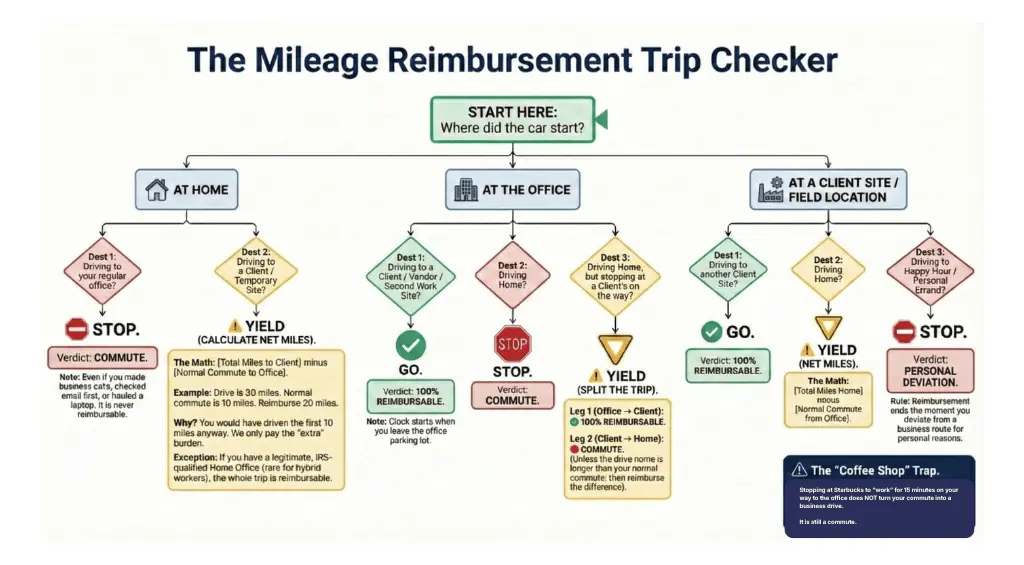
Reimbursable miles = distance an employee drives because of their work, after their workday has officially begun.
Eliminate all the confusion with these simple rules:
✅ Travel must be for business purposes
If driving is required for the employee to be able to do their job, then accrued miles will likely fall under business mileage. Personal errands, commutes to regular work locations, and trips the employee would make regardless of employment status do not qualify for reimbursement.
✅ Miles are traveled after the official workday starts
The workday typically begins when an employee arrives at their established work location. For qualifying remote workers, it starts when they leave home for a business-specific purpose. The workday ends when they return to their regular work location or travel home after finishing their job.
The IRS draws a clear line between commuting miles and business miles. Commuting miles are the distance between an employee's home and workplace.
This principle effectively addresses the majority of scenarios:
Travel from office to client meeting: Business mileage (work-related, during business hours)
Travel from residence to office: Non-business mileage (would occur regardless of specific duties)
Travel between project sites: Business mileage (exclusively for business purposes)
Travel from office to supplier and return: Business mileage (during business hours, for business purposes)
While exceptions exist for temporary work locations and qualifying home offices, this principle provides reliable guidance for approximately 90% of mileage determinations. If you want a deeper look at what the IRS considers business vs. commuting mileage, check out our full guide.
Automatic mileage tracking made simple
Capture mileage automatically when employees clock in and reduce manual logging across your team.
“Being able to track employee’s mileage allows us to help save money and always know where our team is.”
A simple 4-step framework for deciding what counts as business mileage
It can be confusing to know what your company should pay for. Use these four quick checks to review a mileage claim:
1. Is this trip required to do their job?
If an employee needs to travel to perform their job duties, that trip counts as business mileage.
Here are a few examples of mileage you need to pay for:
Driving from the main office to a client site
Moving between two job sites while on the clock
Picking up project supplies
Attending an off-site workshop or business meeting
2. Is this part of their regular commute?
Daily commutes from home to a fixed office are generally not reimbursable. But here is where it gets interesting. If an employee travels directly from their home to multiple work sites, different mileage reimbursement rules apply.
Examples of non-reimbursable mileage include:
The everyday trip from an employee's home to the main office
Driving from home to a fixed shop yard or warehouse where they report daily
Return travel from these regular locations at the end of the day
3. Did they take a personal detour?
Detours like stopping for coffee or groceries are personal and do not count as business mileage.
Let’s say your sales representative leaves the office at 10 AM to meet a client 15 miles away. On the way, they stop at the dry cleaners to pick up their suit for a wedding this weekend. The drive to the dry cleaners adds 3 miles to the trip.
The miles to and from the dry cleaners are not reimbursable. Only the distance from the office to the client is considered business mileage.
4. Was extra distance added for avoidable reasons?
Sometimes extra miles get added unnecessarily. These situations need a judgment call:
Taking the longer route when a highway is available
Getting lost because they didn't check the directions first
Intentionally driving farther than necessary to add extra miles
These miles may not be reimbursable if a more efficient route were available.
Real-world scenarios: How the framework works in practice
Let's see how this plays out with real situations you have probably dealt with when managing mobile teams:
Scenario 1: Home → office → job site
The situation: Maria lives 15 miles from your office. She drives to headquarters each morning for the team meeting, then heads out to a job site 20 miles away.
Home → office (15 miles)
Not reimbursable. This is Maria's normal commute. She makes this drive every workday regardless of where she's going afterward.
Office → job site (20 miles)
Reimbursable (required for work). Once Maria arrived at the office, her workday started. Now she's traveling for a work-specific purpose.
Job site → office (20 miles)
Reimbursable (required for work). She's returning to her regular work location after completing a job.
Office → home
Non-reimbursable (normal commute). Her workday ended when she got back to the office. The drive home is her personal commute.
Total reimbursable: 40 miles
Here’s why: Maria's workday started when she walked into your office. Everything between arriving at work and leaving work is business mileage, except for personal detours.
Scenario 2: Home → temporary job site
The situation: Your HVAC technician, James, does not report to a shop or office. Every morning, he drives straight from his house to the first scheduled service call. Today it is 25 miles away. After that, he has two more calls, then heads home from the last one.
Home → first job site (25 miles)
Reimbursable. James does not have a fixed workplace, so his workday starts the moment he leaves his driveway to head to that first customer.
First job site → second job site (18 miles)
Reimbursable (required for work). He is moving between work locations during his day.
Second job site → third job site (12 miles)
Reimbursable (required for work).
Last job site → home (30 miles)
Reimbursable. Since he started his workday from home, the return trip is also reimbursable.
Total reimbursable: 85miles
Here’s why: The IRS calls this a "temporary work location.” If an employee does not have a regular office or shop yard, and they drive directly to different job sites, then their workday starts the moment they leave home. That means you pay for all their travel, right from their driveway to the first site.
Scenario 3: Multiple stops (office → client A → supplier → client B → home)
The situation: Your project manager, Tom, has a busy day. He starts at the office, drives 12 miles to meet with Client A, then 8 miles to a supplier to pick up materials, then 10 miles to visit Client B. When he is done, he's 18 miles from home and just drives there instead of returning to the office.
Office → Client A (12 miles)
Reimbursable. Tom's workday started at the office, and this is a business trip.
Client A → Supplier (8 miles)
Reimbursable (required for work). He is running a work errand during business hours.
Supplier → Client B (10 miles)
Reimbursable (required for work). This is considered another business stop.
Client B → Home (18 miles)
Not reimbursable. Even though Tom worked hard all day, this last leg is his end-of-day commute. His workday ended at Client B.
Total reimbursable: 30 miles
Here’s why: Once Tom started his workday at the office, all his business driving counted until the workday ended. That final drive home does not count, even if he is coming from a job site instead of the office.
Scenario 4: Remote employee coming in for a meeting
The situation: Lisa works from home full-time. Her house is her office. She rarely comes to your physical headquarters. Today, your team is holding an all-hands meeting, and everyone is expected to be present. Lisa's house is 22 miles from the office.
Home → office (22 miles)
Reimbursable. Wait, didn't we say home-to-office is not reimbursable? Here is the difference: Lisa's home is her principal place of business. The physical office is actually a different work location for her. Therefore, this is not her "commute,” it is a business trip.
Office → home (22 miles)
Reimbursable (required for work).
Total reimbursable: 44 miles
Here’s why: The IRS allows tax-free reimbursement for travel between an employee's residence and another work location, but only if that residence qualifies as their principal place of business. Lisa is not commuting to her regular workplace; she is traveling to a different workplace for a specific business purpose.
Scenario 5: Picking up equipment or materials
The situation: Your landscaping crew has a job scheduled for 9 AM. Before they can start, they need to grab supplies from your main warehouse. The warehouse is 8 miles from the job site.
Job site → warehouse (8 miles)
Reimbursable. Your crew's workday began with a business-related task, which is getting the necessary materials for the job. This is not a commute to a regular workplace but a business errand.
Warehouse → job site (8 miles)
Reimbursable (required for work).
Total reimbursable: 16 miles
Here’s why: When employees start their day by running a work errand, like picking up equipment or supplies, that is considered business travel, not commuting.
Scenario 6: Two employees starting from different places
The situation: You send two technicians to the same job. Tech A (Kevin) drives straight from his house, 15 miles away. Tech B (Rachel) starts her day at your shop yard like she always does, then drives 12 miles to the job site.
Tech A (home → job site, 15 miles)
Reimbursable. Kevin does not report to a fixed location. He is a field technician who goes directly to job sites. His workday starts when he leaves home for work.
Tech B (shop yard → job site, 12 miles)
Reimbursable (required for work). Rachel's workday started when she arrived at the shop yard (her regular reporting location). The drive from the shop to the job site is business travel.
Important: You must have a clear policy based on each employee's primary reporting location, not just where they physically start that day. Fairness comes from the consistent application of the small business mileage reimbursement rules.
Leveraging technology for compliance and efficiency
Now that you have the framework, what are your next steps?
Mileage tracking tools like Timeero integrate seamlessly with your existing payroll systems, giving you the peace of mind that you are paying for the right miles, every time. These tools streamline the process by:
Automating tracking: The GPS tracking feature automatically records mileage, eliminating the need for handwritten logs, odometer readings, and manual tracking.
Ensuring accuracy: The system generates verifiable records of routes, stops, distance, and time.
Reducing risk: These tools ensure accurate reimbursement and a clear audit trail, reducing compliance risk and uncertainty about payment accuracy.
Seamless integration: Mileage tracking tools connect directly to your payroll systems for efficient processing.
You do not need to be an IRS expert if you have a clear framework and the right technology. Eliminate mileage guesswork using Timeero. Start your free trial today (no credit card required) and achieve 100% accurate reimbursement.
FAQs
What mileage am I actually required to reimburse employees for?
You are required to reimburse employees for all "ordinary and necessary" expenses incurred while performing their job duties. This includes miles driven for work after the shift begins, excluding normal commutes or personal detours.
Is driving from home to the office reimbursable?
No, driving from an employee's home to your primary business location, such as the main office or shop yard, is considered a personal commute and is not reimbursable. However, if an employee's home is their primary workspace and they travel to the office for a specific work purpose, those miles are reimbursable.
What’s the difference between a mileage allowance and mileage reimbursement?
Mileage reimbursement covers actual business travel expenses, typically calculated using the IRS standard mileage rate. A mileage allowance is a fixed amount paid regularly, regardless of miles driven. Allowances may be taxable if they exceed actual expenses or lack substantiation. Reimbursement based on actual miles is generally preferred for tax and fairness reasons.
Can software automatically separate business miles from personal miles?
Yes, advanced mileage tracking software such as Timeero can separate business and personal miles. These tools utilize GPS technology to track driving distance. Some software can also recognize recurring routes and automatically categorize them, reducing manual effort and improving accuracy.
Manual logs are risky. GPS tracking is proof.
Capture exact, IRS-compliant mileage with Timeero.
Judyann is a content specialist with nearly a decade of experience in digital marketing. When she's not building brands and strategies, you'll find her exploring new destinations, embarking on spontaneous adventures, hunting down the best local eats, and spoiling her two fur babies. She believes the best content, like the best trips, comes from curiosity, creativity, and never playing it safe.



.webp)

%202.svg)


.png)
.png)



.png)


