Why Workers Aren’t Resisting GPS, They’re Resisting Bad Rollouts
Jessica Helms
Last update on:
March 25, 2026 9:11 AM
Published on:
TL;DR
Workers aren’t opposed to GPS tracking itself—they’re opposed to secrecy and poor communication. Our 2025 survey of 1,000 U.S. field workers shows that acceptance of GPS tracking depends largely on how it’s introduced: transparent rollouts, clear boundaries, and shared access to data dramatically increase employee comfort and trust.
When business owners conduct an audit on internal processes and believe their company would benefit from using GPS tracking, many employers are hesitant to introduce the technology to their workforce.
Delaying implementation is understandable, especially when employers agree with the widespread belief that employees generally dislike GPS tracking.
To avoid potential employee backlash, many employers choose to roll out GPS technology quietly, never sharing the full details of what the new app does or why it is being used. But employees aren’t naive – they will ask questions and investigate the new technology on their own. When they find out the app is enabled with GPS tracking, business owners encounter the very backlash they intended to avoid.
Introducing new technology invokes mixed feelings from multiple angles. But according to 1,000 U.S.-based field and mobile employees we surveyed in 2025, one thing is for certain. Secret rollouts will never gain your employees’ trust and acceptance of GPS tracking.
Not sure your GPS rollout would hold up with employees?
See how transparent tracking, clear boundaries, and shared visibility help teams build trust while keeping accurate records.
Despite employers’ beliefs that employees are anti-GPS, our survey results show that most workers are comfortable with GPS tracking during work hours, 75.5% feeling comfortable or very comfortable with the technology.
This acceptance rate is partially due to the fact that employees understand why their employer uses GPS tracking. Field work often requires employees to be spread across multiple job sites, with many crews working multiple sites in one day. It can be hard to keep up with where crews are located and how much time is being spent at each job site. This is why 68.6% of workers see the technology as helpful or necessary instead of a form of surveillance.
Where does GPS pushback actually come from?
If GPS pushback doesn’t come from employees feeling like they are being spied on, and over half of employees surveyed feel comfortable with the technology, then where does the pushback come from?
Our data shows that employees are more likely to resist GPS tracking when the technology is poorly introduced. What exactly does a poor introduction look like? Let’s examine the following scenario.
Jim is the manager of an HVAC company. He believes some of his employees are stealing time, but he can’t prove it. He decides to introduce a time tracking app to his crew, but doesn’t mention why he’s switched to this platform other than saying, “it makes things easier”. He also hides the fact that it captures GPS location.
Why is this an example of a bad rollout?
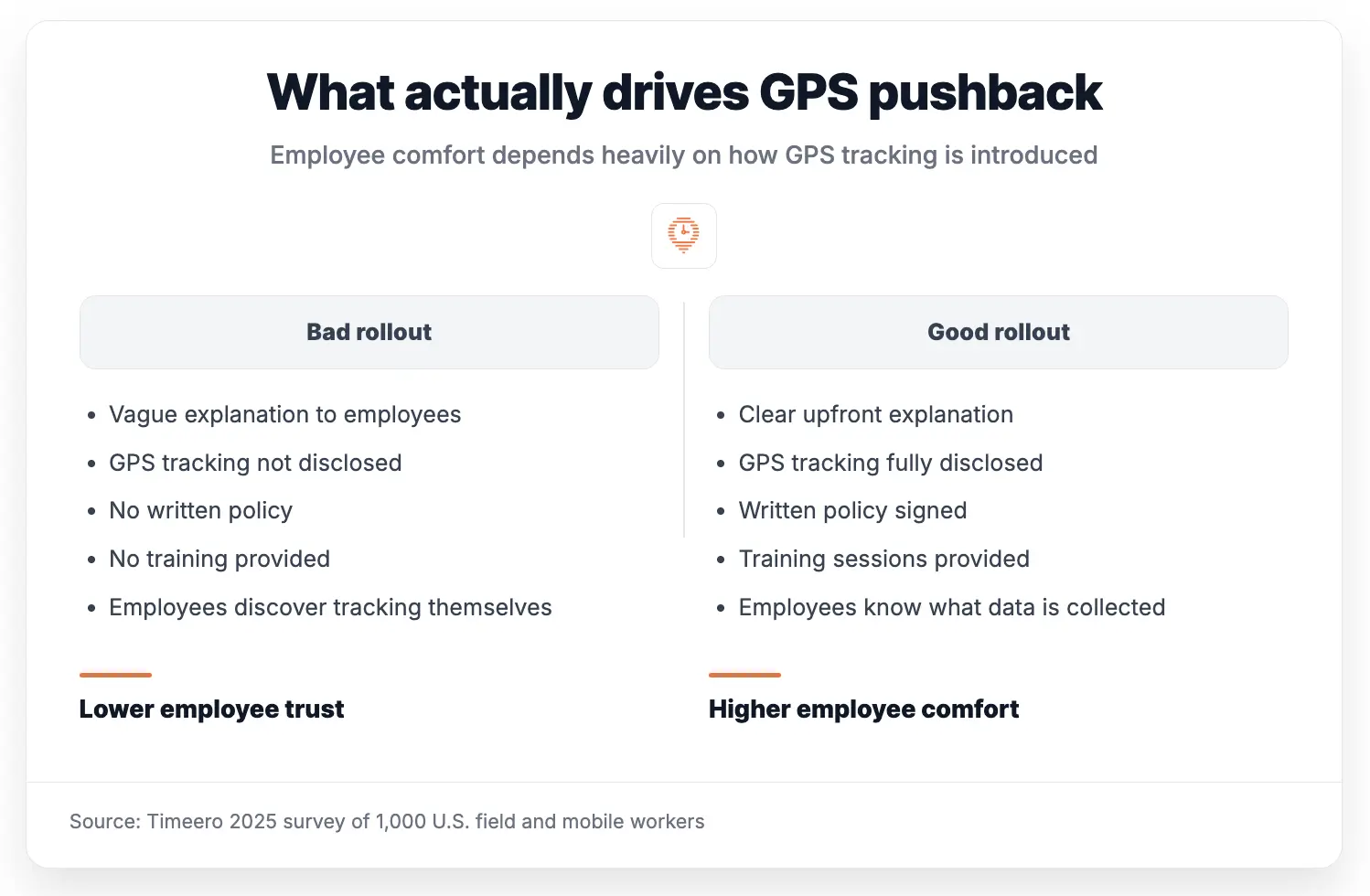
❌ Jim didn’t explain in detail why he is using this new time tracking app. He offered a vague explanation, which doesn’t foster trust.
❌ If Jim catches an employee stealing time and shows GPS data as proof, the employee will more than likely be angry and claim the employer invaded their privacy by tracking their location without consent.
All of these reasons contribute to GPS pushback in the workplace. Vague explanations, hidden details, and unclear rules do nothing to build trust and foster acceptance of GPS tracking.
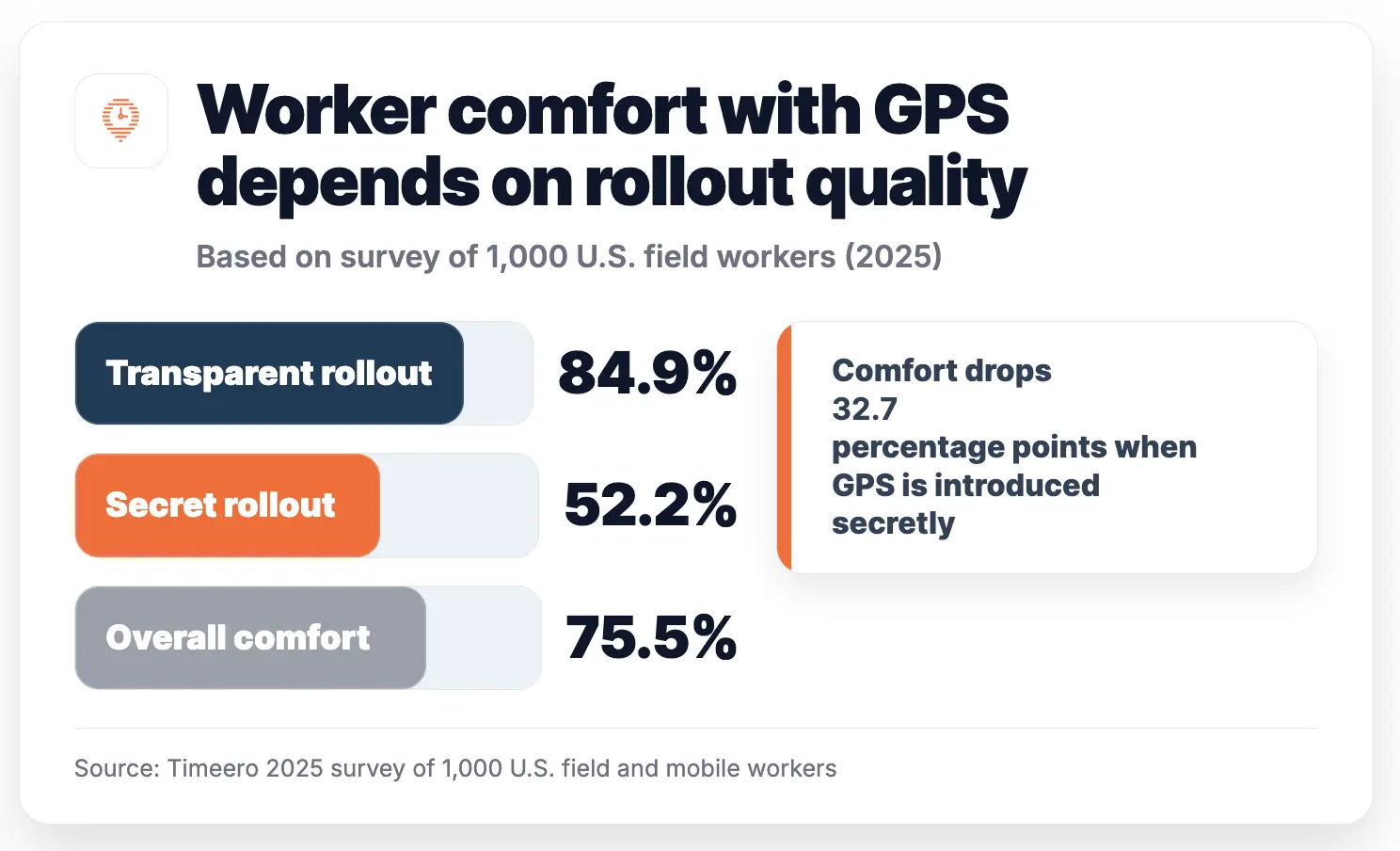
When employers take the time to explain why they are using GPS tracking in detail and disclose the specifics upfront, 84.9% of workers report feeling comfortable with using the technology. But when employers keep GPS tracking a secret, and employees find out they are being tracked on their own, that comfort level drops to 52.2%.
That’s a 32.7 point decline based on communication and rollout quality alone!
Research insight
See what workers really said about GPS tracking
Explore the complete findings from Timeero’s 2025 survey of U.S. field employees.
Previously, we looked at an example of a bad rollout, when Jim failed to provide his HVAC crew with details about the company’s new time tracking app. We pointed out that hiding the fact that the app tracked employee location was the biggest mistake Jim made during rollout.
Let’s take that same scenario and make some changes so it is no longer an example of a bad rollout.
Jim is a manager of an HVAC company. He believes some of his employees are stealing time, but he can’t prove it. Jim talks with his assistant manager and supervisors and decides that implementing a time tracking app with GPS tracking can help solve this problem. Before the company rolls out the new technology, a training meeting is held for all managers and employees. Jim discusses why they are using the new time tracking app. He explains that GPS tracking will be used during work hours only, to capture timestamped records for accurate reporting and dispute resolution. Jim also tells the crew what data is collected and who has access to it. He has all employees and managers sign the GPS tracking policy at the end of the meeting. Separate training meetings are scheduled for employees and managers to learn how to use the technology appropriately.
What makes this an example of a good GPS rollout?
There are several things here that Jim did well to build employees’ trust and encourage acceptance of GPS tracking.
✅ Jim discusses implementing the technology with his assistant manager and supervisor before he makes any changes.
✅ Jim holds a training meeting for all employees and managers to discuss why the tracking app is being used, what data is collected, who has access to that data, what times GPS tracking is active, and the benefits of GPS tracking in the workplace.
✅ All employees are informed that GPS tracking is enabled, and they are asked to sign the GPS tracking policy as a form of consent.
✅ A second meeting is scheduled for employees and managers to make sure they know how to use the technology appropriately.
Restating the stats from above, 84.9% of workers feel comfortable with GPS tracking when employers take the time to thoroughly explain why they are using the technology at work.
When we think about what fears employees have regarding GPS tracking, privacy and security concerns are usually at the top of the list.
But our survey showed something different.
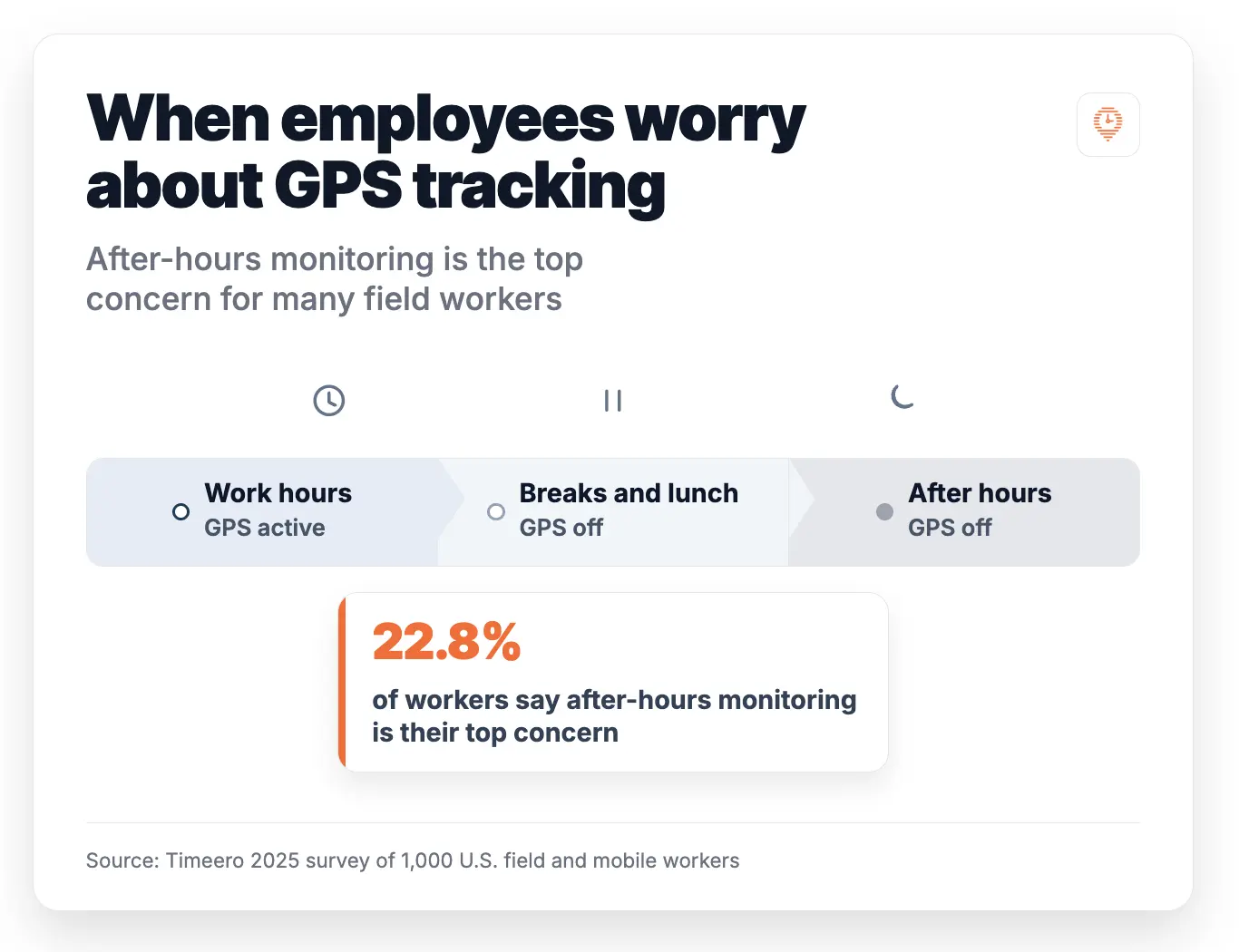
The top concern of employees isn’t privacy and security, or even GPS tracking itself. For 22.8% of workers surveyed, after-hours monitoring was their top concern.
Even though employees want to know exactly when tracking starts and when it stops, 75% of those with after-hours monitoring concerns report still feeling comfortable with GPS tracking.
So how can employers quell those fears?
Develop a strong GPS tracking policy that states the exact times when GPS tracking is used. Make sure you have safeguards in place to prevent after-hours tracking and tracking during breaks.
Transparency changes everything
When using any technology that collects employees’ personal information, transparency is key.
Employees don’t want their employers to be able to access data they can’t see for themselves. One-way visibility can feel intrusive and often creates discomfort in the workplace. Instead, employees should have equal access to their personal data just as much as employers.
Of 1,000 employees surveyed, 87.9% of workers say they are more comfortable with GPS tracking at work when they can access their own data.
Imagine you’re an employee who is always on time and never comes back late from break. Suddenly, your employer starts treating you differently and accusing you of coming back late from breaks multiple times during the month. You know that you clock back in from break on time, but you can’t see the same data your employer is seeing on their end.
Being an employee in this situation is extremely frustrating! While you know you are following your company’s break rules, it’s your employer’s word against yours because they have access to time and location data that you can’t see. Are they telling the truth, or are they making up claims as a reason to fire you?
In cases like these, only 48.9% of employees are comfortable with GPS tracking when it’s unclear what access employees and employers have to personal data.
How tools like Timeero support better GPS rollouts
Not all GPS tools are built the same way. Some solutions focus heavily on tracking, while others are built with rollout and trust in mind.
✅ Employee access to their own time, location, and mileage data
✅ Built-in boundaries that prevent after-hours tracking
GPS tracking tools like Timeero, prioritize transparency, establish clear boundaries, and share visibility among employees and employers.
Instead of using GPS tracking as a form of surveillance, Timeero allows employers to gather valuable insights into their teams’ daily activities as a way to increase employee productivity and the accuracy of recordkeeping.
Tools matter – But rollout matters more
Choosing to incorporate GPS tracking into your daily operations isn’t a decision that should be taken lightly. With employees already on the fence about GPS tracking, every step you take when introducing the technology should be detailed and intentional.
The quality of your GPS tracking rollout correlates directly with how comfortable employees are with GPS tracking at work. Regardless of which GPS tracking tool you use, the way the technology is introduced can either build or break employee trust.
What do employees really think about GPS tracking at work? View our full survey results to find out.
FAQs
Do workers actually dislike GPS tracking?
Workers are actually surprisingly accepting of GPS tracking. However, there are several factors that play into how comfortable workers are with GPS tracking, the quality of introduction and rollout being a top factor.
What causes employee pushback to GPS tracking?
Employees tend to push against GPS tracking when they don’t understand why it is being used, what data is collected, who has access to data, and when tracking stops. When employers don’t take the time to go into detail about their company’s GPS tracking policy and rules around tracking are unclear, employees are reluctant to use the technology.
Does privacy concern mean workers reject GPS?
Privacy concerns do not mean that workers reject GPS tracking. In fact, of the workers surveyed whose top concern was privacy and security, this group was more likely to feel comfortable with GPS tracking in the workplace.
Jessica is a skilled writer and proofreader with a unique flair for crafting engaging and impactful content. Her work reflects her ability to connect with clients on a personal level while successfully addressing their most pressing concerns. Jessica's professional background includes: teaching, social media marketing, and e-commerce. She resides in Alabama and loves the Golden Girls sitcom.




%202.svg)


.png)
.png)



.png)


