Navigating California’s Strict Regulations: What Happens When You Can’t Prove Break Compliance in a PAGA Claim
Judyann Sonido
Last update on:
February 24, 2026 6:13 AM
Published on:
TL;DR
When employers can’t provide clear, consistent records of meal and rest breaks, legal costs skyrocket, discovery expands to more employees, and cases take much longer to resolve. Maintaining centralized, automated records with tools like Timeero is the most effective way to reduce uncertainty and exposure before a claim ever arises.
Monday starts like any other busy week. You’re reviewing payroll, answering questions from operations, or maybe dealing with a staffing gap. Then your assistant walks in and hands you a formal notice no one likes to receive: a Private Attorneys General Act (PAGA) claim alleging meal and rest-break violations.
Your stomach drops. Your first thought? “But we give breaks. We tell everyone to take them.” And you probably do.
Your company has the handbooks and the posters in the breakroom, and you’ve told your supervisors a thousand times to make sure their teams clock out during break time. But as the initial shock wears off, a more nagging thought sets in: “Can I actually prove my employees take their breaks?”
Here's the problem: what you know happened and what you can prove happened are two entirely different things in a California meal break PAGA claim. And when the records aren't there to back you up, even employers with the best intentions find themselves in a drawn-out legal process that gets more expensive by the month.
The question isn't about your intentions, it's about your documentation. This article walks you through what actually happens when you can't clearly prove break compliance in California.
See your potential PAGA exposure in minutes
Estimate how missed or late breaks could impact premium pay and legal risk.
What a PAGA claim is and why break violations are common
A PAGA break compliance claim is a California statute passed in 2014 that allows employees to sue on behalf of themselves, the state, and other employees for labor code violations.
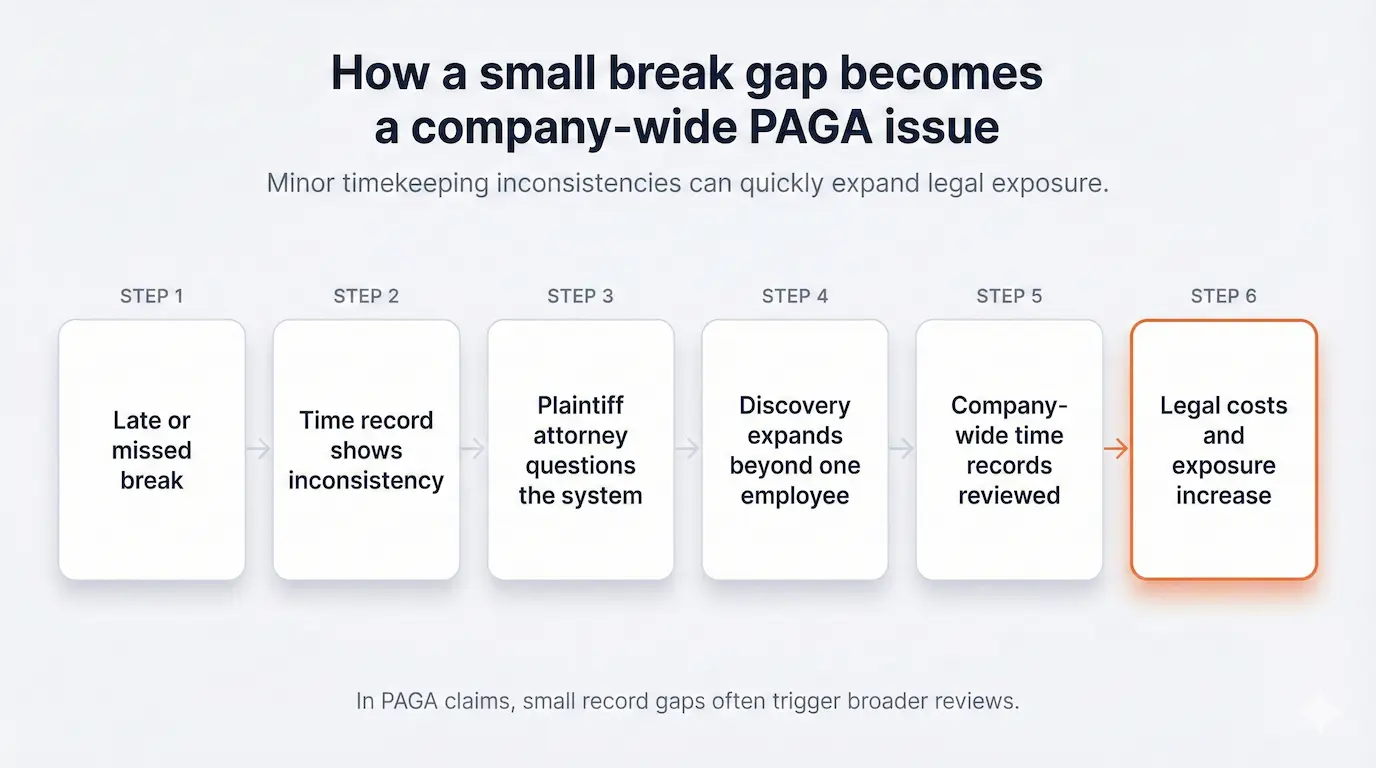
What makes this especially stressful for employers is how quickly the scope can grow. It may start with one employee saying they took a late meal break or missed a rest period. But once the claim is filed, the review often expands to cover months or even years of time records. Suddenly, the question isn’t just “Did this one break happen?” It becomes “Can you prove compliance across your organization?”
To help us understand what happens in a PAGA claim, we spoke with Emilio Rodriguez, a California employment litigator who works with employers across the state. Rodriguez explains that “one mistake or that one inconsistency in your meal break or your rest break policy could trigger one of these lawsuits that carry a lot of penalties.”
How a one-time record gap becomes a PAGA break compliance issue
Consider the case of Mike, a dedicated field technician. Mike is a team player who takes pride in his work.
One Tuesday, Mike is finishing a complex installation. He realizes that if he stops for his lunch break at 12:30 p.m. (his 5-hour mark), the customer will be without service for an extra hour. Mike decides to push through, finishes the job at 1:15 p.m., and then takes his lunch.
To Mike, he’s being a hero. To you, he’s a great employee. However, to a PAGA attorney, Mike is "Exhibit A." This 45-minute delay can quickly become a rest break violation involving 50 employees, hundreds of pay periods, and potential penalties that could reach six or seven figures.
Why rest break violations are common
Under PAGA, rest break violations are treated as strict liability issues. There’s no middle ground or credit for good intentions. California law is incredibly specific:
The 5-hour rule
A 30-minute unpaid meal break must begin before the end of the 5th hour of work. That means if Jonathan clocks in at 7:00 a.m., his meal break must start before 12:00 p.m. Not at 12:01 or 12:03 p.m.
The 10-minute rule
In California, employees must receive a 10-minute paid rest break for every 4 hours worked, or a major fraction thereof, which generally means more than 2 hours. So if Nadine works over 3.5 hours, a 10-minute paid rest break must be provided. If she works more than 6 hours, a second 10-minute rest break is required.
The rule sounds simple, but small timing gaps or missed breaks can quickly turn into PAGA break compliance issues if they’re not properly recorded and implemented.
The “Premium” Penalty
If a compliant meal break starts even one minute late, or if a required meal or rest break is cut short or not provided at all, the employer owes one hour of premium pay at the employee’s regular rate for that day.
That means if Ana clocks in at 8:00 a.m. and starts lunch at 1:01 p.m., even though her meal break is only one minute late, that one minute can trigger an hour of premium pay for the day. If late breaks show up repeatedly across the whole team, that’s a much bigger problem.
Because these rules are so technical, they are the easiest for plaintiff attorneys to challenge.
Why proof matters more than intent in a PAGA claim
You might feel confident that your team is doing things right. You trained your supervisors, shared the policy, and reminded everyone to take their breaks. But in a PAGA claim, none of that matters if you can’t prove what actually happened.
“There’s a difference between doing the right thing and proving that you did the right thing,” says Rodriguez. “Those are two different things.”
To prove break compliance in California, proof matters more than intent for a few key reasons:
1. Courts and claims rely on records, not good faith
It doesn't matter if your managers are good people or if your handbook is perfectly written. If the data reflects a meal break starting at 5 hours and 1 minute, that can trigger premium pay. Without a record to contradict that data, your good faith is just a story without evidence.
2. Verbal explanations don’t replace records
"We have a great culture," or "Mike just likes to work through lunch," are common defenses employers use. Those explanations may be true. However, verbal testimony is easily challenged during a deposition.
A plaintiff’s attorney will ask, "If Mike chose to skip his lunch, where is the signed waiver? Where is the record showing he was paid the required premium?"
They won’t focus on what you believe happened but rather on what you can prove.
3. Missing records shift the burden to you
Here is where things get more serious.
“Employers, they don't do things on purpose, right?” says Rodriguez. “They don't want to take away the meal break of the employee. But the problem is, again, we come back to having the required or the right record or document to prove and write and defend yourself if one of these lawsuits does arise.”
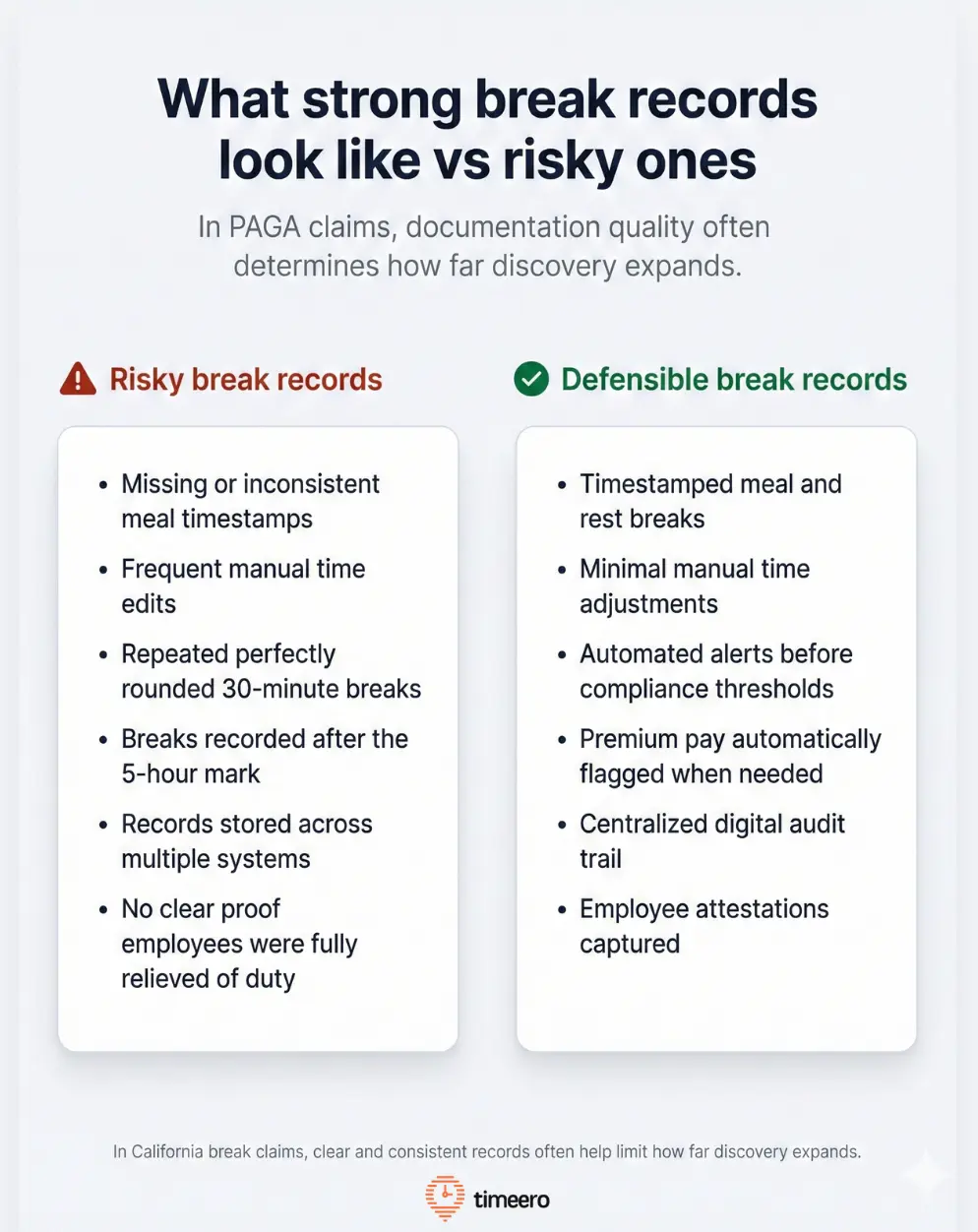
When timecards or payroll records are incomplete, inconsistent, or unclear, that defense becomes much harder. That’s why employers with consistent records are usually in a stronger position than those relying on memory, paper logs, or manual edits. Tools like Timeero help by automatically recording time and break data as work happens.
Reduce PAGA risk with consistent, verifiable break documentation
Implementing an automated solution reduces reliance on memory and paper logs.
Timeero centralizes your time and break records in one system, recording each
entry with a timestamp and GPS location so you’re prepared with verifiable
documentation long before anyone asks for it.
What happens next when records are missing or unclear
When an employer cannot immediately prove break compliance in California, the legal process becomes significantly more invasive and expensive. Here’s how a lack of records changes the trajectory of a claim:
👉 Discovery expands when records don’t answer basic questions
If your records for one employee are messy, the plaintiff’s attorney will use them to argue that your system is broken. This allows them to demand records for every employee you’ve hired over the last several years.
Let’s say Sarah forgot to clock out for lunch for a week because she was rushing through a holiday route. Without a record showing she actually took that break, a lawyer can argue that every driver in your fleet is being denied lunch. Suddenly, a one-week oversight for one person turns into an audit of your entire workforce's history.
👉 Increased reliance on employee interviews and testimony
Without clear records, the plaintiff's attorneys will start interviewing your current and former employees, asking leading questions such as whether they ever felt pressured to skip a break. And with no digital timestamp to act as an unbiased witness, you are at the mercy of fallible human memory.
👉 More time spent reconstructing timelines
When your records are insufficient, your legal team has to play detective. They will have to spend hundreds of billable hours piecing together what happened on specific days using circumstantial evidence such as emails, gate logs, or GPS pings.
Multiply that process across multiple employees and multiple pay periods, and the case can stretch far longer than expected. Clear records answer questions quickly. Missing records fuel investigations.
👉 Higher legal costs and longer case duration
Rodriguez notes a stark difference in timelines. While a case with solid records might be gone in half a year, “...if you're missing records, if your records are not legible, and we have seen those, or if they're just non-existent at all, well then it will take a considerable amount of time.”
For a business owner, that means months or even years of mounting legal fees and constant distraction from your actual business.
Why missing records make PAGA claims harder to resolve
Ambiguity benefits the plaintiff. When records are unclear, the plaintiff's attorney can argue that there's a pattern of noncompliance. Then, suddenly, one missing meal break entry becomes evidence of a systemic issue. Additionally, a few late rest breaks can suggest consistent policy violations.
According to Rodriguez, “the only other way that [proving breaks happened] could be done is going to be by asking employees, by going through the litigation, by doing depositions, by doing discovery, which is just more time and more costly for the defense."
Unclear records don't just create doubt; they broaden your exposure
In California, if a record is illegible or non-existent, the law often presumes the violation occurred. This presumption makes it incredibly easy for a lawyer to expand the scope of the lawsuit from one aggrieved employee to your entire workforce.
Let’s say Marcus was scheduled from 7 a.m. to 3:30 p.m. On paper, there’s no recorded meal break for several days in July. The timesheet shows 8.5 straight hours worked. Marcus says he usually ate in his truck between service calls, but there’s no clock out to prove it. Because you trusted him, you never forced the issue of the missing timestamps.
Months later, Marcus joins a PAGA claim. Because there is no record of those lunches, the law assumes they never happened. It then raises more questions:
If Marcus’s breaks were not clearly recorded, what about the other technicians?
Were their meal periods documented the same way?
Did supervisors ever manually adjust time to clean up missing punches?
Are there other shifts that look perfectly smooth on paper but lack real break timestamps?
What started as one employee’s complaint became a review of everyone’s records. That is how exposure expands.
Resolution takes longer when facts are disputed
As Rodriguez points out, the timeline for a PAGA case is directly tied to the quality of your documentation. "The better the record, the faster it’s going to be," he says.
However, when facts are disputed, the case enters a grueling cycle of depositions and discovery. Instead of a fast resolution, you’re looking at a case that will take months or even years, because you’re fighting over what actually happened years ago.
Let’s take Marcus’s case as an example. Because there are no recorded meal breaks for those shifts in July, your attorney now has to build a defense piece by piece. That could include:
Subpoenaing Marcus's phone GPS records to show he was stationary during lunch hours.
Questioning Marcus’s former co-workers to see if they remember seeing him take his lunch breaks.
Cross-referencing his job site logs with his timecards to reconstruct his day.
Every one of those steps costs you thousands in billable legal hours.
How Timeero supports record consistency before claims arise
You shouldn't wait for a PAGA break compliance notice to audit your records. Timeero acts as a proactive defense system, ensuring that when a lawyer asks for proof, you can provide it immediately.
Centralized time and break records: Instead of chasing paper logs, spreadsheets, or text messages from supervisors, you can access clean digital records in one place.
More consistent tracking across teams and locations: Whether you manage one office or multiple field crews, Timeero standardizes how breaks are recorded.
Faster response when records are requested: Clear, organized records reduce the need to reconstruct schedules from memory or dig through scattered files.
Break attestations: Employees can confirm that they were allowed to take required breaks.
Automated reminders: Break reminders help employees take their meal and rest breaks on time, reducing the risk of late or missed entries in the first place.
No system eliminates risk entirely. But consistent, centralized records put you
in a far stronger position if questions ever arise about PAGA break compliance.
Consistent records strengthen your defense against PAGA claims. They shift the conversation away from assumptions and back to verifiable facts.
“Rarely do we see a noncompliant policy,” says Rodriguez.
“The law is the law. But sometimes, depending on what your recording method is, if an employee forgets to punch in or punch out, then there's going to be an inconsistency there. And that's the thing we see all the time – consistency in recording, consistency in paying the meal premium or the rest premium if it's needed."
When you have a clear digital audit trail, you’re not leaning on memory or explanations. You’re relying on documented data. That changes a PAGA claim in a few important ways:
1. Clear records move the discussion from assumptions to facts
Instead of debating whether a pattern of skipping breaks exists, you are looking at specific timestamps. If a record shows a break was missed, you can immediately show that the corresponding meal premium was paid. This turns a potential violation into a documented PAGA break compliance.
2. Less reliance on employee memory or testimony
You no longer have to hope that a supervisor remembers a specific lunch break from three years ago. As Rodriguez points out, relying on human memory is expensive and risky. Clear records act as an unbiased witness that doesn’t forget details or change its story under pressure.
3. Fewer disputes about timing, missed breaks, or exceptions
Most PAGA break compliance litigation lives in the gray area of late or short breaks. Consistent records eliminate these disputes by providing exact timestamps. If Mike took his break at 4 hours and 59 minutes, a digital record proves it instantly, preventing a late break allegation from ever gaining traction.
4. Faster understanding of what actually happened
When a legal team can review a clean data record, they can quickly determine whether a claim has merit or was an isolated administrative error. This prevents the fishing expedition where plaintiff attorneys dig through years of files looking for patterns that don't exist.
5. Easier, more focused path toward resolution
Ambiguity is what makes lawsuits drag on for years. With solid documentation, you can often reach a resolution or dismissal faster, saving your company tens of thousands in ongoing legal fees.
The bottom line: Preparation is your best defense
By the time you’re sitting in a deposition, it’s too late to fix a messy paper trail. Consistency in record keeping and policy implementation is what separates a manageable six-month resolution from a multi-year legal ordeal.
"Every business is a team,” says Rodriguez. “And every team member has a very specific job, and if everyone is doing that job well, then you can rest assured that you're either not going to get sued, or if you do get sued, then you're going to be out of it rather quickly because of your policies and your training being perfect.”
Preparation reduces uncertainty, even when claims happen
By automating your processes today using tools like Timeero, you ensure that if a rest break violation claim ever hits your desk, you can move the conversation back to verifiable facts that protect your business.
See how much you could save in premium pay and potential PAGA lawsuit settlement with our free interactive calculator.
FAQs
What does it mean to “prove” break compliance in a PAGA claim?
Proving break compliance means showing clear, consistent records that demonstrate employees were provided meal and rest breaks at the right times.
Why does proof matter more than intent in a PAGA claim?
California courts rely on documentation, not good intentions. Even if you genuinely provided breaks and followed your policy, you need records to prove it. When records are missing or unclear, the burden shifts to you to demonstrate PAGA break compliance.
Do missing records automatically mean an employer will lose a PAGA claim?
No, missing records don't guarantee a loss, but they create ambiguity that plaintiffs can use to argue noncompliance. You'll likely spend more time and money reconstructing what happened through employee interviews and discovery.
Judyann is a content specialist with nearly a decade of experience in digital marketing. When she's not building brands and strategies, you'll find her exploring new destinations, embarking on spontaneous adventures, hunting down the best local eats, and spoiling her two fur babies. She believes the best content, like the best trips, comes from curiosity, creativity, and never playing it safe.




%202.svg)


.png)
.png)



.png)


