ClockShark Review 2026: GPS, Geofencing, Mileage Tested, Plus Pricing
Andjelka Prvulovic
Last update on:
Oct 16, 2026
Published on:
TL;DR
Field teams need records they can defend at payroll: accurate hours, real locations, and mileage that holds up. Vendor pages rarely tell you where a tool falls short.
I ran ClockShark on real drives and job sites in September 2026 and captured screenshots of each result.
ClockShark is a capable jobs-and-crews time clock that added manual, typed mileage and AI features in 2026, but it samples location about every 15 minutes and reminds rather than stops off-site clock-ins.
Teams whose core need is automatic mileage, continuous GPS, and compliance controls will hit its limits, and that is where Timeero fits.
Timesheets that don't match the hours worked and mileage claims no one can verify turn every payroll run into a negotiation. ClockShark is one of the tools construction and field-service teams choose to handle time and mileage tracking, but most reviews of it are either stale or written for a commission, so they skip what matters for crews in the field.
I tested ClockShark myself, taking it on real drives and through staged job sites, next to Timeero, a GPS-based time and mileage tracker built for field crews.
By the end, you’ll know whether ClockShark fits your team before you commit to a multi-year contract, and where a GPS-first tool would serve you better.
Want to track employees’ hours, locations, and mileage accurately in real-time?
Discover why Timeero is the ultimate app for your field team and jobs
Arrival and exit reminders; does not stop a clock-in
Automatic clock-in/out
Not available; Clock-in/out reminders only
Admin alerts
Out-of-bounds, location tampering, location-off, unrecognized face
Mileage
Mileage tracking
Manual entry required (Lightning, Pro)
Mileage from GPS route
No
Crew & job tools
Kiosk with facial recognition
Yes
CrewClockClock in a crew at one time
Yes
Lightning AI extras
Task checklists and a JobReady daily brief
App & integrations
Offline behavior (mobile app)
Time clock works; Schedule and Timesheets viewing blocked
Integrations
QuickBooks, ADP, Sage, Xero, Gusto, Paychex, and more
Best for: Construction and field-service teams organized around jobs and crews that want job costing, crew punching, and scheduling features
Less suited to: Mobile teams whose core need is automatic mileage, continuous GPS trails, or a hard clock-in control at the geofence.
What is ClockShark?
ClockShark is a construction and field-service time tracking app built around jobs and crews. Employees clock in and out by job and task from a mobile app or the web, and a shift leader can punch a whole crew in at once with CrewClock. The company says more than 9,500 businesses use it, and its design leans toward trades where work is organized by job site.
The 2026 version adds an AI layer called Lightning, which I cover in its own section below. At the core, ClockShark is a jobs-first time clock with GPS, scheduling, and job costing, built for owners and office admins that need to know where teams worked each day.
How I tested ClockShark
I ran ClockShark and Timeero simultaneously from my iPhone during September 2026. I took both apps on real test drives, and saved a dated screenshot for every finding. For this review, I signed up for a ClockShark Pro trial, using an admin account and an employee account so I could see results from both sides.
What I tested
The app’s clock-in/out function as well as CrewClock
How the app captures GPS location during drives and while walking
Geofence reminders and the admin alert set
Lightning mileage entry, task checklists, and the JobReady brief
Scheduling, breaks, and offline behavior
Pricing, confirmed against an in-app invoice
Test conditions: September 2026 · ClockShark mobile on iOS and the web app · a Pro trial with admin and employee accounts · real drives with weak, normal, and no signal · pricing captured from clockshark.com and an in-app invoice on September 27, 2026.
Every hands-on finding below comes from my own testing, backed by screenshots. Facts that come from elsewhere, like pricing and ratings, are credited to their source.
Key features
Time tracking and CrewClock
ClockShark’s obvious strength is time tracking. The clock-in/out process is simple. An employee opens the app, picks a job and task, and starts the time clock to begin their shift. There is an option for employees to add notes to their timecard.
For crews using ClockShark, CrewClock lets one person clock the whole team in, out, or onto a break at the same time, which is useful when half the crew is carrying tools instead of phones.
GPS tracking and location cadence
During my testing, I found that ClockShark tags an employee's location about every 15 minutes while they are on the clock, rather than recording a continuous trail.
ClockShark’s own documentation puts the interval around 15 to 20 minutes, and confirms location is captured at clock-in/out and periodically during shifts.
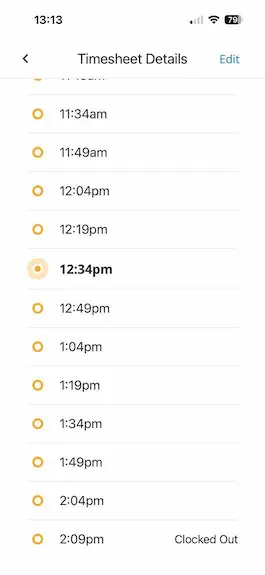
In my September 2026 test, my location history showed GPS points were captured every 15 minutes. Both the mobile timesheet and web playback showed the same results.
The location list shows records in 15-minute intervals, the cadence I saw on both mobile and web (September 2026 test).
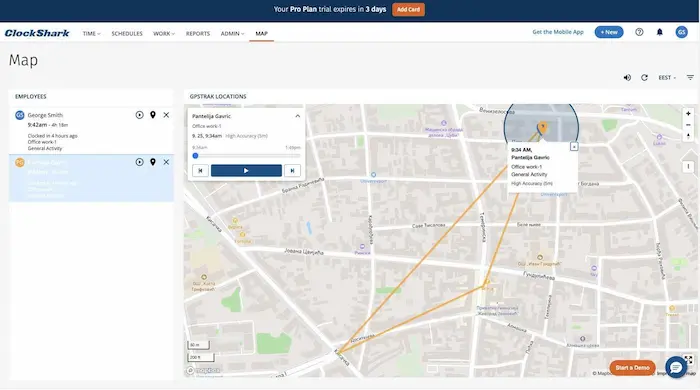
ClockShark tagged its points as high accuracy, within 5 to 8 meters.
The same session on the map: high-accuracy points, but few are recorded so pings connect in a straight line (September 2026 test).
On a straight highway, points spaced 15 minutes apart still look like a route. However, on a winding city walk, the same spacing produced a sparse trail of points joined by straight lines that cut across blocks, while Timeero's trail followed the streets.
Additionally, I also observed that ClockShark’s location tracking stops when it should. In my test, ClockShark kept location off while an employee was on break and after clock-out, keeping employees’ personal data private.
Geofence reminders and alerts
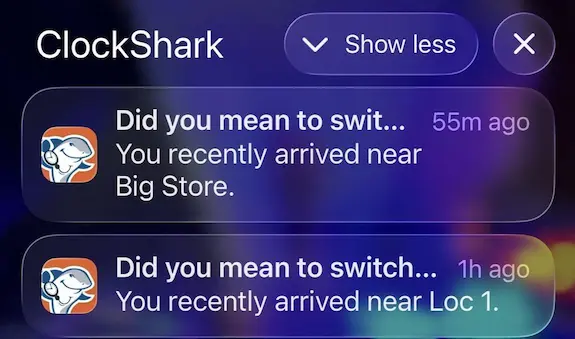
ClockShark’s geofencing feature reminds and alerts workers, but it does not stop a clock-in. In my September 2026 test, arriving at a job site triggered a reminder that I had arrived at the job site.
ClockShark's geofence sends an arrival reminder. It nudges the worker; it does not stop the clock-in (September 2026 test).
Leaving the site triggered a second reminder, and a separate time-based reminder asked whether it was time for a break after several hours on the clock. When I attempted to clock in outside of the geofence, the admin received an alert.
What none of them do is hold the line at the boundary. Every one is a nudge or a flag; the employee still taps the button, and nothing prevents a clock-in from the wrong place. For a manager worried about time theft, that is the distinction to understand: ClockShark tells you after the fact, it does not stop the punch.
Key difference: geofence control
ClockShark's geofence sends reminders and admin alerts, but it does not stop a clock-in. Timeero's geofencing, paired with Work Schedule Settings, prevents off-site and early clock-ins. Timeero’s Auto Clock-In/Out also uses geofences to automatically clock employees in or out when they enter or exit a geofence.
Mileage in ClockShark Lightning
ClockShark now tracks mileage, but the number is typed by the employee, not measured from GPS.
Mileage arrived with the 2026 Lightning add-on and is turned on per task by an admin.
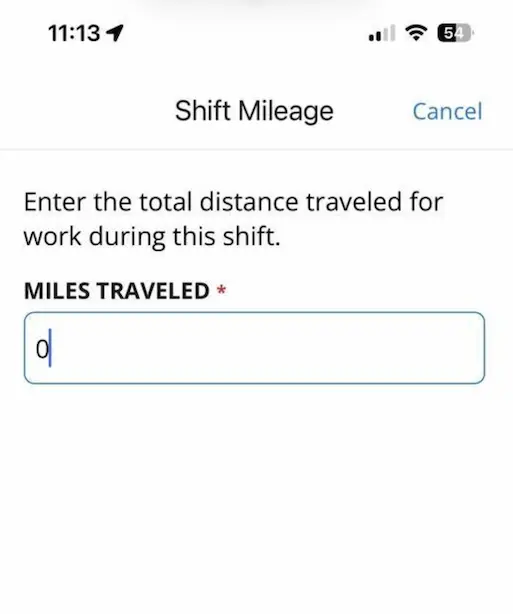
At clock-out, ClockShark asks the employee to type total shift miles by hand. There is no route behind the number (September 2026 test).
When the employee clocks out or switches tasks, ClockShark asks them to enter the total distance traveled for the shift as a single whole number. There is no route captured to back up the mileage records, and once a total is submitted it cannot be edited.
The feature is limited to the Pro plan, and the totals roll up into Employee and Job mileage reports that export to PDF and CSV.
For teams that want a rough reimbursement figure it may be enough. But if your company needs accurate mileage for reimbursement or tax deductions, a typed total with no route is harder to back up.
This is the clearest change since the 2025 version of the app, which had no mileage feature in ClockShark at all.
Key difference: how mileage is measured
ClockShark mileage is a whole number the employee types in at clock-out. However, the app captures no driving routes to verify mileage amounts. Timeero uses automatic GPS mileage tracking, deriving business miles from the drive itself rather than from an end-of-day estimate.
Cleaning up timesheets and mileage math before every payroll run costs you hours.
Timeero captures verified hours and automatic mileage from a single clock-in.
ClockShark Lightning: JobReady and task checklists
Lightning is ClockShark's 2026 AI layer, and beyond mileage it adds task checklists and a JobReady daily brief.
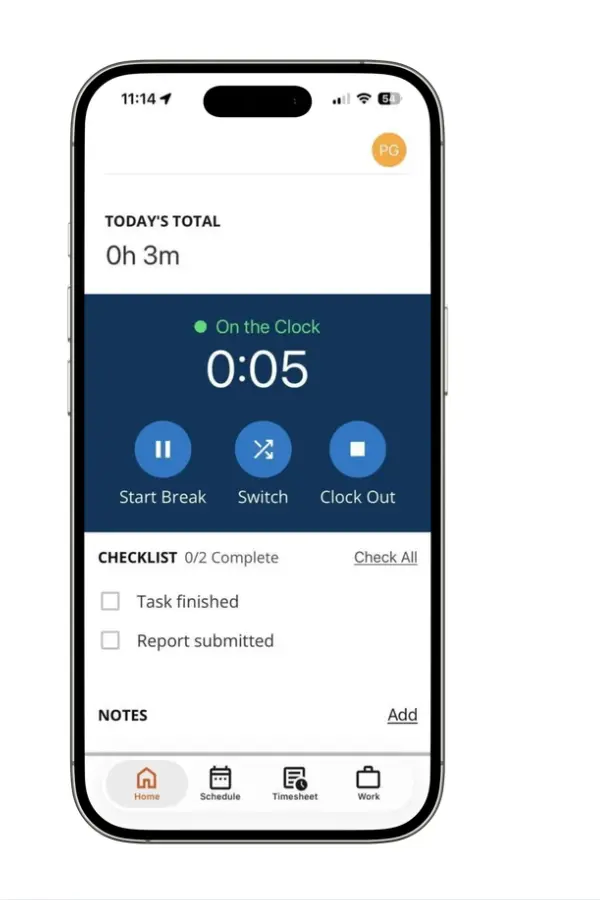
Lightning task checklists appear on the clock screen and roll up into a completion report (September 2026 test).
Task checklists appear right on the time clock screen. During my testing, a two-item checklist was displayed below the clock-out button. Items could be checked off as work progressed, and the results turned up later in a checklist completion report. For crews that need proof a step was done, this is a nice addition.
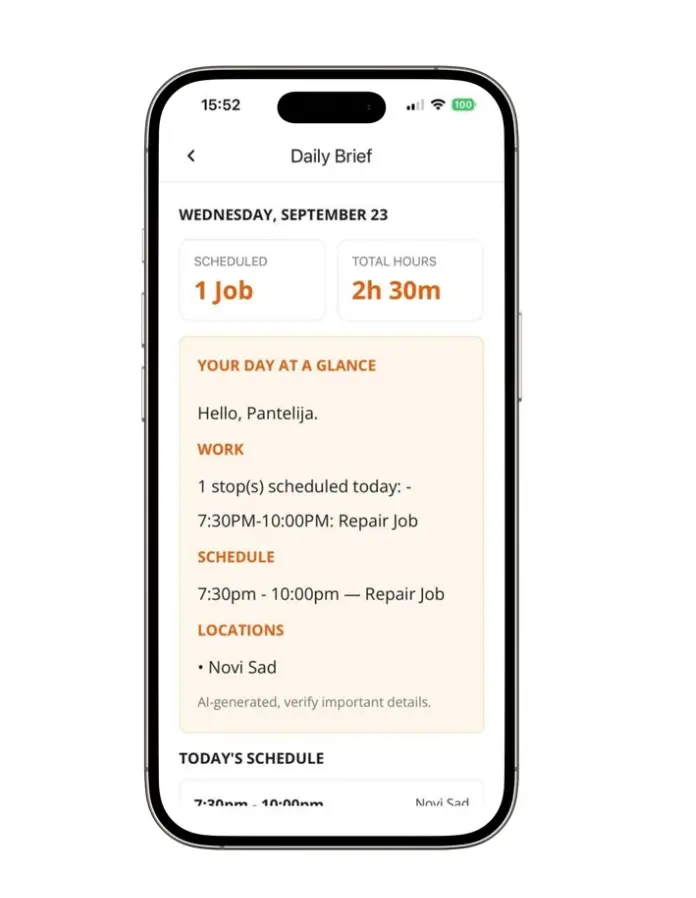
The JobReady daily brief summarizes the day's jobs and labels itself AI-generated, telling the reader to verify details (September 2026 test).
JobReady produces an AI-generated daily brief of the day's scheduled jobs, with times, locations, and short notes, shown with a label that it is AI-generated and that important details should be verified.
I captured the brief but did not stress-test how well it summarizes a real schedule, so my advice is to treat it as a convenience that you’ll still need to review.
Scheduling, PTO, and breaks
A manager builds shifts on a calendar and assigns jobs and tasks to employees. ClockShark’s scheduling does have drag-and-drop capabilities, which is a plus if you need to edit schedules quickly.
Paid time off is a Pro-plan feature, alongside multi-department controls and advanced job costing.
Breaks lean on the same reminder model as the geofence: the app can nudge a worker that a break is due, and it keeps location off during the break itself.
Job management, job costing, and Kiosk
Jobs and job costing are a real ClockShark strength.
You can build jobs with customers and tasks, track labor against them, and generate job-costing details that suit a construction operation.
A shared Kiosk with Facial Recognition lets crews punch in or out from a single tablet on site while cutting down on buddy punching, and Pro adds shift wrap-up and compliance forms for capturing sign-offs at the end of a shift.
If your business needs to know labor cost per job, this is where ClockShark earns its keep.
Reporting, integrations, and offline access
ClockShark exports standard reports, connects to major accounting and payroll tools, and continues tracking time when offline.
Its own site lists integrations with QuickBooks, ADP, Sage, Xero, Zapier, Paychex, Simpro, Gusto, and MYOB, so most payroll stacks are covered.
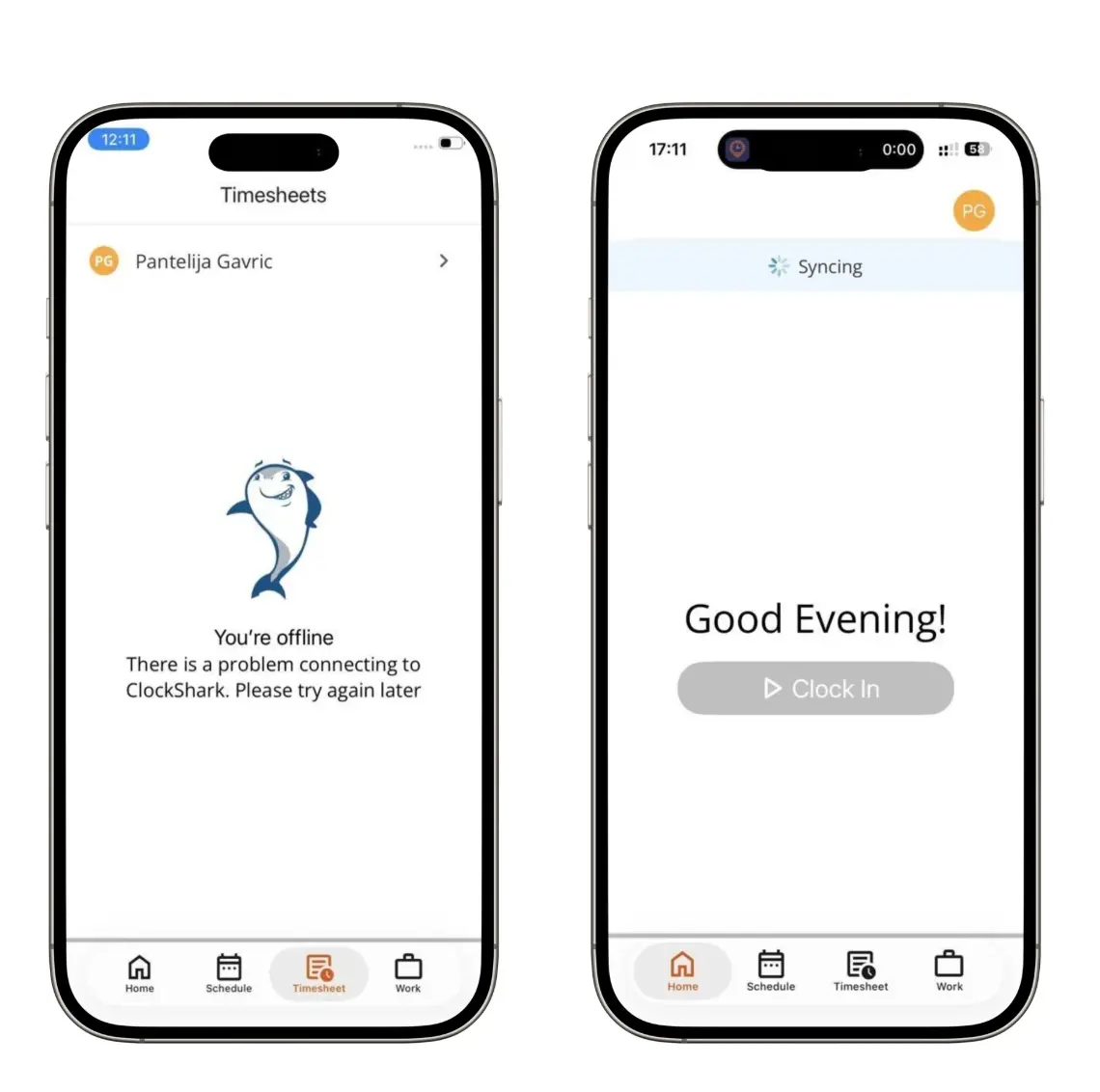
The reliability of ClockShark’s offline tracking depends largely on which app is being used. On the employee mobile app, the clock itself kept working with no connection, and cached job details stayed readable, but the Schedule and Timesheets tabs were blocked with an offline message until the phone reconnected.
ClockShark's shared Kiosk app has its own offline mode that saves entries on the device and syncs them manually, so a fixed-site setup can keep working offline in a way the individual app does not.
Offline, the Timesheets and Schedule tabs are blocked, while the clock itself keeps running. (September 2026 test).
ClockShark synced its data on reconnect, but the mobile app showed no sign that anything had happened offline. On a job with patchy coverage, that leaves workers no way to tell from the app what was recorded while offline.
One more reliability note from the field: with a weak signal, ClockShark sometimes stalled on a syncing screen with the clock-in button disabled. In one run it sat there for about 21 minutes before it let the employee clock in, and everything in that window is missing from its record.
With normal connection, clock-in was instant, so this is a weak-coverage problem rather than an everyday one which is worth knowing if your crews work in dead zones.
ClockShark pricing in 2026
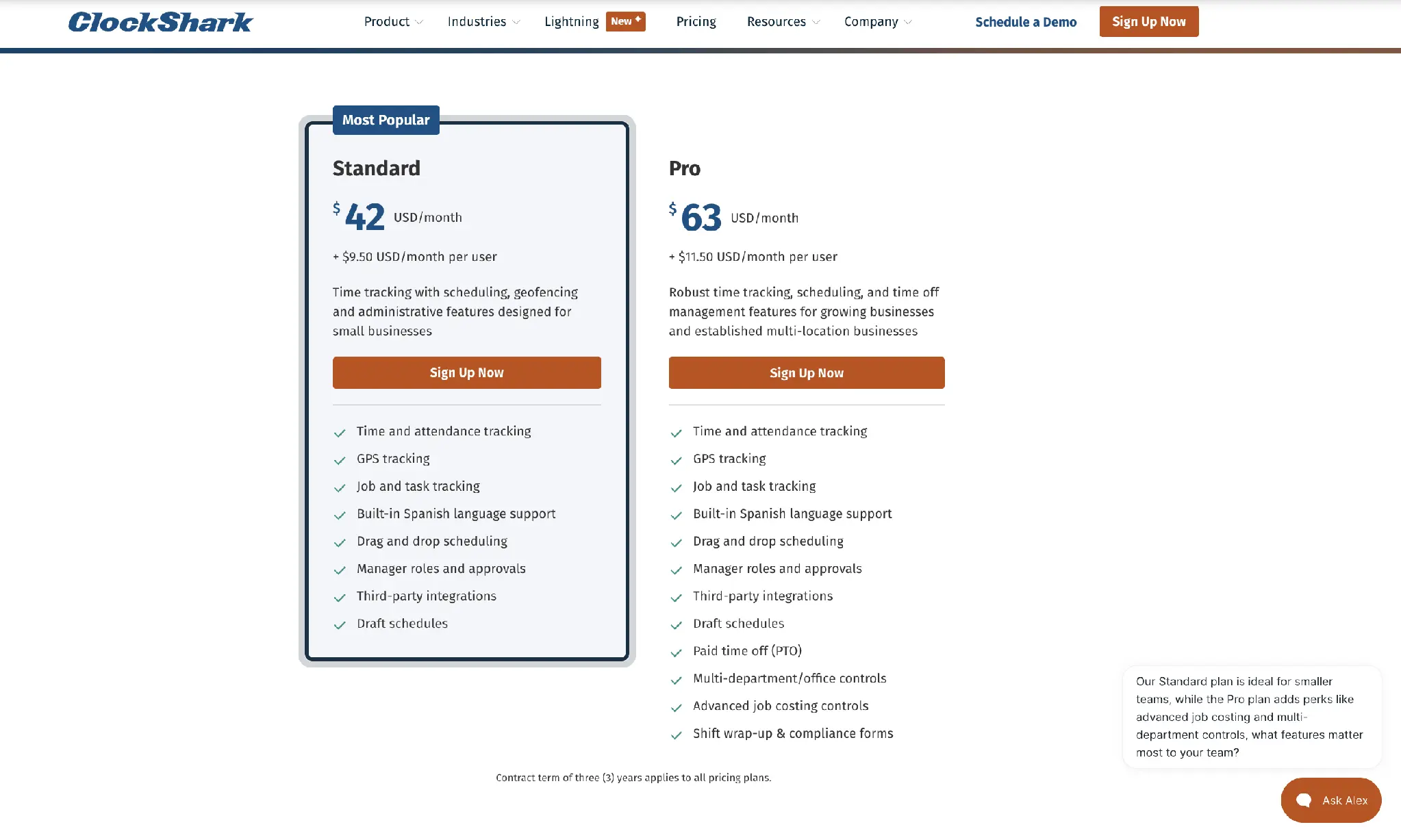
ClockShark charges a monthly platform fee plus a per-user fee, on a three-year contract term.
Standard: $42 per month plus $9.50 per user
Pro: $63 per month plus $11.50 per user
Contract term: three years on every plan
Billing: every user is billed, including the admin, so the base fee does not include a free seat
Trial: 14 days
Annual discount: none shown on the pricing page
ClockShark's pricing page: a platform fee plus a per-user rate, billed on a three-year term (clockshark.com, September 2026).
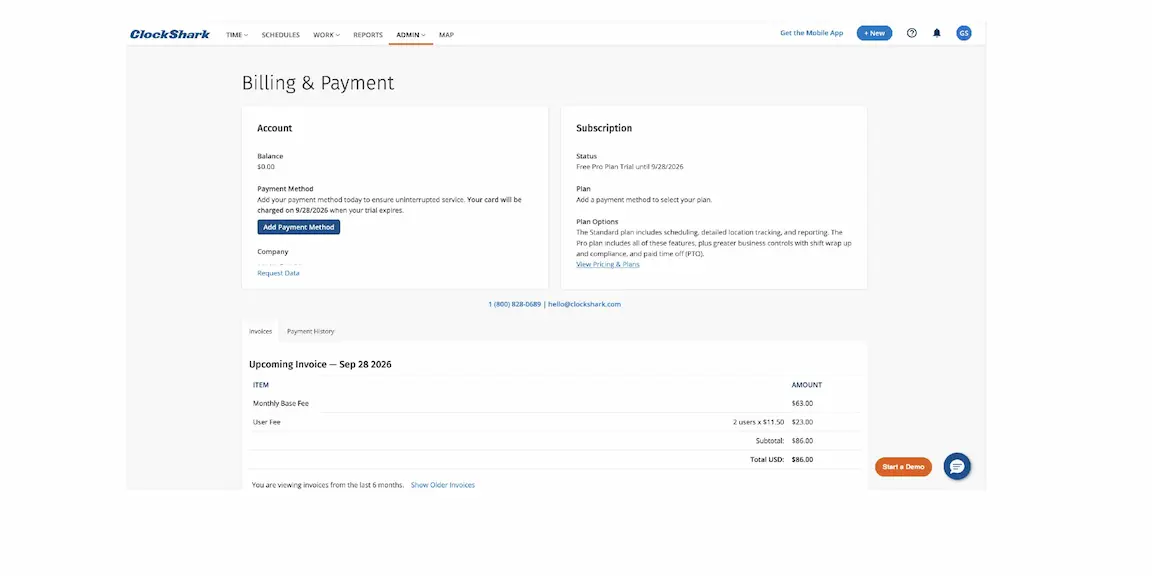
Prices are from ClockShark’s pricing page, confirmed against an in-app invoice on a Pro trial in September 2026.
The in-app invoice on a Pro trial: a 63 dollar base fee plus a per-user charge, with every user billed (September 2026 test).
The platform-fee-plus-per-user model means the effective cost per head falls as the crew grows. For example, a 20-person crew on the Standard plan:
Base fee: $42
User fees: 20 × $9.50 = $190
Total: $232 per month, about $11.60 per user
For a small crew the base fee dominates, so the per-head cost is higher. The three-year term is the part to read closely, because it commits you well beyond the point where you can tell whether the tool fits.
ClockShark pros and cons
✓Pros
CrewClock punches a whole crew in, out, or onto a break at once
Job management and job costing suited to construction work
Drag-and-drop scheduling
On-site Kiosk with Facial Recognition to cut buddy punching
New Lightning task checklists on the clock screen, with a completion report
A broad admin alert set, from out-of-bounds clock-ins/outs to location tampering and unrecognized faces
Easy to learn
✕Cons
Mileage is typed by the employee rather than recorded from GPS points
Location is tagged every 15 minutes, not continuously
Entering or exiting a geofence reminds and alerts employees but does not stop a clock-in
A three-year contract term required on every plan
Every user is billed, including the admin
The employee mobile app blocks Schedule and Timesheets viewing offline
The third-party ratings split along predictable lines. On the buyer-facing directories, ClockShark rates well: 4.7 out of 5 across 1,910 reviews on Capterra and 4.6 across roughly 313 on G2, where reviewers consistently praise ease of use, job tracking, and responsive support.
The friction points that recur across sources are GPS accuracy under poor conditions, occasional app glitches, per-user cost as headcount grows, and the absence of native payroll, which routes through an integration instead.
Where Timeero differs for field teams
Beyond the geofence and mileage differences mentioned above, my side-by-side test and Timeero's feature pages show other important differences worth knowing.
Route detail: Timeero's Segmented Tracking add-on works by reconstructing the workday into stops and drives from a single clock-in, while ClockShark records location points about 15 minutes apart.
Offline visibility: in my test, Timeero showed an offline banner each time and kept logged entries viewable without a connection.
Home care: Timeero records EVV visit details that ClockShark does not, for agencies billing Medicaid.
Verdict: who ClockShark fits, and who should look at Timeero
Choose ClockShark if your work is organized around jobs and crews and your priority is job costing, crew punching, and clean scheduling. It does those well. The app’s Kiosk and CrewClock suit teams where not everyone carries a phone, and the 2026 Lightning additions make it more capable than the 2025 version of the app.
If accurate mileage, continuous location, and real compliance controls are what your team actually needs, Timeero is a GPS time tracking and workforce management platform for field teams. With features like Auto Clock-In/Out, Segmented Tracking, automatic mileage tracking and California break tracking, Timeero simplifies the way you manage your workforce.
Yes, since its 2026 Lightning add-on on the Pro plan. The employee types a whole-number mileage figure per shift at clock-out or on a task switch, and it cannot be edited once entered. The worker enters it by hand, and GPS never measures it.
Does ClockShark track your location off the clock?
No. In my test, ClockShark tagged location only while an employee was on the clock, about every 15 minutes, and it kept location off during breaks and after clock-out.
How much does ClockShark cost, and is there a contract?
Standard is $42 per month plus $9.50 per user, and Pro is $63 per month plus $11.50 per user, both on a three-year contract term. There is a 14-day trial, and the pricing page shows no annual-billing discount.
Does ClockShark's geofence stop off-site clock-ins?
No. It sends reminders when a worker arrives at or leaves a job site and raises an out-of-bounds alert for admins, but it does not stop the clock-in. Timeero, by contrast, can prevent workers from clocking in until they’re inside the geofence.
Does ClockShark work offline?
Partly, and it depends on the app. On the employee mobile app, the clock and cached job details work with no connection and sync when the phone reconnects. But the Schedule and Timesheets tabs are blocked while offline. The shared Kiosk app has a separate offline mode that stores entries on the device and syncs them manually.
What are the best ClockShark alternatives?
The most common alternatives for field teams are Timeero, Connecteam, BuddyPunch, and QuickBooks Time, each with different strengths around GPS, mileage, and price.
If accurate mileage and continuous GPS are what your team actually needs, try Timeero.
Andjelka is a researcher and writer with 7+ years in digital marketing. Her background in social work and journalism has sharpened her skill in connecting with people from all walks of life. For the past 4 years, she’s specialized in time, location, and mileage tracking. Outside work, she enjoys yoga, swimming, and unwinding with her cats while listening to Leonard Cohen’s music.