7 Best Clock-In Clock-Out Apps in 2026: How to Choose the Right Time Clock for Your Team
Wisdom Dabit
Last update on:
November 3, 2026 8:15 AM
Published on:
TL;DR
For mobile and multi-location teams, a useful time clock should connect each employee’s hours to the location, job, connectivity conditions, and travel that shaped the workday, rather than leaving managers with start and end times alone.
GPS tracking can show where employees punch and, on supported apps, where they move during the workday, while geofencing can restrict clock-ins and outs to approved locations.
Timeero is best for mobile teams moving between job sites because your team can track time, location, mileage, and travel between job sites from one app, with geofencing to control where employees can clock in and out.
Other features worth comparing include automatic clock-in and out, punch verification, payroll integrations, and how well each app fits the way your team works.
A field technician starts the morning at one customer’s property, drives to two more job sites, and finishes the day at a fourth. Eight hours on a timesheet does not show where those hours were spent, whether each punch came from the right location, or how much travel happened between jobs.
For mobile and multi-location teams, missed punches, off-site clock-ins, unreliable connectivity, buddy punching, and manual timesheets can leave managers correcting records or guessing what happened when they review hours at the end of the week.
The best GPS time tracking apps turn clock-in and clock-out records into information a business can actually use to verify work, assign hours, handle poor connectivity, and prepare payroll.
I tested Timeero, Buddy Punch, Clockify, ClockShark, Connecteam, When I Work, and Jibble, evaluating how well they handle the realities that multi-location teams face.
Simplify time tracking and boost productivity with Timeero.
I tested each app from the perspective of a business managing hourly employees, with particular attention to mobile and multi-location workflows.
I tested Timeero directly on the web dashboard and Android app in September 2026, including mobile clock-ins and outs, GPS/location records, timesheets, mileage views, scheduling, and the Auto Clock-In/Out setup.
I also signed up for and reviewed the current dashboards of Buddy Punch, Clockify, ClockShark, Connecteam, When I Work, and Jibble, focusing on the time-clock, location, scheduling, and integration workflows discussed below.
Where a feature could not be fully exercised in the test account, I checked its current behavior and limitations against the vendor’s documentation.
Across the seven apps, I compared:
Mobile clock-in and out: How easy is it for employees to punch from their phones and what gets recorded with each punch?
GPS tracking and geofencing: Can managers see where employees are and control where they can clock in and out?
Offline tracking: Can employees still record their time when they have little or no internet connection?
Automatic clock-in and out: Does the app record punches automatically instead of relying on employees to remember them?
Punch verification: What does the app offer to verify that the right employee made the punch?
Jobs and locations: Can employee hours can be assigned to the right job, project, or worksite?
Timesheets and payroll: How do approvals work and how easily can recorded hours be exported or sent to payroll?
Mileage and travel: Does the app track mileage or show travel between job sites?
Pricing: What does each plan cost and which features require a higher tier or add-on?
App
Best for
Pricing
Timeero Our pick
Mobile teams moving between job sites
From $5/user/month billed annually ($6 monthly)
Buddy Punch
Configurable punch verification
From $4.99/user/month + $19/month base fee, billed annually
Clockify
Project-based time tracking
Free for up to 5 users; paid plans from $3.99/user/month billed annually
ClockShark
Job and crew time tracking
From $42/month + $9.50/user/month
Connecteam
Time tracking within a broader workforce management platform
Free plans available; paid Operations plans from $29/month for the first 30 users, billed annually
When I Work
Time tracking alongside employee scheduling
From $2.50/user/month
Jibble
Time and attendance tracking with a free plan
Free forever for unlimited users; paid plans available
Don’t have time to read through the article? Watch our walkthrough of the best seven clock-in clock-out apps.
1. Timeero: Best for mobile teams moving between job sites
Timeero is a strong fit for field and mobile teams that move between customer locations or job sites, mostly because managers can review when employees clocked in and out, where those punches happened, how far they drove between jobs, and the route recorded during the workday in the same system.
Available on: Web, iOS, and Android.
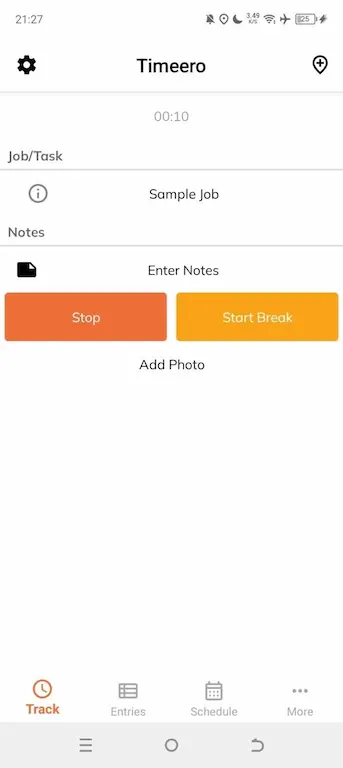
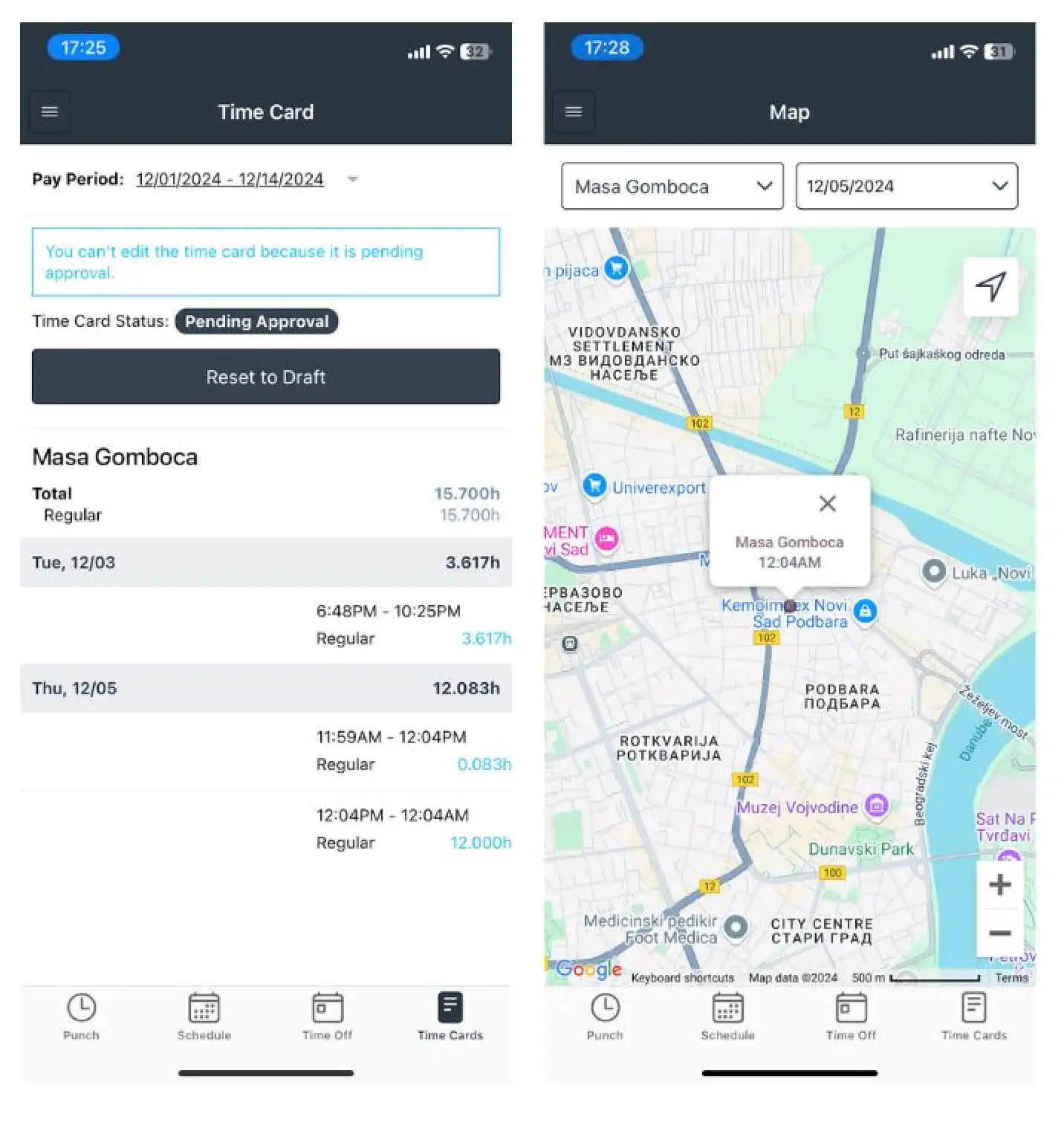
Timeero mobile time card interface used for employee clock-ins and clock-outs.
Timeero combines a GPS time clock with geofencing, offline time tracking , mileage tracking, timesheet approvals, and payroll integrations, so teams that move between locations can review when someone worked alongside where the work happened and, when relevant, the travel between jobs.
GPS Time Tracking and Geofencing
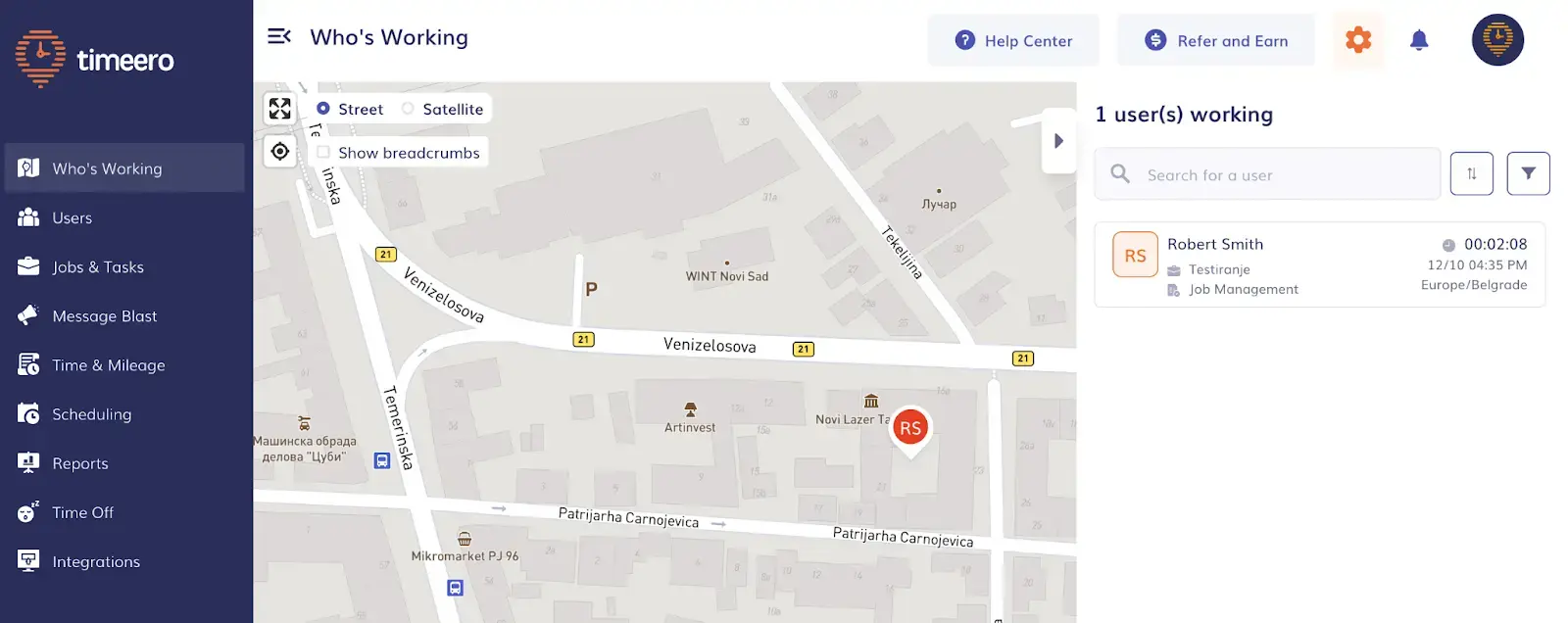
Timeero records location data with employee time entries, allowing managers to compare each punch with its recorded location and review the route captured while the employee is on the clock to investigate off-site punches and confirm that recorded hours line up with the job location.
Timeero web dashboard showing employee location and GPS context.
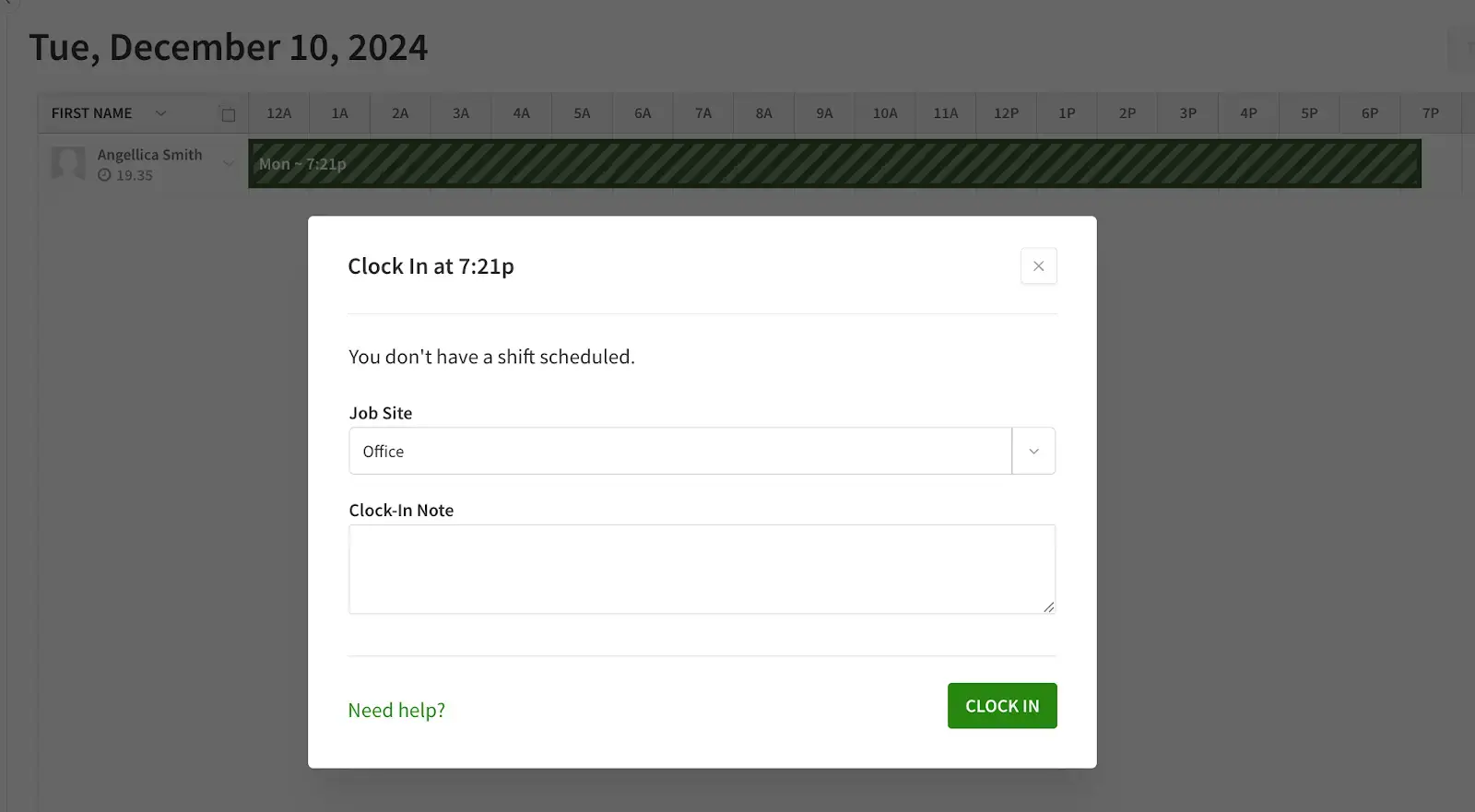
Geofences add another layer of control by creating a virtual boundary around a job site. You can use that boundary to limit where manual punches happen.
Auto Clock-In/Out goes further by using job geofences and schedules to record punches automatically when an employee arrives and leaves.
Auto Clock-In/Out
Auto Clock-In/Out reduces missed punches, automatically clocking employees in or out when they enter or depart a geofenced job site.
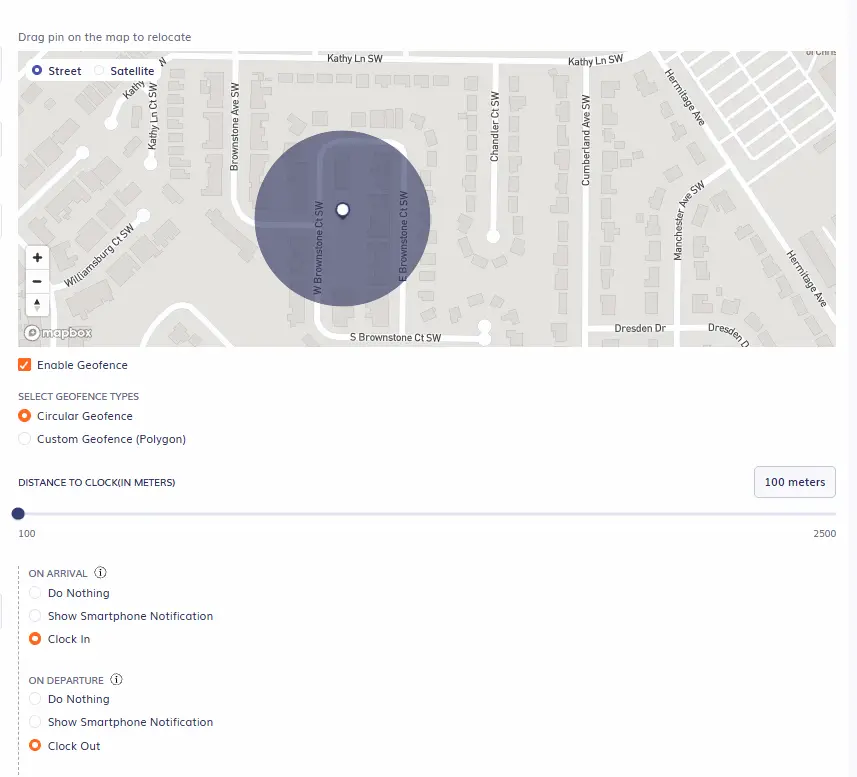
A standard geofence restriction controls where an employee can make a manual punch, while Auto Clock-In/Out creates the punch when the employee enters or leaves the configured work location.
Timeero job geofence actions with Clock In selected for arrival and Clock Out selected for departure.
Offline Tracking
Timeero continues recording clock-ins, clock-outs, GPS points, and mileage on the employee’s device when connectivity drops. All locally stored data is synced to the cloud after the phone reconnects.
For field teams working in areas with weak service, Timeero’s offline tracking helps companies prevent a poor connection from turning into a gap in timesheets that managers review later.
Mileage and Travel Between Job Sites
For employees who drive between customers or job sites, tracking mileage alongside time gives managers a clear record of what happened between one punch and the next.
Instead of reconciling a timesheet with a separate mileage log, the workday can show both labor time and job-related travel in the same system.
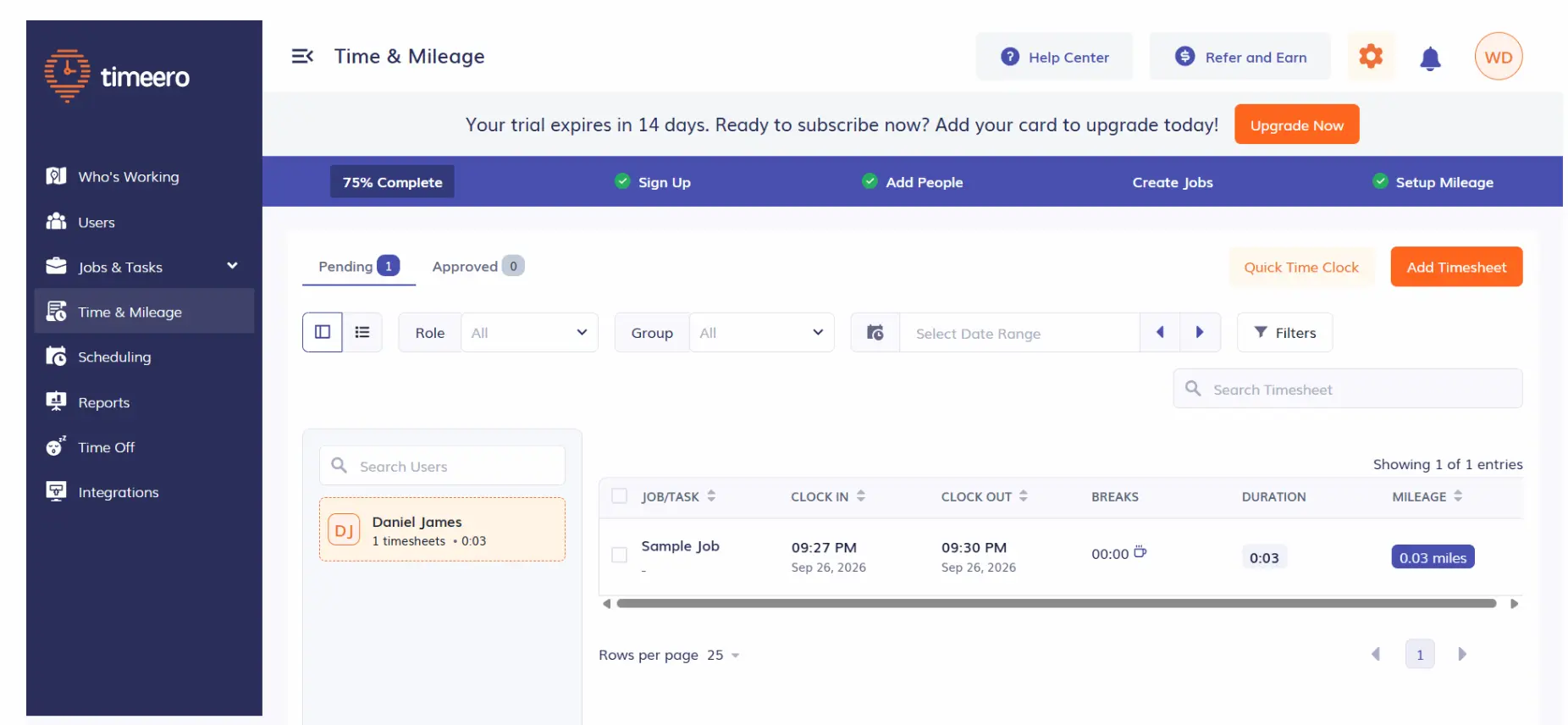
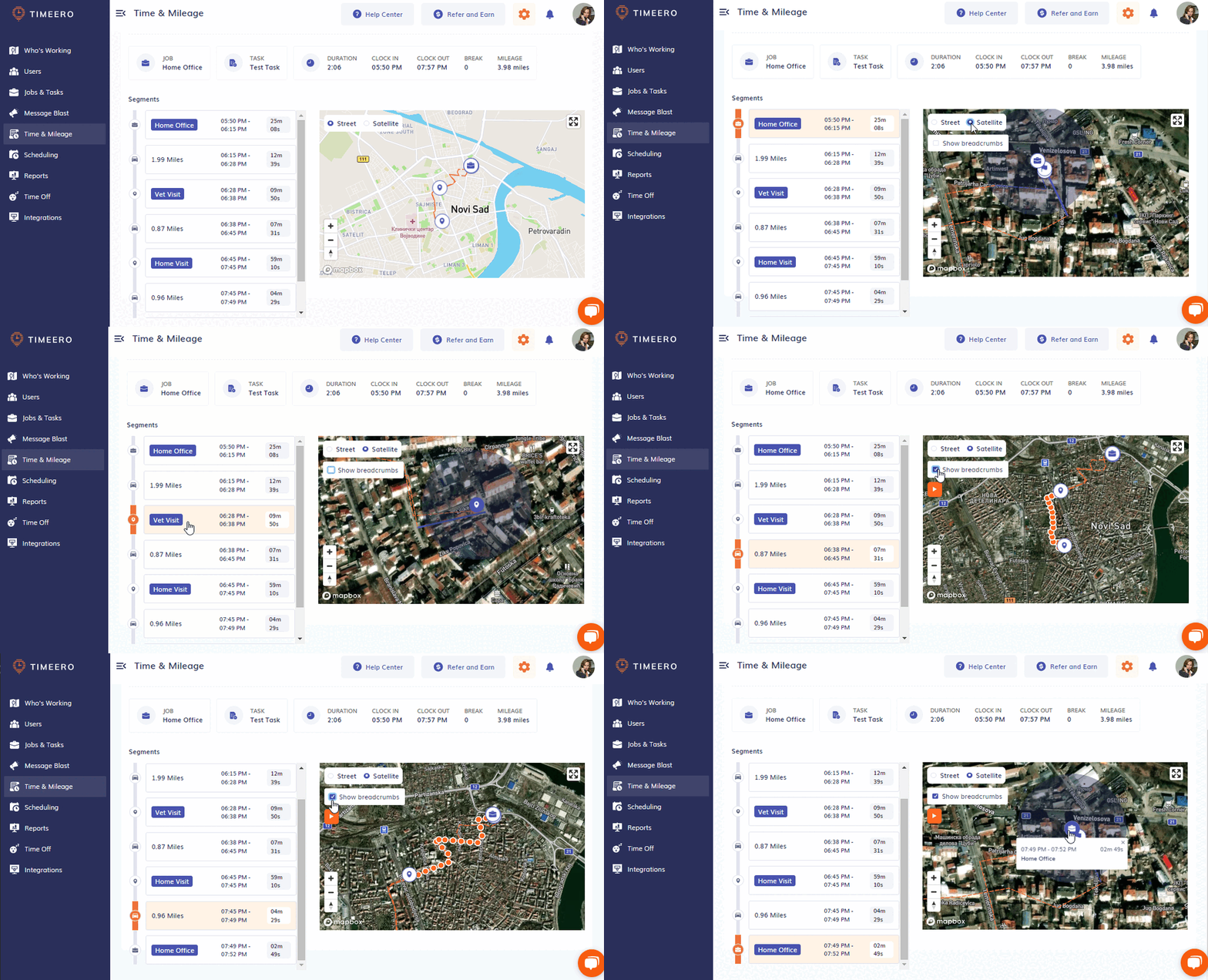
Hands-on test: the Sample Job clock-in appears in Timeero’s Time & Mileage dashboard with the recorded duration and mileage.
Segmented Tracking and Route Replay
Segmented Tracking is useful when the bigger problem is understanding how a mobile employee’s day was distributed across stops and travel. It turns one continuous workday into separate stop and drive segments, helping managers see the time spent at locations, driving time, and mileage without asking employees to manually switch jobs at every stop.
Timeero Segmented Tracking dashboard showing how a mobile workday is divided across travel and stops.
Note: Segmented Tracking and Auto Clock-In/Out are alternative Timeero workflows, so you cannot enable them together.
Integrations
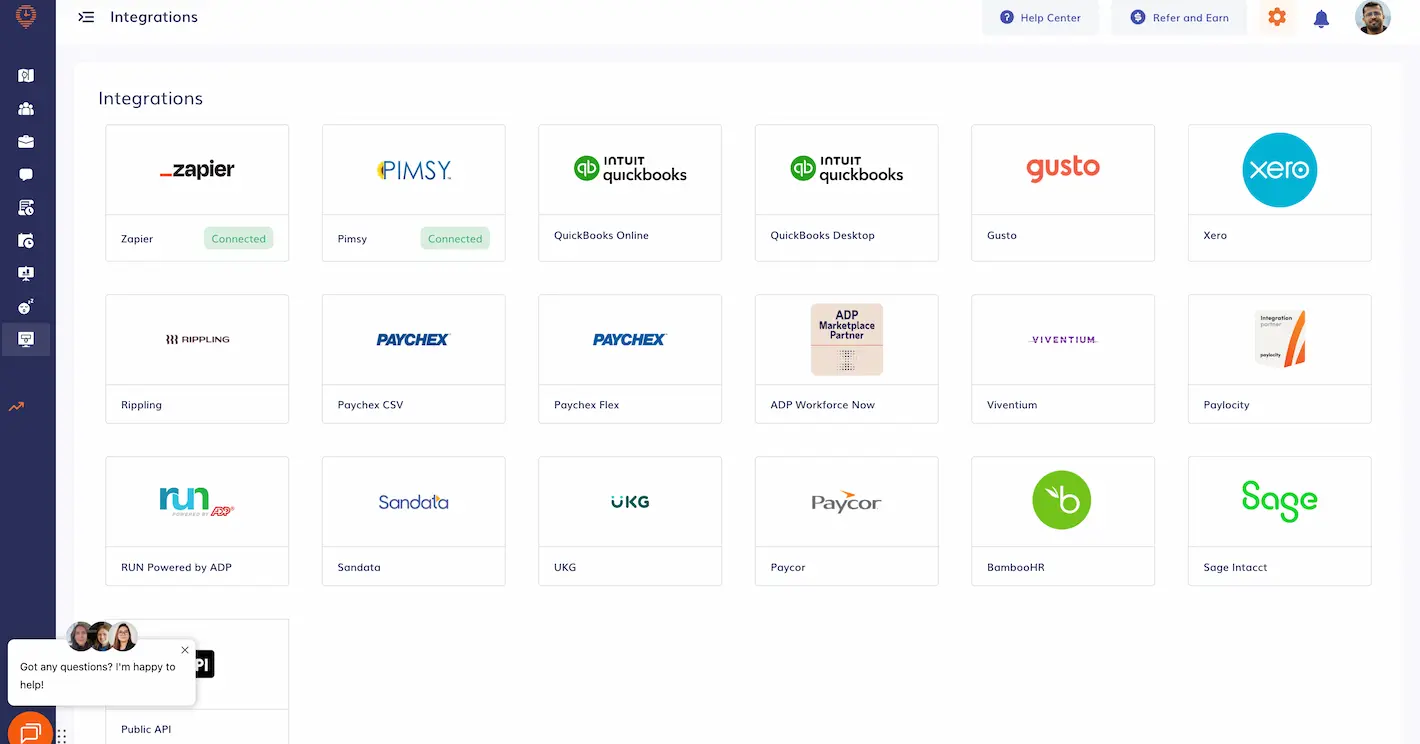
Timeero integrates with payroll and accounting platforms including QuickBooks, Gusto, ADP, Paychex, Paylocity, Rippling, Xero, BambooHR, Paycor, Sage Intacct, and Viventium.
Supported integrations can move approved employee hours, mileage, job information, and reimbursement data from Timeero into the payroll or accounting system your team already uses. That reduces duplicate entry and the errors that come with rebuilding time records by hand.
Timeero integrations dashboard showing payroll, accounting, HR, and API connections available.
Additional Timeero Features
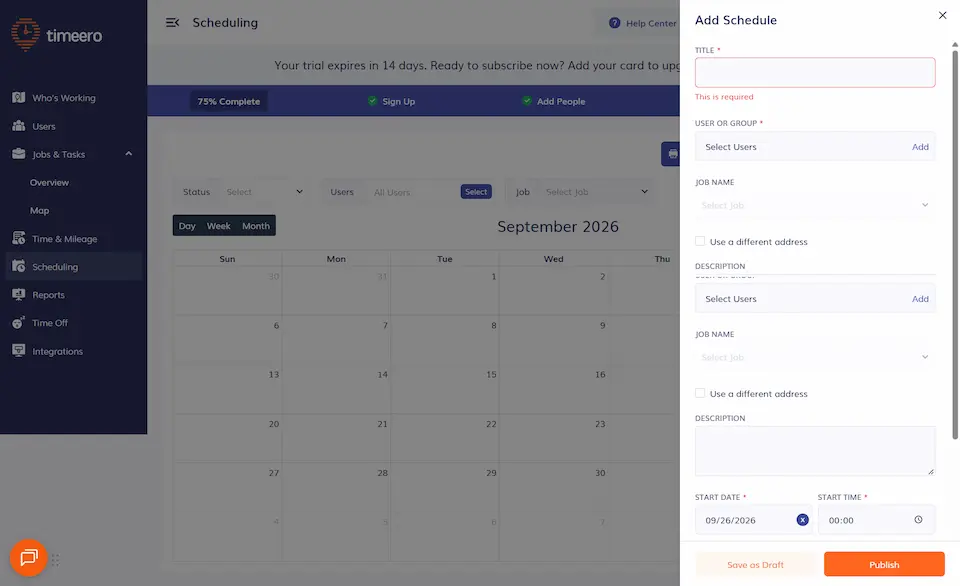
Employee scheduling: Create shifts, assign them to employees, and give workers access to their schedules from the app.
Timeero scheduling screen showing the workflow for creating and assigning an employee shift.
Jobs and tasks: Assign tracked time to specific jobs and tasks so you can see how long employees spend on each one.
Break and overtime tracking: Record employee breaks and overtime alongside regular working hours.
Paid time off: Let employees submit time-off requests and track available balances.
Photo attachments: Employees can attach photos to jobs when you need additional documentation from the field.
Electronic visit verification (EVV): Track the information home healthcare teams need for EVV workflows.
Messaging: Communicate with employees from within Timeero.
Public API: Connect Timeero with other systems when an existing native integration doesn’t cover your workflow.
Pros
Time, location, and mileage data sit in the same system.
Timeero stores clock-ins and outs made during connectivity gaps and syncs them when the device reconnects, allowing employees to keep recording time in areas with unreliable service.
GPS records where punches happen, geofencing limits manual punches to approved areas, and Auto Clock-In/Out can create punches automatically for eligible scheduled jobs, giving managers several ways to reduce inaccurate or missed entries.
Segmented Tracking gives mobile teams a different workflow when managers need to understand stops, driving time, mileage, and time spent at locations across a continuous workday.
Payroll integrations can move approved time and other supported data into major payroll and accounting systems, reducing the re-entry and manual timesheet rebuilding that otherwise happens at the end of the pay period.
Cons
Timeero offers a 14-day free trial rather than a free-forever plan, so continued use requires a paid subscription once the trial ends.
Because the Basic plan is capped at 10 users, teams with more than 10 employees need Pro or a higher plan even when the Basic feature set would otherwise cover their needs.
Segmented Tracking costs extra and cannot run at the same time as Auto Clock-In/Out.
Pricing
Plan
Monthly billing
Annual billing
Basic
$6/user/month
$5/user/month
Pro
$9/user/month
$7.50/user/month
Premium
$12/user/month
$10/user/month
Enterprise
Contact sales
Contact sales
You can try Timeero free for 14 days before choosing a paid plan.
Optional add-ons
Segmented Tracking: Starts at $5/user/month as an add-on to Pro, Premium, and Enterprise.
Messaging: $2/user/month on supported plans.
Verdict
Timeero is well suited to field and mobile teams because GPS and geofencing help managers verify where work happened, offline tracking protects time records when connectivity is unreliable, and mileage plus Segmented Tracking show the driving and stops between jobs. Teams whose employees regularly move between customers or job sites can keep those records connected to timesheets and payroll.
2. Buddy Punch: Best for configurable punch verification
Buddy Punch is an employee time clock and scheduling app with several options for controlling how and where employees clock in and out. You can capture GPS coordinates with punches, restrict punches to specific locations or devices, use webcam photos for verification, and set limits around when employees can punch.
Available on: Web, iOS, and Android.
Buddy Punch mobile time card showing employee hours alongside location data.
Punch controls and verification
Buddy Punch lets you restrict punches based on time of day, scheduled shifts, devices, IP addresses, and locations, depending on your plan.
On Pro and Advanced, you can also use webcam photos, QR codes, and PIN-based kiosk punching. Webcam photos give managers a visual record of who made each punch, while geofencing restricts clock-ins and outs to approved work locations.
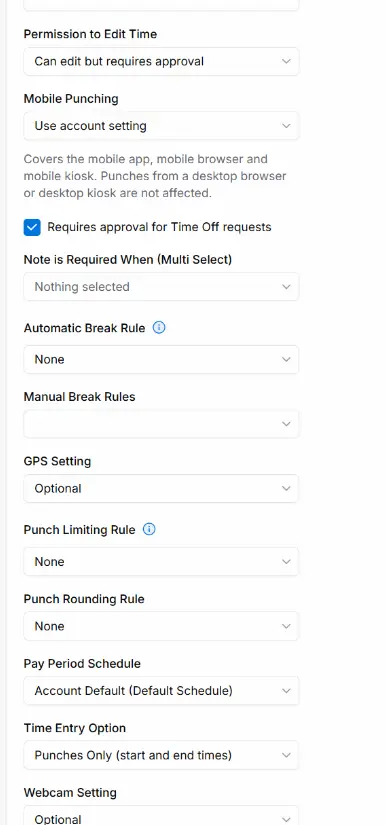
In the test account I created for this review, the employee settings also exposed separate controls for mobile punching, GPS, punch limiting, punch rounding, time entry, and webcam requirements.
Buddy Punch employee settings showing mobile punching, GPS requirements, and punch-limiting controls.
Buddy Punch can also use a geofence to restrict punches to an approved worksite. The employee still makes the punch manually, but the location rule controls where that punch can happen.
GPS tracking
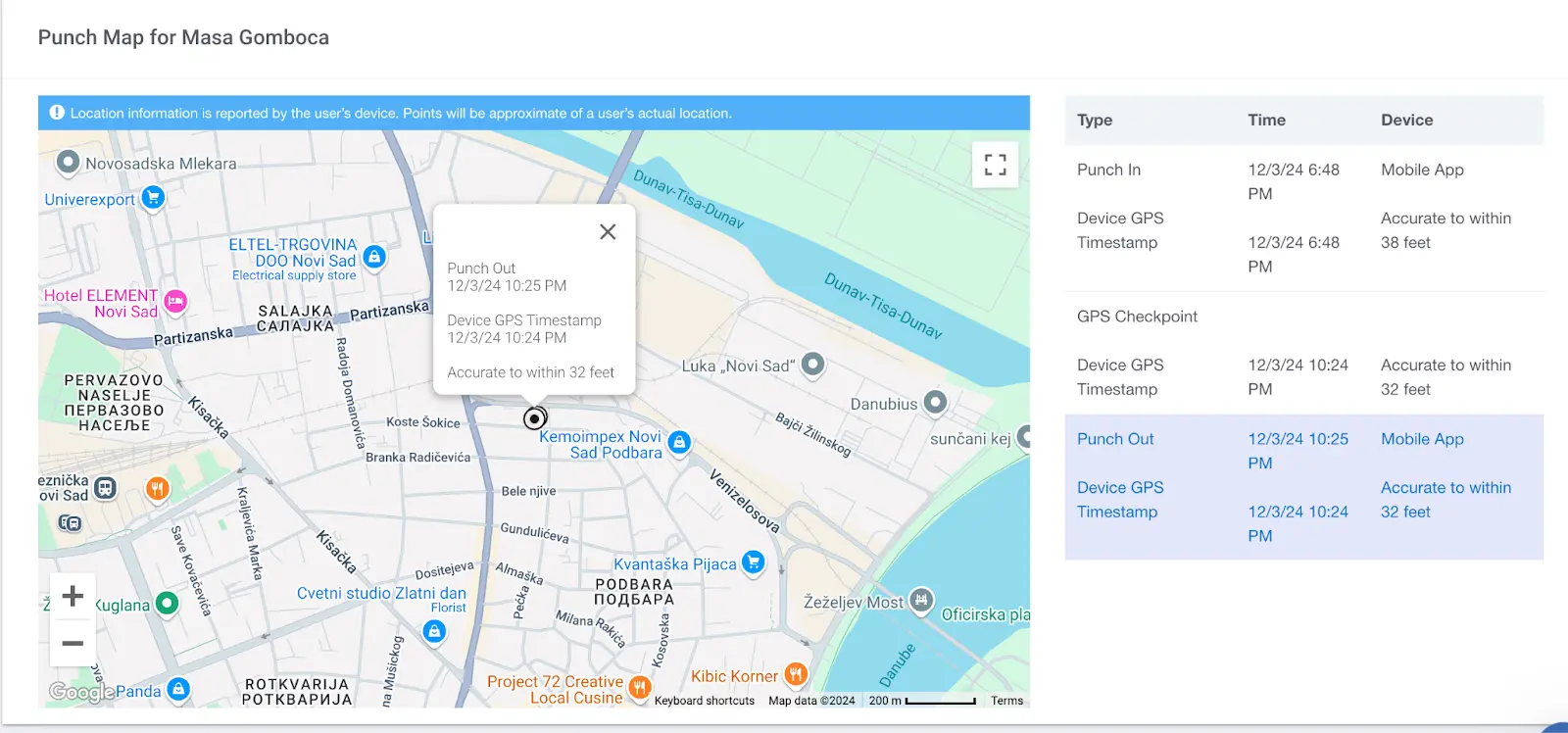
Basic GPS records an employee’s coordinates when they clock in or out.
Buddy Punch Punch Map showing GPS coordinates recorded with punch events.
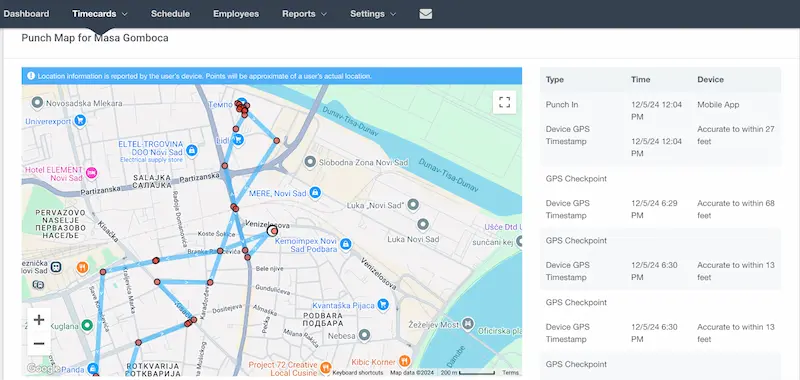
If you need to see where employees move throughout the workday, Buddy Punch also offers Real-Time GPS, which shows their locations while they’re clocked in and lets you review their routes later.
Buddy Punch Real-Time GPS route showing employee movement recorded during the workday.
Note: Buddy Punch does not provide formal mileage tracking, so teams that reimburse or cost employee travel between customers or job sites need another way to calculate those miles; Timeero includes GPS and mileage tracking in its Basic plan.
Offline time tracking
Buddy Punch lets employees on Pro and Advanced clock in and out, start or end breaks, and keep using the mobile Time Entry screen without an internet connection as long as they were already signed in, then syncs the stored actions when the connection returns.
Employee scheduling
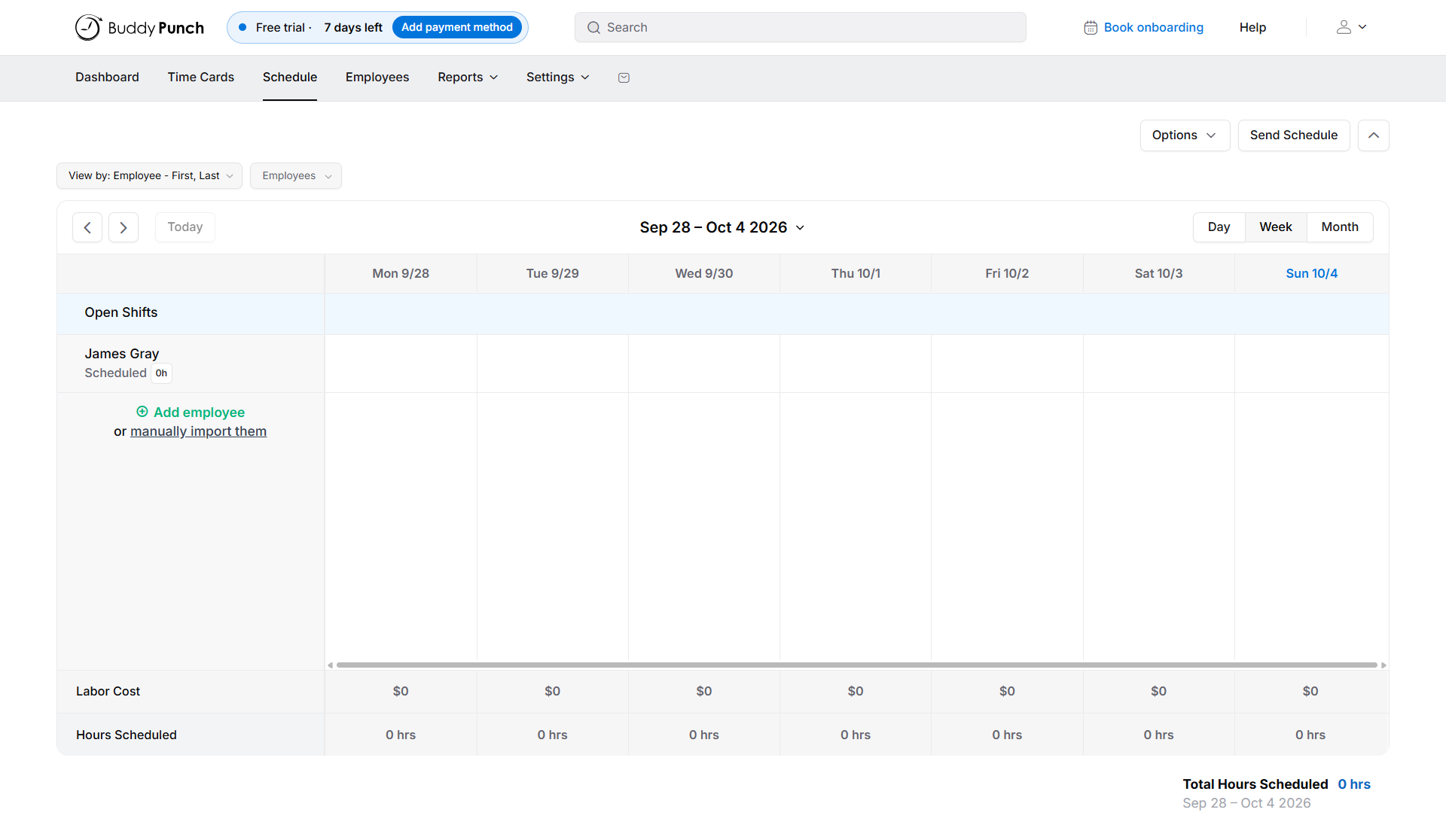
Buddy Punch lets you build recurring schedules, track employee availability, manage shift trades, and set limits around how early or late employees can punch relative to their scheduled shifts. Scheduling is included with Pro and Advanced and available as an add-on on Starter.
Buddy Punch weekly scheduling calendar showing an employee row and controls for sending the schedule.
Integrations
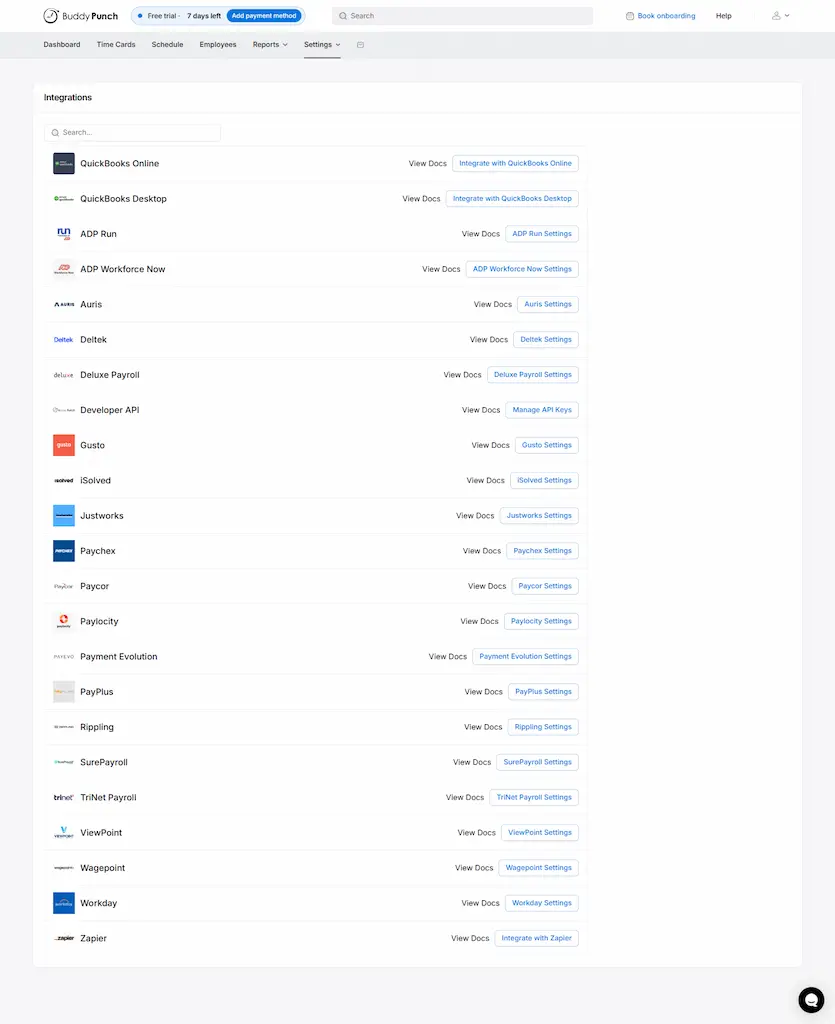
Buddy Punch integrates with payroll and accounting platforms including ADP RUN, ADP Workforce Now, Gusto, Paychex Flex, Paycor, Paylocity, QuickBooks, Rippling, Workday, and iSolved.
Some integrations transfer employee hours directly, while others require you to export the data from Buddy Punch and import it into your payroll platform, so check how the integration with your provider works before choosing a plan.
Additional Buddy Punch Features
Jobs and locations: Assign employee hours to specific jobs, projects, departments, or locations.
Time off: Track PTO balances and manage employee time-off requests.
Overtime and breaks: Set overtime rules, punch rounding, automatic breaks, and other timekeeping rules.
Alerts and reminders: Notify employees about punches, breaks, and upcoming shifts.
Timecard approvals: Let managers review and approve employee timecards before payroll.
Reporting: Generate reports for employee hours, attendance, payroll, and other time data.
Payroll: Add Buddy Punch Payroll if you want to handle payroll within the same platform.
Pros
GPS, geofencing, webcam photos, device restrictions, QR codes, and kiosk options give managers several ways to control where and how employees clock in and out and to review who made each punch.
On Pro and Advanced, employees can record punches without internet access and have those entries sync once they reconnect.
Buddy Punch works with a broad range of payroll platforms.
Real-Time GPS is available when punch locations aren’t enough.
Cons
Several useful mobile-workforce features sit above Buddy Punch’s entry tier: offline tracking and geofencing are included on Pro and Advanced, Starter users can add geofencing through Real-Time GPS, and Real-Time GPS itself costs extra on Starter and Pro.
Buddy Punch requires employees assigned to a geofence to make their punches from within it, including break punches, which can make the workflow awkward when an employee needs to step outside the approved area.
Buddy Punch’s geofences restrict where employees can punch, but they don’t automatically clock employees in or out when they enter or leave a geofence. If forgotten punches are the bigger problem for your team, Timeero’s Auto Clock-In/Out can handle those punches automatically.
Pricing
Buddy Punch’s advertised starting price is $4.99 per user per month, but that rate requires annual billing and doesn’t include the $19 monthly base fee. If you pay monthly, Starter begins at $5.99 per user per month plus the same base fee.
Plan
Monthly billing
Annual billing
Starter
$5.99/user/month + $19 base fee
$4.99/user/month + $19 base fee
Pro
$7.99/user/month + $19 base fee
$6.99/user/month + $19 base fee
Advanced
$13.99/user/month + $19 base fee
$12.99/user/month + $19 base fee
Note: Real-Time GPS is $2/user/month on Starter and Pro, scheduling is $1/user/month on Starter, and Buddy Punch Payroll costs $8/user/month plus a $49 monthly base fee.
Verdict
Buddy Punch gives managers plenty of control over how employees clock in and out, especially through geofencing, webcam photos, device restrictions, and scheduled punch rules.If your employees spend the day driving between customers or job sites and you also need mileage and travel data, Timeero covers more of that mobile workflow within the same app.
3. Clockify: Best for project-based time tracking
Clockify is a time tracking and timesheet app built around projects, clients, tasks, and billable hours. Employees can clock in with a timer, fill in timesheets manually, or use a shared kiosk, while managers can see where time goes across different projects and compare tracked hours against budgets and estimates.
Available on: Web, iOS, and Android.
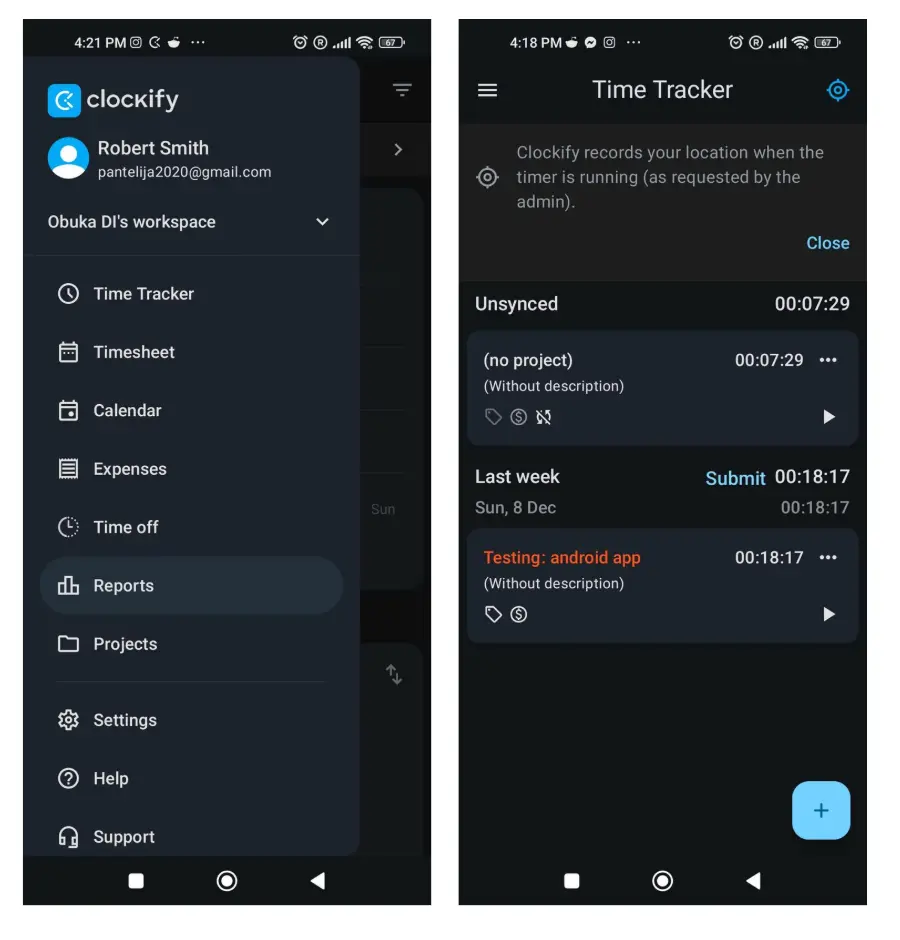
Employees can use Clockify’s mobile timer to start and stop work from their phones, which is the basic clock-in experience for mobile workers.
Clockify mobile app showing the timer and time-tracking workspace.
Project and task tracking
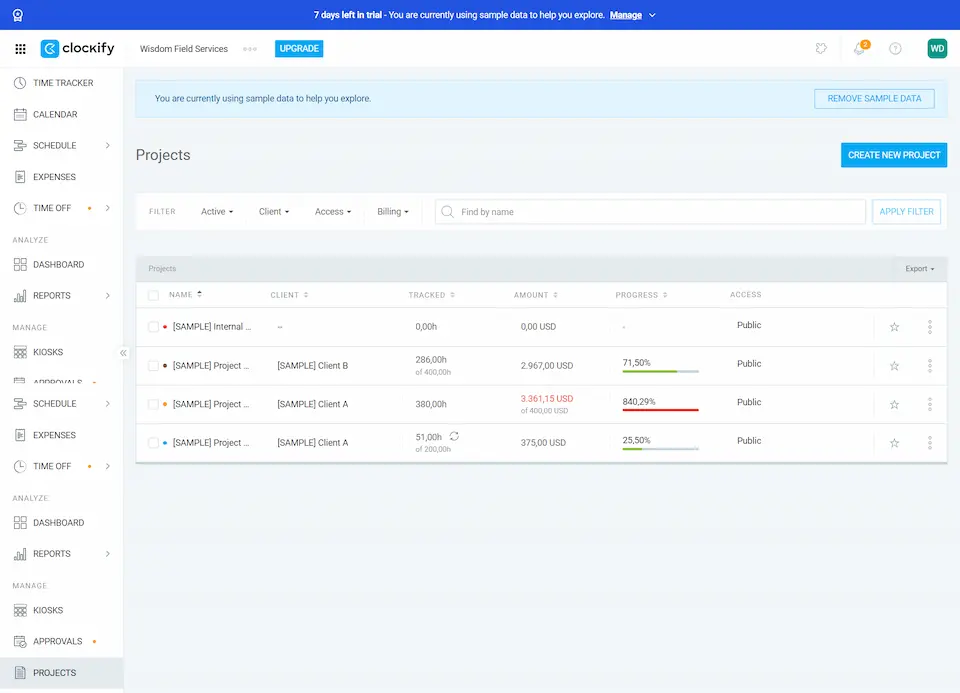
Clockify ties tracked time to clients, projects, and tasks, then lets you set estimates and budgets, mark work as billable, and use reports to see how much time the team spends on each project.
Clockify Projects view showing tracked hours, project amounts, and progress against project estimates.
GPS tracking
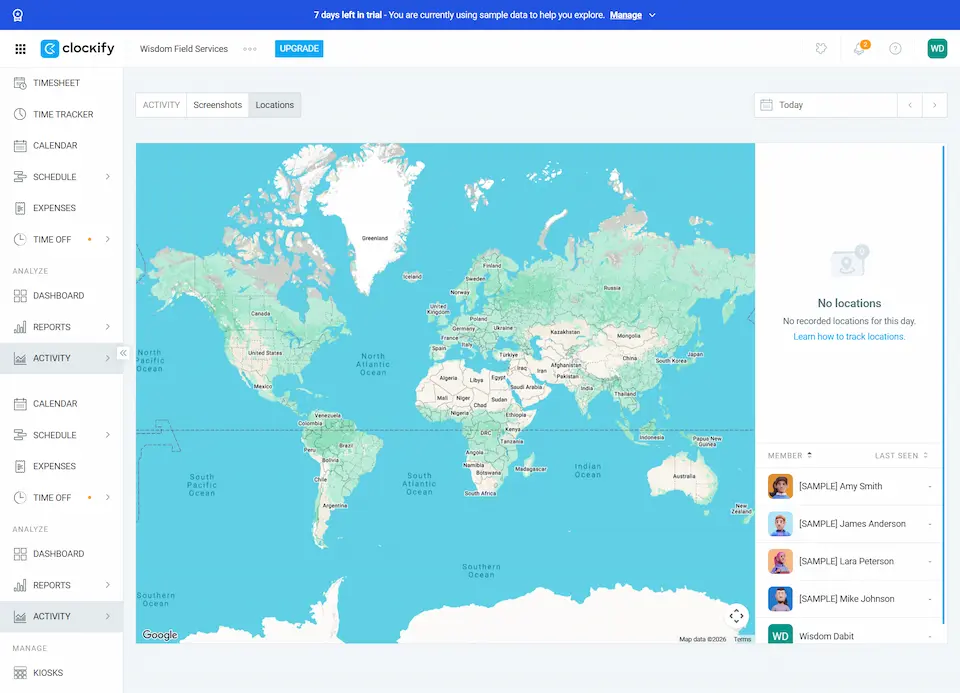
Clockify can record employee locations while they’re on the clock and show visited locations and routes on a map. GPS tracking is available on the Pro and Enterprise plans and requires employees to track time through the iOS or Android app.
Clockify Activity > Locations view, where GPS locations and route history appear when mobile location tracking records data.
Clockify does not currently offer geofencing; its public roadmap lists location-based restrictions and automatic clock-ins and outs as planned features, while Timeero already supports geofenced punch restrictions and Auto Clock-In/Out.
Offline time tracking
Employees can start and stop timers or create time entries from the mobile app without an internet connection. Clockify stores those entries locally and syncs them when the device reconnects.
Kiosk and timesheets
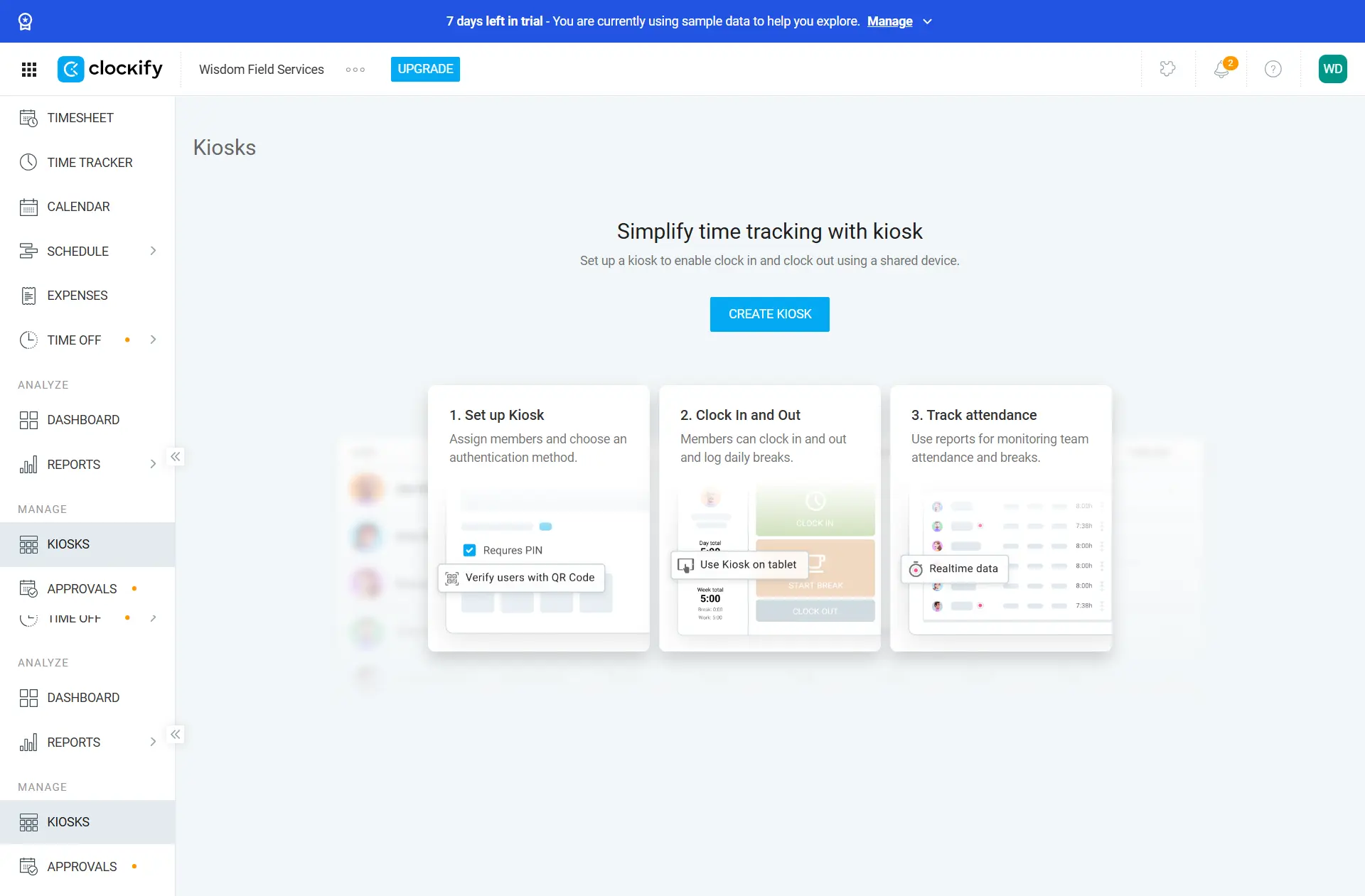
Employees can clock in and out from a shared kiosk or submit their hours through timesheets. Plan limits determine which review, editing, approval, and export controls managers can use.
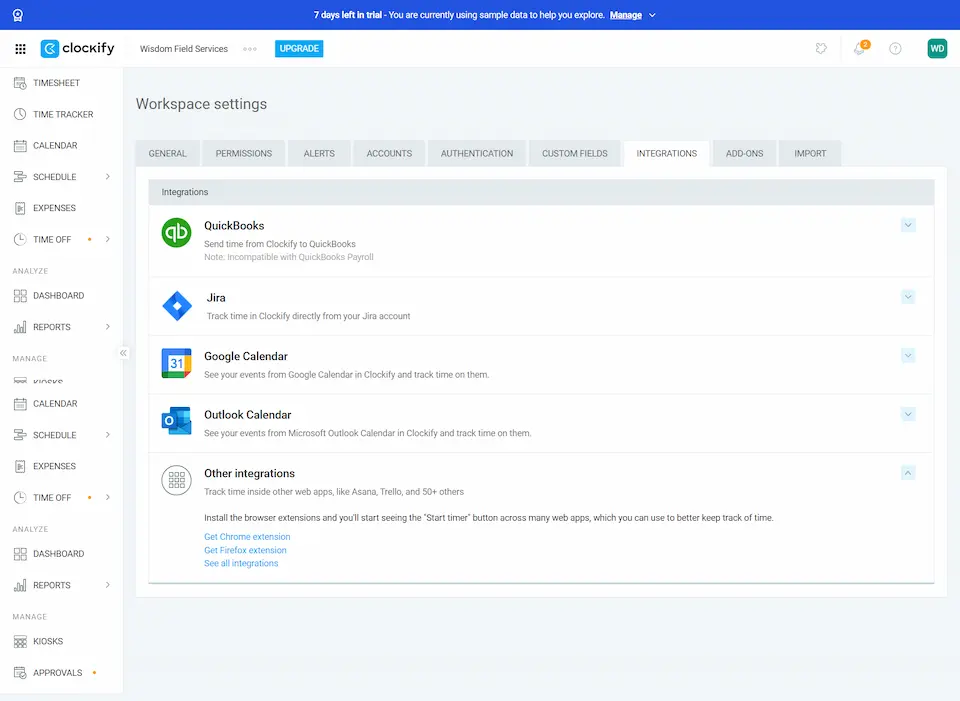
Clockify integrates with 100+ web apps, including QuickBooks, Xero, Jira, Google Calendar, Outlook, Zapier, Asana, Trello, ClickUp, Monday, GitHub, Salesforce, and HubSpot.
Clockify’s integrations work differently depending on the app: some, such as QuickBooks, can transfer time data directly, while many others use the browser extension to let employees start timers inside tools they already use.
Clockify workspace integrations showing QuickBooks, Jira, Google Calendar, Outlook Calendar, and browser-extension integrations.
Additional Clockify Features
Scheduling: Plan shifts, assignments, and employee capacity.
Time off: Manage employee leave balances and requests.
Expenses: Record work expenses and attach receipts.
Invoicing: Create invoices from tracked billable time.
Approvals: Review and approve employee timesheets and expenses.
Reports: Analyze tracked time, costs, billable hours, and project profitability.
Auto tracker: Record computer activity so users can later turn it into time entries.
Pros
Clockify is strong for teams that need to know where time goes across projects.
Employees have several ways to record time.
Offline tracking is available on mobile.
It has a large integration ecosystem.
Cons
GPS tracking requires Pro or Enterprise.
Clockify doesn’t currently offer geofencing.
A March 2026 G2 reviewer who uses Clockify in the office and in the field reported that the mobile app sometimes fails to sync properly with the desktop app, which can make the mobile and desktop records fall out of step.
Pricing
Clockify’s free plan is still free, but it is now capped at five users instead of offering unlimited users.
Plan
Monthly billing
Annual billing
Free
$0 for up to 5 users
$0 for up to 5 users
Basic
$4.99/user/month
$3.99/user/month
Standard
$6.99/user/month
$5.49/user/month
Pro
$9.99/user/month
$7.99/user/month
Enterprise
$14.99/user/month
$11.99/user/month
Note: Clockify also offers lower-priced limited seats for employees who only use the kiosk, starting at $0.79 per seat per month with annual billing on Basic.
Verdict
Clockify makes the most sense for teams that want to connect employee time to projects, clients, tasks, budgets, and billable work. For mobile teams that need geofencing, automatic clock-ins and outs, mileage tracking, and more detail around travel between job sites, Timeero is the better fit.
4. ClockShark: Best for job and crew time tracking
ClockShark is built for construction, trades, and other field-service businesses that need to track employee time against specific jobs and tasks. Alongside clock-ins and outs, you can monitor employee locations, schedule field work, and use recorded hours for job costing.
Available on: Web, iOS, and Android.
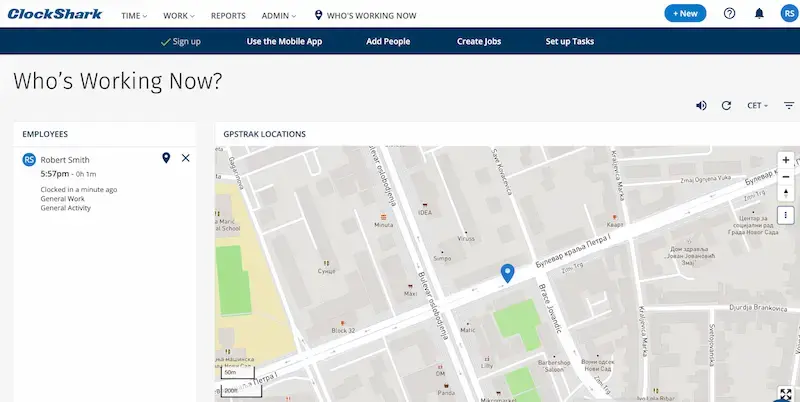
ClockShark Who’s Working Now map showing employee locations in the web dashboard.
Job and task tracking
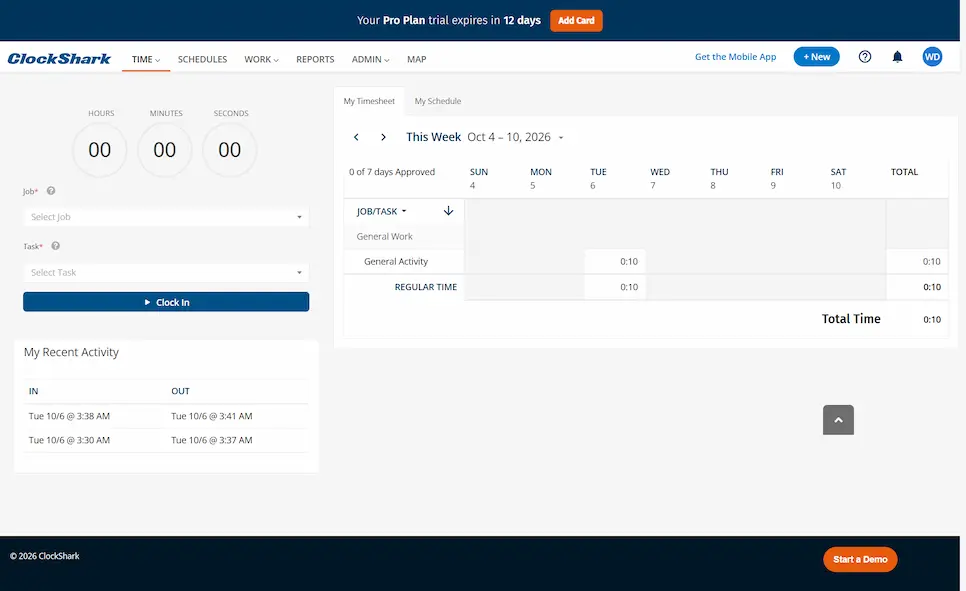
Employees can clock into specific jobs and tasks from the field, so their hours stay tied to the work they actually performed. Managers can then use that data for timesheets, labor reporting, and job costing rather than trying to allocate hours after the fact.
ClockShark My Timesheet view showing tracked time tied to the General Work job and General Activity task.
GPS tracking
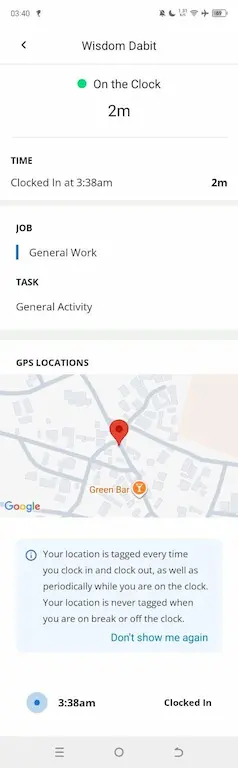
ClockShark records employee locations throughout the workday while they’re clocked in and gives managers a breadcrumb trail of where they’ve been.
ClockShark mobile timesheet details showing GPS locations recorded while the employee is on the clock.
Geofencing
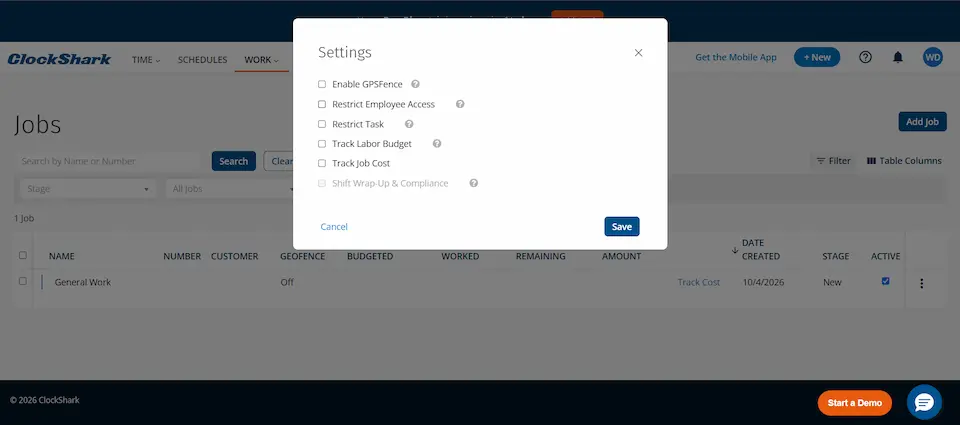
ClockShark lets you create geofences around job sites that can remind employees to clock in, clock out, or switch tasks when they cross the boundary and flag punches made outside the approved area.
ClockShark job settings showing the Enable GPSFence control used to apply geofencing to a job.
Offline time tracking
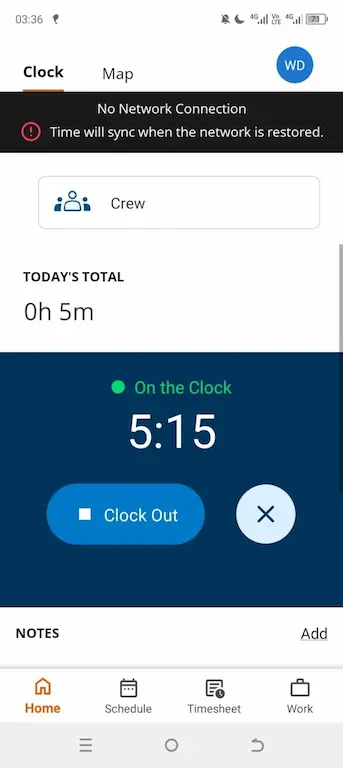
ClockShark lets employees stay clocked in and keep recording time without a network connection. The mobile app shows that time will sync once the connection is restored.
ClockShark mobile app continuing to track time offline and indicating that records will sync when the network is restored.
Mileage tracking
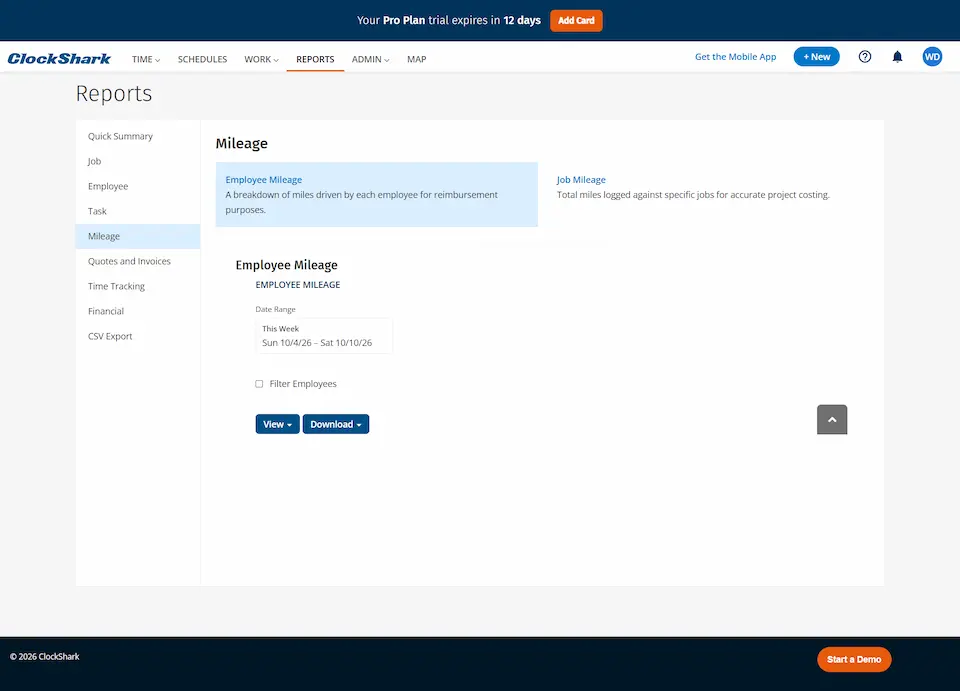
ClockShark’s mileage reports separate employee reimbursement from project costing:
Employee Mileage breaks down miles driven by each worker, while Job Mileage shows the miles logged against specific jobs.
ClockShark Mileage reports for employee reimbursement and job-level project costing.
Integrations
ClockShark integrates with payroll and accounting platforms including QuickBooks, ADP, Sage 100 Contractor, Xero, Gusto, Paychex, Paylocity, Simpro, MYOB, and Zapier.
These integrations let you move approved time into payroll or accounting systems and reduce the amount of employee and job data you need to enter again manually.
ClockShark integrations page showing connections for QuickBooks, ADP, Xero, Sage, Gusto, Paychex, Paylocity, Simpro, MYOB, and Zapier.
Additional ClockShark Features
Employee scheduling: Create and update schedules and assign employees to jobs and tasks.
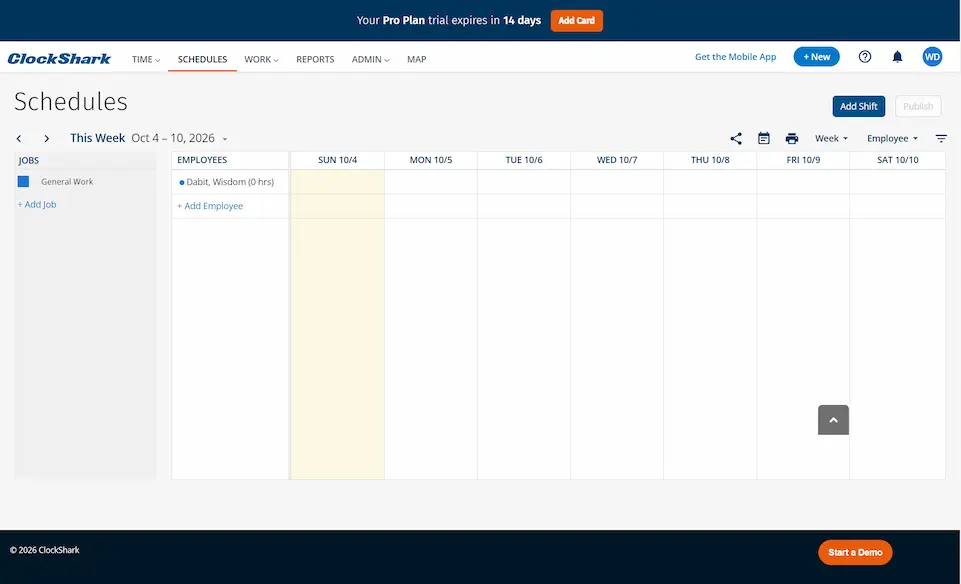
ClockShark weekly schedule showing a job and employee ready for shift assignment.
Who’s Working Now: View currently clocked-in employees and their locations on a map.
Time off: Create sick and vacation policies and manage employee leave.
Clock-out questions: Collect job details or status updates when employees finish a shift.
Job notes and attachments: Share photos, files, and job information between field employees and the office.
Task Checklists: Create job checklists that appear when employees clock into a task and timestamp completed items.
JobReady: Give employees an AI-generated brief based on their schedule, job details, notes, and attachments before they start work.
Pros
ClockShark is built around field jobs rather than generic employee attendance.
GPS and geofencing help managers verify where field punches happened and whether employees were at the expected job site.
Time and GPS continue working offline.
Scheduling and job information sit alongside time tracking.
Cons
ClockShark’s current pricing page states that all plans require a three-year contract, which is a significant commitment for teams that prefer month-to-month flexibility.
By the way: ClockShark’s geofences can remind employees to clock in, clock out, or switch tasks when they enter or leave a job site, but the employee still makes the punch manually; Timeero’s Auto Clock-In/Out can create that punch automatically.
ClockShark’s mileage workflow still depends on employees entering their mileage at clock-out, while Timeero can track mileage automatically as employees travel between job sites.
Pricing
ClockShark’s current published pricing starts at $42 per month plus $9.5 per user for Standard and $63 per month plus $11 per user for Pro. Its pricing page also states that a three-year contract applies to all plans.
Plan
Pricing
Standard
$42/month + $9.50/user/month
Pro
$63/month + $11.50/user/month
ClockShark offers a 14-day free trial with Pro features and doesn’t require a credit card to start.
Verdict
ClockShark is a strong fit for field businesses that want employee time tied closely to jobs, tasks, schedules, and labor costs. If you also want automatic mileage and trip details or automatic punches when employees enter and leave job sites, Timeero handles those workflows with less employee input.
5. Connecteam: Best for time tracking within a broader workforce management platform
Connecteam is a workforce management platform for deskless teams, with time tracking alongside scheduling, forms, tasks, communication, training, and other employee-management tools. Its Time Clock sits inside the Operations Hub, making it useful for teams that want to manage more of their workforce from one platform instead of using a standalone time clock.
Available on: Web, iOS, and Android.
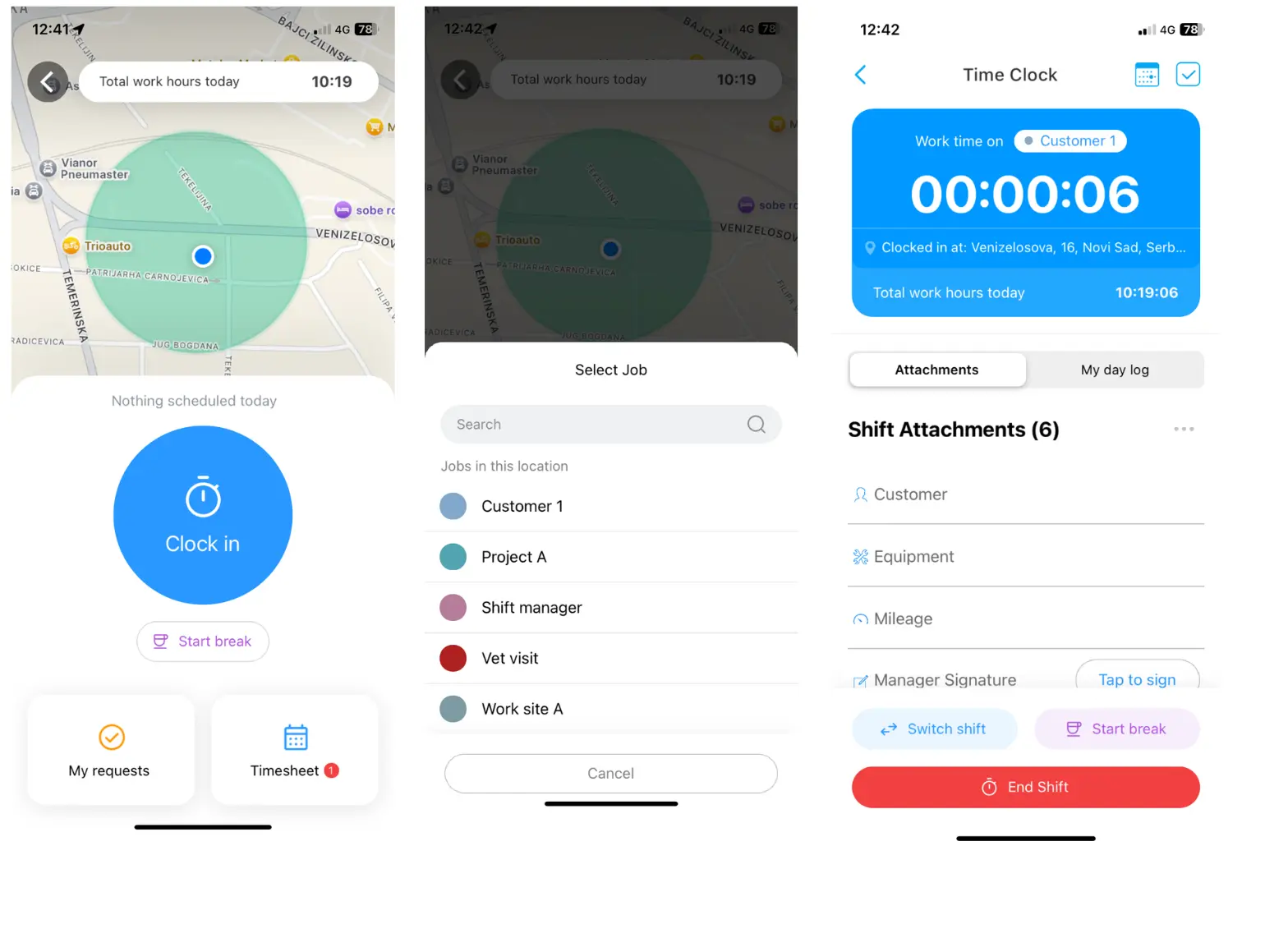
For employees, Connecteam’s mobile Time Clock provides the day-to-day clock-in and clock-out interface before managers review hours and location data in the web dashboard.
Connecteam mobile Time Clock showing clock-in controls and location-based time tracking.
Flexible clock-in options
Employees can clock in and out from the mobile app, desktop, a shared kiosk, or using NFC. You can also assign time to specific jobs and collect additional information from employees during or at the end of a shift.
GPS tracking
Connecteam can record an employee’s location when they clock in or out, while Breadcrumbs provides location trails while employees are clocked in and moving.
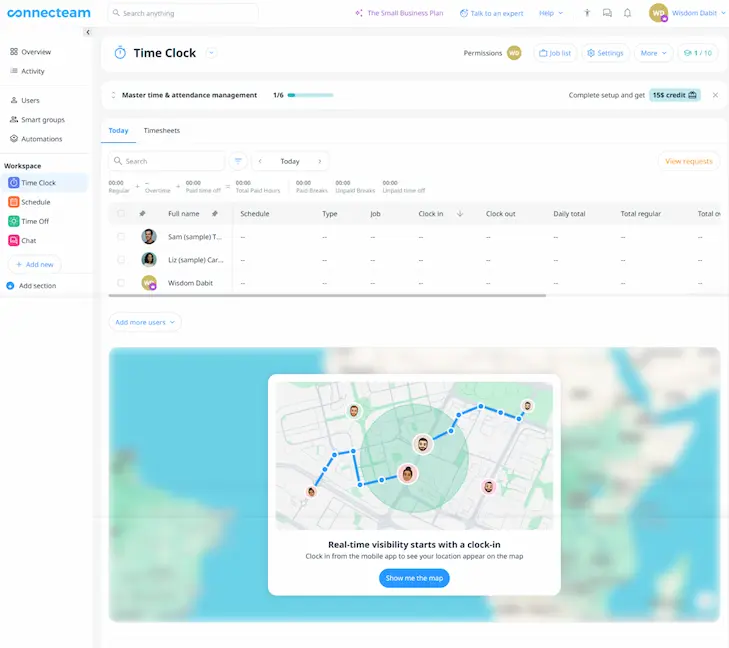
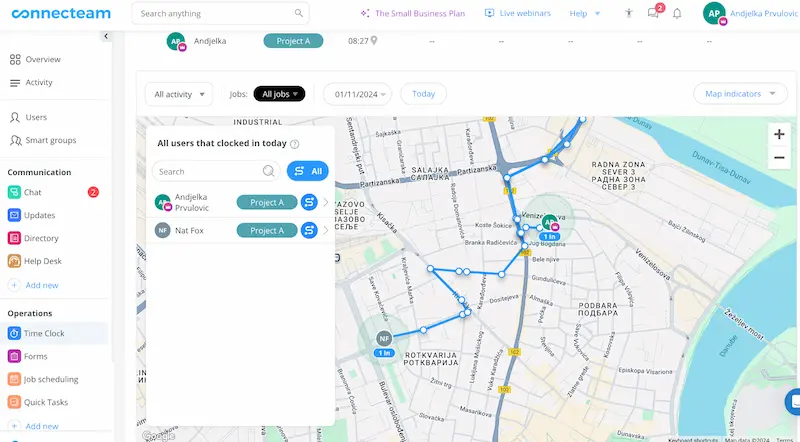
Connecteam Time Clock dashboard showing attendance records and the location-visibility workspace.
The web map lets managers review employee location and route visibility from the desktop dashboard while those employees are on the clock.
Connecteam web map showing employee location and route visibility.
Geofencing
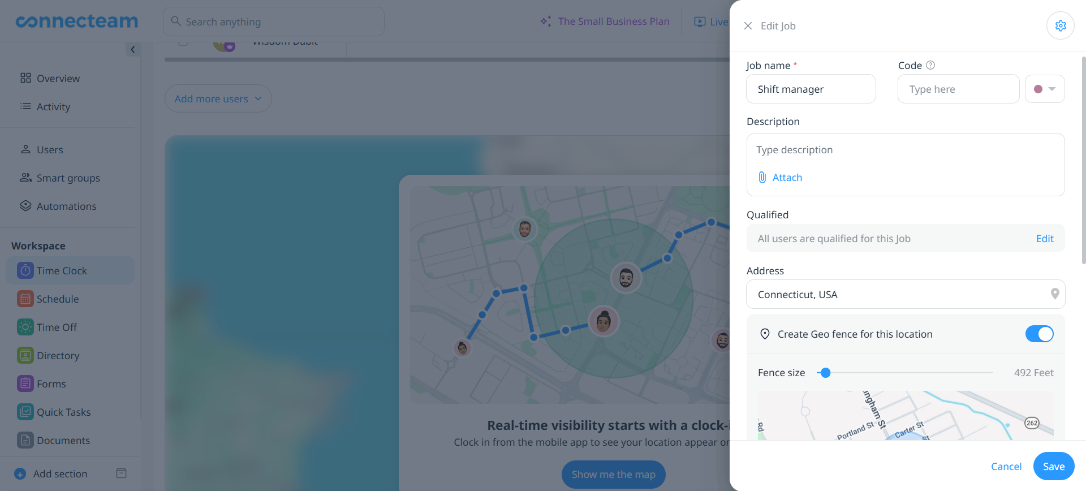
You can create a geofence around a job location and use it to control where employees are allowed to clock in and out. Connecteam also supports location alerts and stronger geofence controls on higher Operations plans.
Connecteam job settings with a worksite address, geofence enabled, and an adjustable fence radius.
On the Operations Expert plan, Connecteam can go further and automatically clock an employee out after they leave a geofenced worksite.
Job scheduling
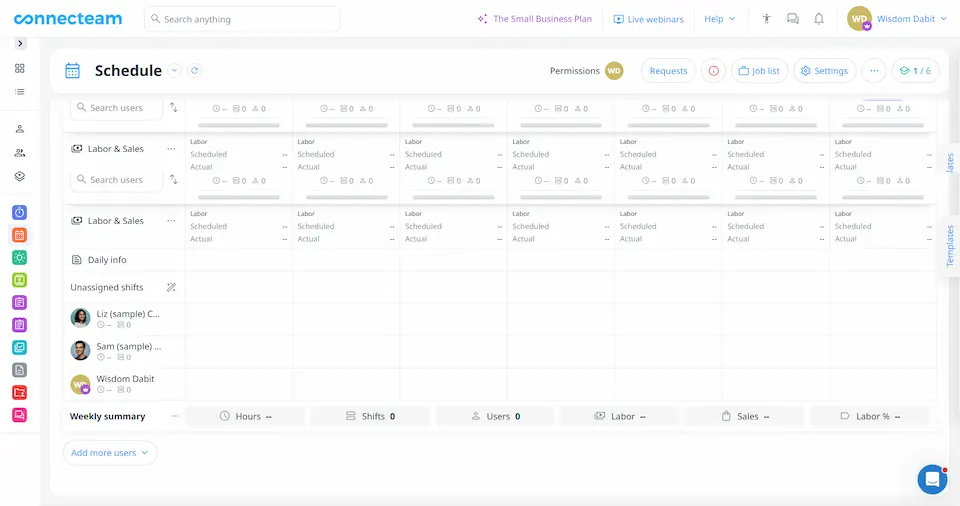
Connecteam’s scheduler sits alongside its Time Clock, so you can create and assign shifts, attach jobs to schedules, manage open shifts, and have employees clock directly into the work they’ve been assigned.
Connecteam Schedule view for assigning employees and jobs across the week.
Forms and tasks
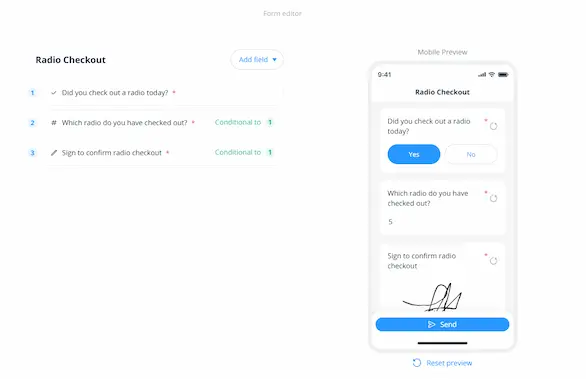
The Operations Hub also includes Forms and Quick Tasks, so field teams can use the same platform for checklists, job updates, inspections, and one-off task assignments.
Connecteam Forms workspace, where teams can create and assign digital forms for field workflows.
Integrations
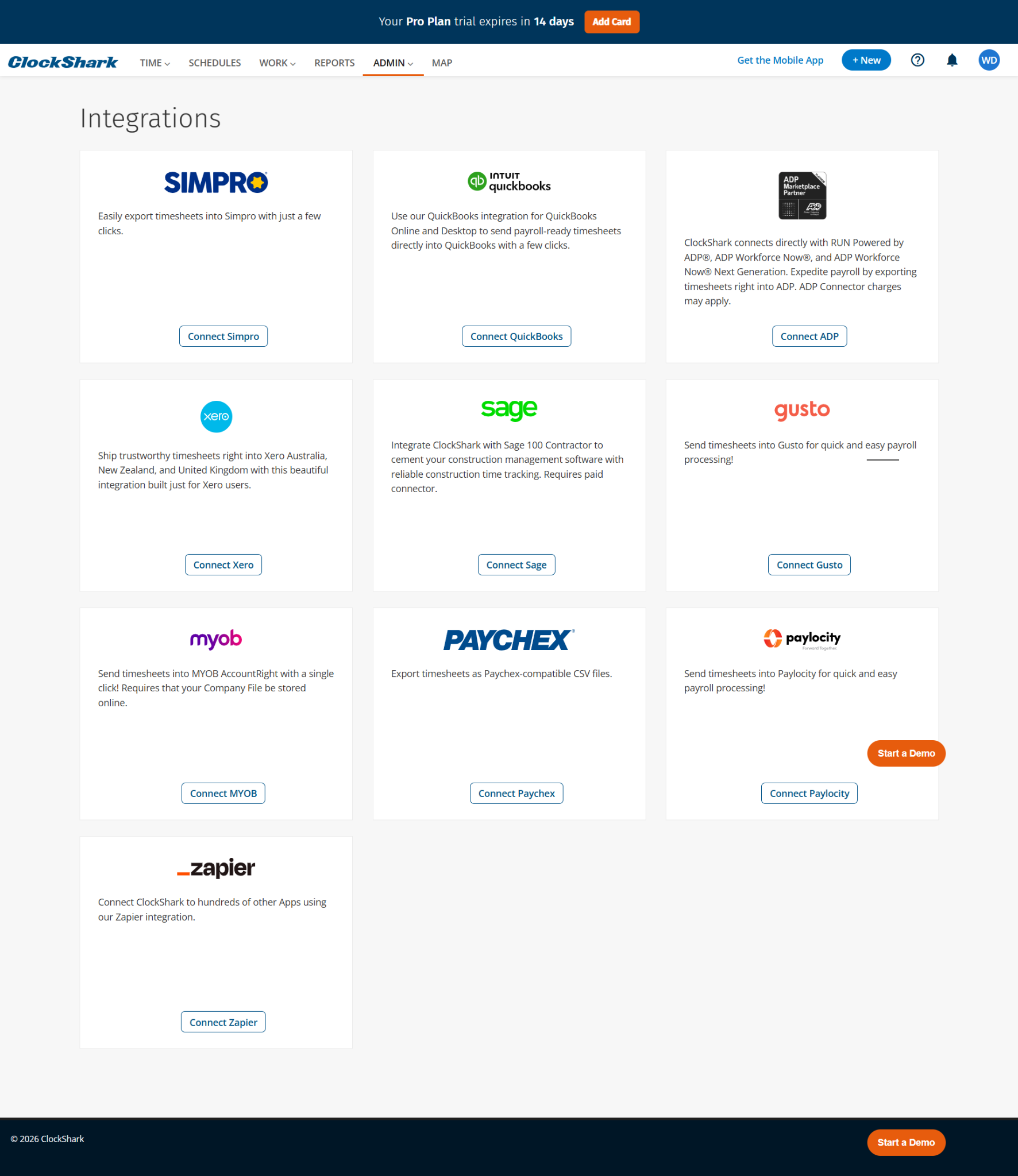
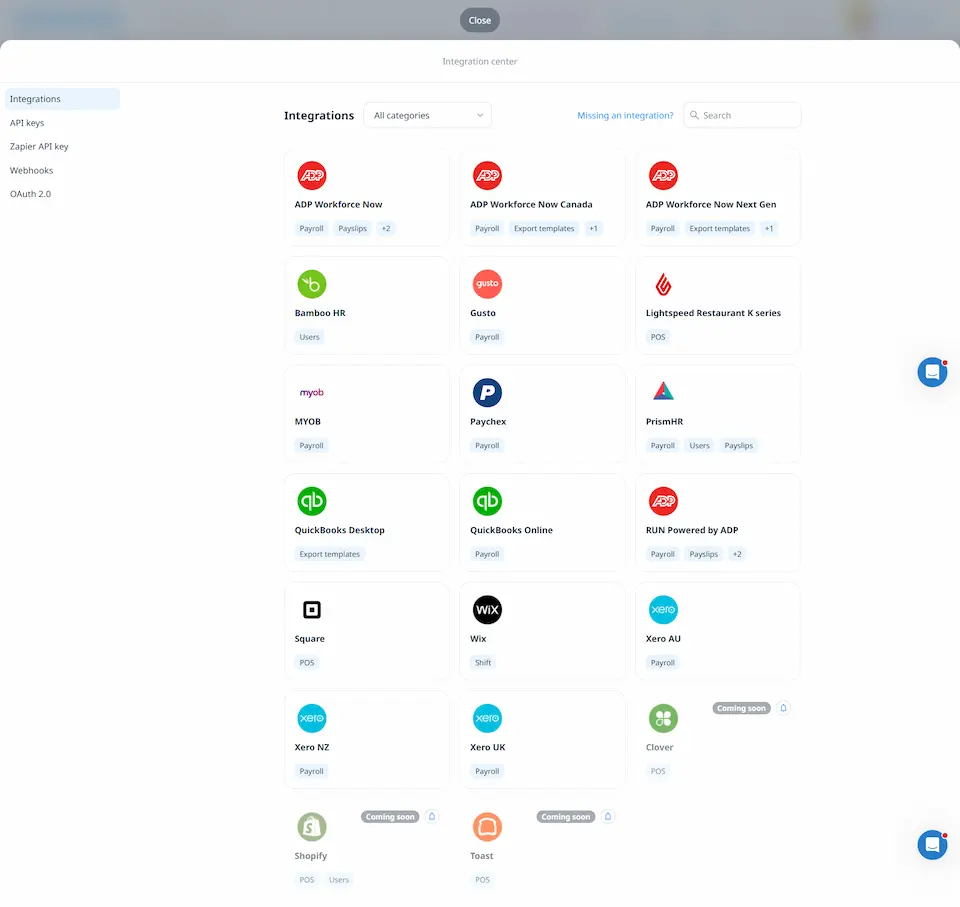
Connecteam’s Integration Center includes payroll and workforce connections such as QuickBooks Online, QuickBooks Desktop export templates, Gusto, Paychex, PrismHR, MYOB, ADP Workforce Now, RUN Powered by ADP, and regional Xero integrations, alongside other HR and POS connections.
Connecteam Integration Center showing payroll, HR, POS, and export integrations including ADP, Gusto, Paychex, QuickBooks, Xero, and MYOB.
Additional Connecteam Features
Team communication: Chat, company updates, directories, surveys, and events.
Time off: Manage leave requests, balances, and policies.
Training and onboarding: Build courses, quizzes, and employee onboarding workflows.
Documents: Store and manage employee documents and e-signatures.
Checklists and forms: Digitize recurring field reports, inspections, and other paperwork.
Quick Tasks: Assign and track one-off employee tasks.
Recognition and rewards: Run employee recognition and reward programs.
Knowledge base: Give employees access to internal information from the app.
Pros
Connecteam covers much more than employee time tracking.
Its location tools go beyond a GPS stamp at clock-in.
There are several ways for employees to punch.
Small teams have free options.
Cons
Connecteam’s mobile app, Kiosk app, desktop Time Clock, and in-product NFC clocking require an active internet connection to clock in or out, so teams that regularly lose service cannot rely on the standard Time Clock offline; Timeero can store offline punches and sync them after reconnection.
Connecteam does not currently record mileage automatically, so teams have to collect it through a field such as a required shift entry before clock-out; Timeero can track mileage automatically alongside employee travel.
Connecteam gates some of its stronger location controls behind higher plans, with geofencing starting above the entry tier and location-triggered Auto Clock-Out requiring Expert.
Pricing
Connecteam’s pricing looks simple until you start working out which hub and plan contains the features you need. The platform is split into Operations, Communications, and HR & Skills hubs, and each hub has its own tiers.
Connecteam’s clock-in and clock-out features sit in the Operations Hub, whose paid plans cover the first 30 users at a fixed monthly rate before adding a per-user charge for larger teams.
Operations plan
Monthly billing
Annual billing
Basic
$35/month for first 30 users + $1/additional user
$29/month for first 30 users + $0.80/additional user
Advanced
$59/month for first 30 users + $3/additional user
$49/month for first 30 users + $2.50/additional user
Expert
$119/month for first 30 users + $5/additional user
$99/month for first 30 users + $4.20/additional user
Enterprise
Custom
Custom
Connecteam offers a 14-day free trial without a credit card, while annual plans are paid upfront.
Verdict
Connecteam fits teams that want time tracking inside a broader system for scheduling, tasks, forms, communication, training, and workforce management. If reliable offline punches and automatic mileage tracking matter more to your mobile team, Timeero handles both without requiring employees to manually reconstruct that information later.
6. When I Work: Best for time tracking alongside employee scheduling
When I Work is built primarily around employee scheduling, with time and attendance tools connected to the shifts employees are already expected to work. Managers can build schedules, manage open shifts and availability, track attendance, and send approved hours to payroll from the same platform.
Available on: Web, iOS, and Android.
When I Work web dashboard showing the employee time-clock workspace.
Employee scheduling
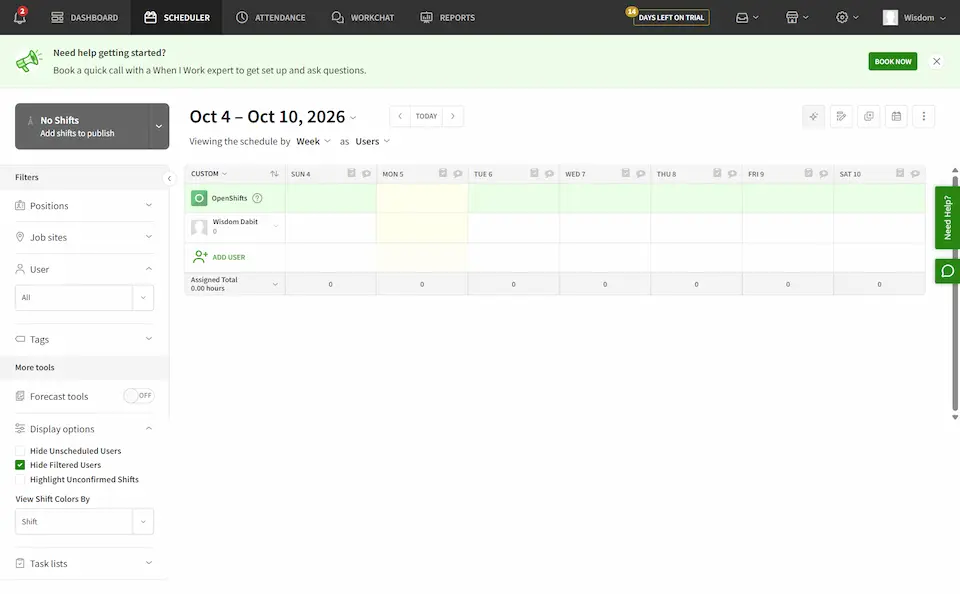
When I Work lets managers create recurring schedules, reuse templates, publish OpenShifts, manage availability and time-off requests, and automatically build schedules based on employee availability and qualifications.
When I Work scheduler showing the weekly schedule, OpenShifts, employee rows, and scheduling controls.
Time clock and location restrictions
Employees can clock in and out from the mobile app, a personal computer, or a shared Time Clock Terminal. You can also restrict punches to a radius around a scheduled location or job site, preventing employees from clocking in or out when they’re too far away.
When location restrictions are enabled, When I Work records the employee’s location at clock-in and clock-out. It does not continue collecting their location throughout the shift.
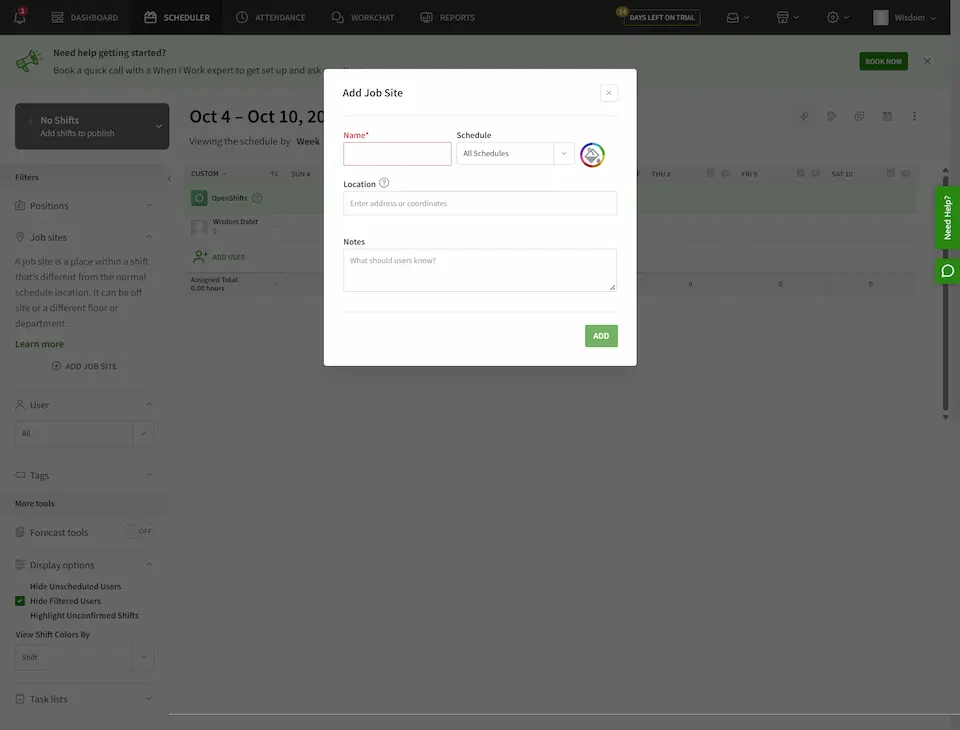
When I Work job-site setup lets managers add a named work location to a schedule.
The mobile app lets employees review their time entries and shift history after clocking in and out under those location rules.
When I Work mobile app showing time entry and shift history.
By the way: When I Work’s location restrictions don’t automatically clock employees in or out when they arrive at or leave a worksite. Employees still have to make the punch themselves. Timeero’s Auto Clock-In/Out can automate that process based on a job-site geofence.
Timesheets and attendance
Managers can compare scheduled and worked hours, review timesheet edits, manage breaks and overtime, and approve employee time before sending it to payroll.
Team communication
WorkChat lets managers and employees communicate directly within When I Work, while schedule changes, OpenShifts, and other updates can trigger notifications automatically.
Integrations
When I Work currently supports payroll integrations with Rippling, Gusto, Paychex, QuickBooks Online, and Square, alongside several third-party integrations.
When I Work stopped offering its direct ADP Workforce Now integration to new customers after June 2026. Existing customers that already had the integration enabled can continue using it.
Additional When I Work Features
OpenShifts and shift swapping: Let employees claim available shifts or exchange shifts with coworkers.
Employee availability: Collect recurring availability and use it when building schedules.
Time off: Manage employee time-off requests alongside the schedule.
Auto Scheduling: Generate schedules based on employee availability and qualifications.
Labor forecasting: Compare staffing levels and labor costs against expected demand.
Custom reporting: Build more detailed workforce reports on higher plans.
Labor sharing: Share qualified employees between schedules and locations on supported plans.
Pros
Scheduling and time tracking work closely together.
Employees have several ways to clock in and out.
Location restrictions can reduce off-site punches.
Shift management is a major strength.
Cons
When location restrictions are enabled, When I Work records an employee’s location at clock-in and clock-out but does not track movement throughout the workday, while Timeero can provide a GPS trail for the period the employee is on the clock.
When I Work’s location restrictions can control where punches happen, but employees still have to remember to clock in and out when they arrive at or leave a location.
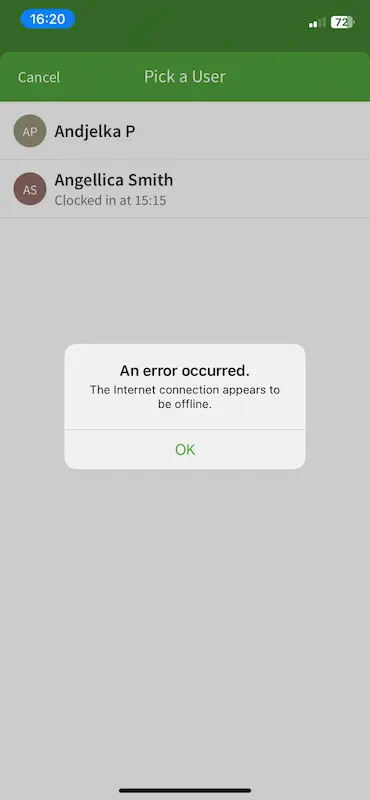
Because When I Work needs both a reliable GPS signal and an internet connection to verify location-based punches, employees can be unable to clock in or out when either is unavailable.
When I Work mobile app showing an error when the internet connection is offline.
When the app can’t verify the employee’s location for a location-restricted punch, When I Work can show a location error instead of accepting the punch.
Pricing
When I Work bills in user tiers of five, so the bill does not always increase one employee at a time.
Plan
Starting price
Essentials
$2.50/user/month
Pro
$5/user/month
Premium
$8/user/month
When I Work offers monthly and annual billing, has no long-term contract, and includes a 14-day free trial with no credit card required.
Verdict
When I Work fits businesses where employee scheduling drives the rest of the time-tracking workflow, especially teams managing availability, OpenShifts, shift swaps, and attendance in the same app. For teams moving between job sites that need continuous GPS visibility, automatic geofence-based punches, mileage tracking, and travel data, Timeero is built around more of that mobile-workforce workflow.
7. Jibble: Best free clock-in clock-out app
Jibble is a time and attendance app with a free plan for unlimited users. The Free plan covers core time tracking and attendance features. Paid tiers add broader controls, including advanced location workflows.
Available on: Web, iOS, Android, macOS, and Windows.
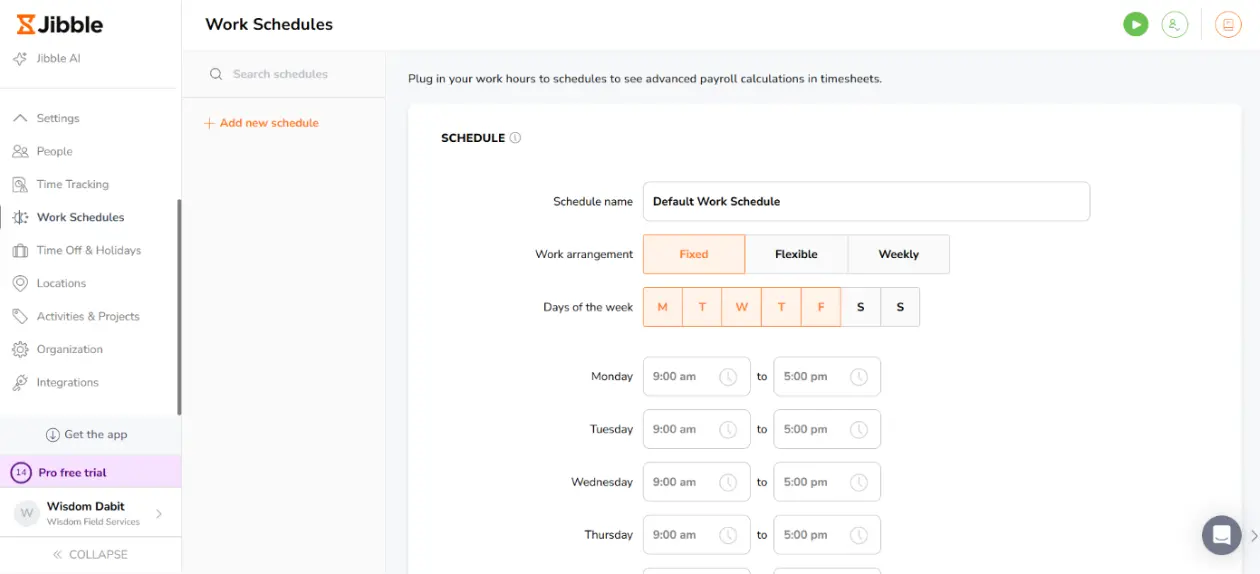
Jibble’s Work Schedules settings let you define fixed or flexible work hours, breaks, automatic deductions, overtime rules, and assign approved locations to a schedule.
Jibble Work Schedules settings showing fixed hours, breaks, automatic deductions, overtime rules, and location assignment.
GPS-verified clock-ins and geofencing
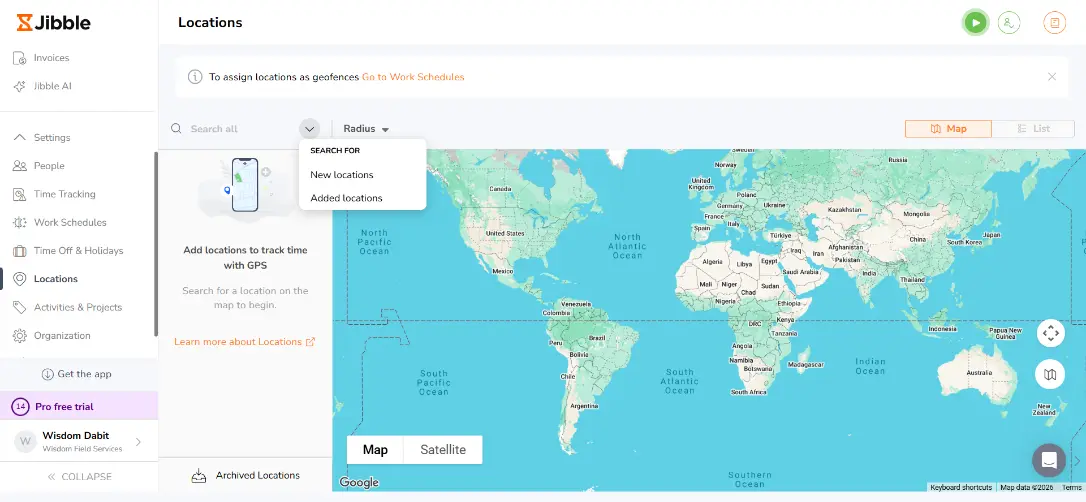
Jibble captures GPS data when employees clock in and out and can restrict punches to approved locations with geofencing. Admins create work locations in the Locations area, then assign them to work schedules before enforcing geofencing.
Jibble Locations page for adding GPS work locations that can be assigned as geofences.
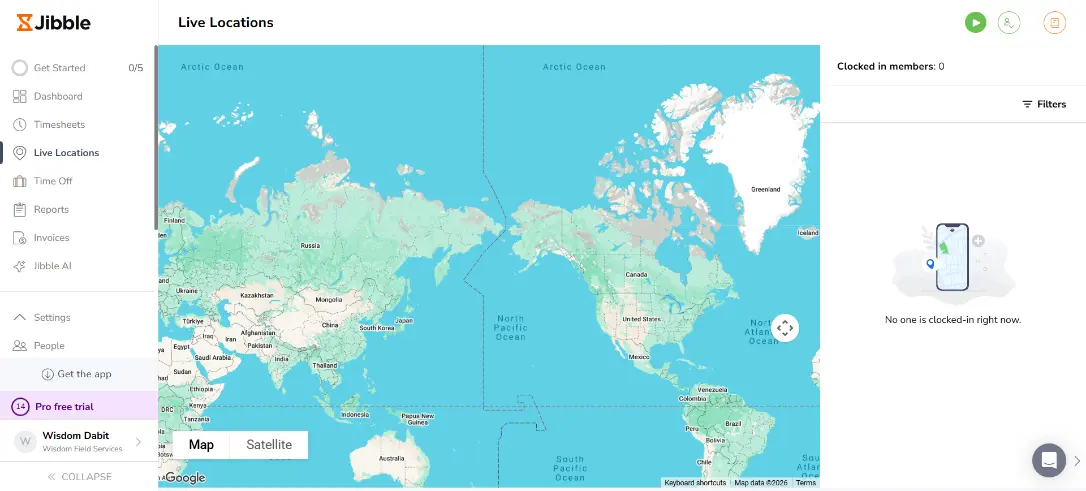
Live Locations
Jibble’s Pro plan adds Live Locations, which shows clocked-in team members on a map throughout the workday but stops recording during breaks and after clock-out.
Jibble Live Locations map for tracking clocked-in team members on supported plans.
Geofence Automation
Jibble’s Geofence Automation creates In and Out entries when team members cross an assigned geofence. Automated entries bypass facial recognition, selfies, enforced projects, activities, and some work-schedule restrictions.
By the way: Jibble does not let you use Live Locations and Geofence Automation at the same time, so you have to choose between continuous location visibility and automatic geofence-based punches.
Facial recognition
Employees can verify their identity with facial recognition from the mobile app or a shared kiosk. Admins can decide what happens when verification fails: allow the entry, flag it for review, or block the employee from tracking time until verification succeeds.
Offline mode
Jibble’s Offline mode lets employees clock in and out without an internet connection and syncs those entries after the device reconnects. Offline use has limits for activities, projects, breaks, reminders, and automatic clock-outs. GPS capture still depends on the device’s GPS capability.
Integrations
Jibble integrates directly with tools including QuickBooks Online, Xero, and Deel, allowing approved timesheet data to move into accounting, billing, or payroll workflows.
It also integrates with workplace tools such as Slack and Microsoft Teams, and offers an open API and webhooks for custom workflows.
Additional Jibble Features
Projects and activities: Track employee hours against specific projects, clients, and activities.
Kiosk mode: Turn a phone or tablet into a shared employee time clock.
NFC and RFID: Let employees clock in using compatible cards from a kiosk.
Timesheet approvals: Review and approve employee hours before payroll.
Time off: Manage leave policies, requests, and balances.
Break and overtime rules: Apply custom rules to employee timesheets on supported plans.
Reports: Analyze attendance, tracked time, projects, and payroll hours.
Screenshots: Capture screenshots for employees tracking time from supported desktop workflows.
Pros
Jibble’s Free plan is unusually generous at $0 forever for unlimited users, with GPS-verified clock-ins, biometric verification, automated timesheets, job and task tracking, and payroll exports included before you move to a paid tier.
Punch verification is strong even before you pay.
Offline tracking covers more than basic punches.
You can automate location-based time entries on supported plans.
Cons
Jibble’s automated geofence entries bypass facial recognition, selfies, required projects, and required activities, so teams using those controls have to choose which requirement matters more for that workflow.
Some of the stronger location features require paid plans.
Jibble cannot run Geofence Automation and Live Locations at the same time, so automatic punches at a worksite boundary come at the cost of continuous live-location recording for that workflow.
Pricing
Jibble’s Free plan costs $0 forever and supports unlimited users.
Jibble’s four self-serve plans are Free, Essential, Growth, and Pro; with annual billing selected in the account reviewed for this article, the paid tiers were listed at $1.99, $4.49, and $7.99 per user/month after trial, respectively.
Plan
Annual price shown in app
Free
$0 forever
Essential
$1.99/user/month
Growth
$4.49/user/month
Pro
$7.99/user/month
New accounts also get a 14-day trial of paid-plan features before continuing on a paid tier or the Free plan. Monthly and localized pricing can differ from the annual rates shown above.
Verdict
Jibble is a strong option for teams that want to keep time and attendance costs low without giving up GPS-verified clock-ins, geofencing, facial recognition, or offline punches.For mobile teams that also need mileage tracking and a more detailed picture of travel between job sites, Timeero is built around more of that workflow.
How to choose the right clock-in clock-out app
The features you need depend largely on how and where your employees work. Here are the main things I’d compare before choosing an app:
GPS tracking and geofencing: GPS lets you see where employees clock in or work, while geofencing lets you control where punches can happen. If employees move between job sites, check whether the app only records punch locations or continues tracking location throughout the workday.
Offline tracking: If your team works in areas with unreliable internet access, make sure employees can still clock in and out offline and sync their punches later.
Punch verification: Facial recognition, webcam photos, PINs, QR codes, and device restrictions can help you verify that the right employee made the punch.
Automatic clock-in and out: Geofencing alone doesn’t mean an app can automatically punch employees in or out. If forgotten punches are a recurring problem, check whether the app can actually automate them.
Payroll integrations: Look at whether the app connects directly with your payroll provider or simply gives you a file to export and upload manually.
Mileage tracking: If employees drive between customers or job sites, check whether mileage is calculated automatically or employees have to enter it themselves.
Scheduling, jobs, and tasks: If you also need to know what employees worked on, look for tools that let you connect tracked hours to specific shifts, jobs, tasks, or locations.
Pricing: Compare the actual cost of the features you need. Base fees, add-ons, annual-billing discounts, higher-tier feature gates, and contract terms can make the headline price quite different from what you eventually pay.
Why mobile teams choose Timeero as their clock-in clock-out app
A regular time clock can tell you when an employee started and finished work. For mobile teams, Timeero can connect those timestamps with where work happened, whether the employee was inside the expected job area, and the travel that happened between locations.
Auto Clock-In/Out can reduce forgotten punches at eligible job sites, while offline tracking keeps recording time when connectivity is unreliable. Teams that need to see what happened between jobs can use Segmented Tracking instead, which organizes stops, driving time, and mileage across the workday.
The same records can flow into timesheet approvals, reporting, and supported payroll integrations, so managers have a clearer path from a field employee’s workday to payroll-ready data.
Which clock-in clock-out app should you choose?
All seven apps can handle employee clock-ins and outs, but they solve different workforce problems.
Buddy Punch stands out for punch controls, Clockify for project-based time tracking, ClockShark for tying hours to field jobs, Connecteam for broader workforce management, When I Work for scheduling, and Jibble for the most generous free plan in this comparison.
The best clock-in clock-out app depends on how your workforce operates, with mobile teams needing to pay particular attention to GPS accuracy, geofencing, offline reliability, mileage and travel visibility, and how easily approved records move into payroll.
A clock-in clock-out app is software employees use to record when they start and finish work. Many apps also track location, breaks, overtime, jobs, and mileage.
What is the best clock-in clock-out app for employees?
The best clock-in clock-out app for employees is one that makes punching in and out simple while giving managers the data they need to verify and process those hours.
What is the best clock-in clock-out app with GPS?
Timeero is one of the best clock-in clock-out apps with GPS for mobile teams because it also includes geofencing, mileage tracking, and travel visibility.
Can employees clock in and out without internet access?
Yes, if the app supports offline tracking, employees can clock in and out without internet access and sync those punches once the device reconnects.
What is the difference between GPS tracking and geofencing?
GPS tracking shows an employee’s location, while geofencing creates a virtual boundary around a worksite and controls where employees can clock in or out.
How do time clock apps prevent buddy punching?
Time clock apps prevent buddy punching with features such as facial recognition, webcam photos, PINs, GPS verification, and device restrictions.
Can clock-in clock-out apps integrate with payroll?
Yes, many clock-in clock-out apps integrate with payroll software directly or let you export approved timesheets for payroll processing.
Ready to ditch paper timesheets and let Timeero transform your workforce?