Workers Trust GPS Data More Than Managers. Here's Why That Matters
Emman Velos
Last update on:
March 25, 2026 10:24 AM
Published on:
TL;DR
Our survey of 1,000 field workers shows that 39.1% of employees trust GPS records more than manager or customer reports, highlighting how strongly employees value objective documentation. GPS tracking creates a clear timeline of the workday by automatically recording clock-ins, travel, and job-site visits. When both managers and employees can review the same records, disagreements become easier to verify and resolve.
When something goes wrong at work, who does your team trust more — personal judgment or objective data?
For example, a technician says they arrived at the job site at 8:02, but the customer insists they arrived late, around 8:30. As the manager, who do you believe? The timecard or the customer's word?
For many field workers involved in client disputes, our GPS tracking survey report showed that 39.1% of field workers say they trust GPS records more than manager or customer reports. Only 14% said they trust human judgment more — and that’s a big deal.
Want to see the full breakdown?
We surveyed 1,000 field workers to uncover exactly how they feel about location tracking, privacy, and workplace disputes.
In the survey mentioned above, workers were asked, “When there’s a dispute about time or location, which source do you trust more?”.
Timeero field workforce study
Who do workers trust most to resolve disputes?
When a workplace dispute arises, which source of evidence do field workers trust?
Trust GPS data more39.1%
Trust both equally34.9%
Trust human judgment more14.0%
74% of field workers lean toward GPS evidence — either exclusively or alongside human testimony — when disputes arise on the job.
Here’s how the responses broke down:
39.1% trust GPS data more than human reports
34.9% trust both equally
14.0% trust human judgment more than GPS
The numbers tell a simple story of objective records versus subjective judgment. When a disagreement appears, trusting GPS-backed records feels safer than relying on memory alone.
Why objective records change the conversation
Most workers don’t love the idea of being tracked, which is understandable.
But when a dispute comes up regarding time or mileage, employees are looking for more than their word to defend them. When companies use GPS records to resolve a real conflict, the system that once felt intrusive suddenly feels protective.
This change of thinking happens for 3 main reasons:
GPS is neutral
Managers bring context, experience, and judgment to their decisions. However, they also bring assumptions.
When an employee is consistently late or is known to exaggerate work hours, supervisors may not trust their numbers.
GPS systems don’t make assumptions. Instead, they track exactly what happened throughout the workday:
The exact time an employee clocked in, took breaks, and clocked out
Where the employee traveled to, and how many miles were driven
How long the employees stayed at the job site
GPS records aren’t open to interpretation. This kind of neutrality matters when disputes arise.
GPS creates verifiable records
Field operations inherently come with a great amount of uncertainty.
Crews don’t work at the same site every day, which makes it hard to accurately attribute time worked to the correct job. Foremen and supervisors often communicate project notes via text or leave handwritten notes, which leaves room for miscommunication. Employees track their time and mileage on paper at the end of the day, relying on estimates instead of exactness.
Over time, these small uncertainties add up.
GPS tracking changes the structure of recordkeeping by automating the documentation process.
Most GPS systems automatically track and record employees’:
Clock-in and clock-out times
Travel routes
Arrival and departure times at job sites
Mileage driven between locations
All of these records combine to create an indisputable audit trail that shifts the conversation from a debate to verification.
GPS reduces emotional escalation
Anyone who has mediated a payroll dispute knows how quickly tensions can rise.
When there's no objective anchor, everyone retreats to their own version of events. Now, one worker feels accused, while the customer insists they’re right.
But instead of arguing over memory, the team can simply look at the record together and ask a simpler question: “What does the timeline show?”
And now suddenly, the conversation is over and the matter is settled. The shift from opinion to documentation stops the conflict from escalating.
Disputes change how workers see GPS
Scale of the problem
79.3%
of field workers have experienced or witnessed a workplace dispute about time or location
0%25%50%75%100%
That's nearly 4 out of every 5 workers in the field. GPS timestamps eliminate the ambiguity at the center of most of these disputes before they escalate.
Our survey uncovered another pattern– workers who have experienced workplace disputes value GPS tracking and prefer working for employers who use GPS systems.
Across all respondents, 79.3% of field workers say they have experienced or witnessed workplace disputes involving hours worked, time on-site, or mileage.
When employees have faced multiple workplace conflicts, their preference for using GPS tracking increases along with their trust in the objective data GPS provides:
48.4% trust GPS data more than human reports
Only 17.5% trust human reports more
This shows that a worker who has gone through several “he said/she said” situations understands how difficult it is to defend themselves without documentation — and how GPS records provide that documentation automatically.
Why this matters for your business
While the survey numbers are interesting, operations leaders should ask, “What changes inside a business when workers trust GPS data more than human judgment?”
In most field operations, disputes rarely stay confined between the employer and employee. One disagreement about hours or mileage can ripple through payroll, customer relationships, and team morale.
Implementing GPS tracking systems that provide objective records can help stop the ripples before they spread. When clock in/outs are timestamped and GPS verified, and mileage is tracked in real time, it’s easier to make decisions, resolve disputes, and prioritize the day’s activities.
Payroll disagreements become easier to resolve
Payroll disputes involving field workers rarely start with fraud or bad intentions. More often than not, they start with small gaps in the record.
A technician logs eight hours worked, but the office only sees six hours tied to customer invoices. So, does the employee get paid for 8 hours, or 6?
Without a clear record, there’s no way to know who is right.
With GPS-backed time and mileage records, employees don’t have to reconstruct their workday from memory. Employers can access clock-in/out times, break times, driving routes, and jobs worked to resolve payroll disputes quickly and efficiently.
Overtime questions become clearer
Overtime disputes typically revolve around two key questions: When did the workday actually begin? And when did it end?
Field workers may begin loading equipment before the official shift. They may finish a final job after the scheduled end time.
Those extra minutes rarely make it onto a manual timecard.
GPS-supported clock-ins create a clearer record of when the workday actually unfolded. That makes it easier for HR teams to review overtime questions without relying entirely on supervisor observation.
Customer complaints become easier to verify
Customer complaints are harder to address when you’re stuck between two versions of a story.
The customer complains that the technician arrived late, and the technician insists they spent 30 minutes waiting outside the property before the client arrived.
Complaints become easier to resolve when employers use GPS-backed records to verify the time and location of events that took place.
Workforce visibility apps that use GPS tracking can show business owners the following details:
When the worker arrived near or at the job site
The exact time the worker clocked in to the job
How long they were present at the location
Being able to access real-time records helps managers quickly resolve client disputes and get work back on track.
Mileage verification stops being a guessing game
At the end of a long day, logging mileage is usually the farthest thing from your employees’ minds. Instead of recording stops as they happen, workers usually wait until the end of the day to write down what they remember about their mileage and driving routes.
Submitting mileage estimates is the fastest way to end up in a mileage dispute, because estimates lead to uncertainty.
Managers reviewing submissions may believe an employees’ mileage is too much given the job site they were assigned to work at and may feel hesitant to issue the reimbursement.
GPS-based mileage tracking removes uncertainty by recording the route as it happens. Distances, travel times, and job-to-job movement are automatically logged throughout the workday.
Curious how much those rough estimates are actually costing your business?
Plug your team's numbers into our
Free Mileage Reimbursement Savings Calculator
to see exactly how much you can save by switching to automated tracking.
Performance disputes gain context
Not every disagreement involves pay. Sometimes, the question is about productivity.
A manager might look at the schedule and wonder why a repair expected to take two hours stretched to three. Other times, the opposite happens. A technician finishes early and the timeline raises a different question, “What did he do with the rest of his time?”
Without a clear record of the day, managers only see the outcomes, while workers remember the obstacles– traffic, a complex installation, missing equipment, or the extra time they spent diagnosing an issue that wasn’t visible from the job ticket.
Location records provide a complete picture of the day's activities without any guesswork required.
Instead of looking at a single time entry, managers can review the sequence of the workday — where the employee traveled, when they arrived on-site, and how long each stop lasted.
That added context changes the tone of the discussion, making performance conversations more constructive and less defensive.
How Timeero uses GPS as verification, not surveillance
From our 2026 GPS Survey & Employee Trust survey, we learned that many workers trust GPS records more than human judgment when disputes arise.
But trusting a GPS system during a dispute doesn't automatically mean all employees are on board with GPS tracking. Many workers wonder whether the technology is meant for oversight and monitoring instead of increasing accuracy and productivity.
Timeero approaches GPS differently.
The platform creates a shared, verifiable timeline of work activity, increasing visibility across your workforce. When questions arise about hours worked, travel routes, or time spent at job sites, managers and employees can look at the same records and come to an agreed conclusion.
In that sense, GPS becomes less about surveillance and more about documentation.
Here’s how Timeero structures that approach in practice.
GPS only remains active from clock-in to clock-out
One of the biggest concerns employees have about GPS tracking is simple, “Will the company be able to see where I am all the time?”
Timeero avoids that issue by tying GPS activity directly to the time clock.
When an employee clocks in through the Timeero app, the system begins recording location points that correspond to the shift. When the employee clocks out, location tracking stops.
For operations teams, this setup does two important things at once:
It creates a verifiable timeline of the shift
It respects the employee’s time off the clock.
This structure creates a clear boundary that is limited to work activity only, not personal movement outside of working hours.
Want to formalize these boundaries and get your team on board? Answer a few quick questions in our
free Employee GPS Tracking Policy Builder
to generate a custom, compliant policy in under a minute.
Clear audit trails
When employees clock in with Timeero, the system begins building a record of the workday in the background.
Time, location, and mileage data is organized into the employee’s digital time card for that shift.
Throughout the day, Timeero captures key events and attaches them directly to the time card, including:
When and where the employee clocked in
The job sites they visited
Arrival times at each location
How long they remained on site
Break start and end times
When they clocked out
By the end of the shift, an employee's time card accurately reflects the activities of their workday.
For managers, this creates a clear audit trail that can be reviewed whenever questions arise. If payroll needs to verify hours or a customer challenges an arrival time, the time card already contains the sequence of events.
Instead of relying on memory or piecing together scattered updates, the system provides a documented record of how the day actually unfolded.
Verifiable time and mileage logs
Because each shift produces a detailed time card, Timeero allows managers to verify both time worked and miles traveled using the same record.
Timeero has two features that simplify time and mileage verification – Segmented Tracking and Route Replay.
Segmented Tracking
Timeero organizes the workday into a visual timeline within the time card. Each segment represents a stop made along a driving route, containing complete details about that stop, including the address, miles traveled between each stop, and how much time was spent at that location. This makes it easy to see how the shift was structured without digging through raw location points.
Route Replay
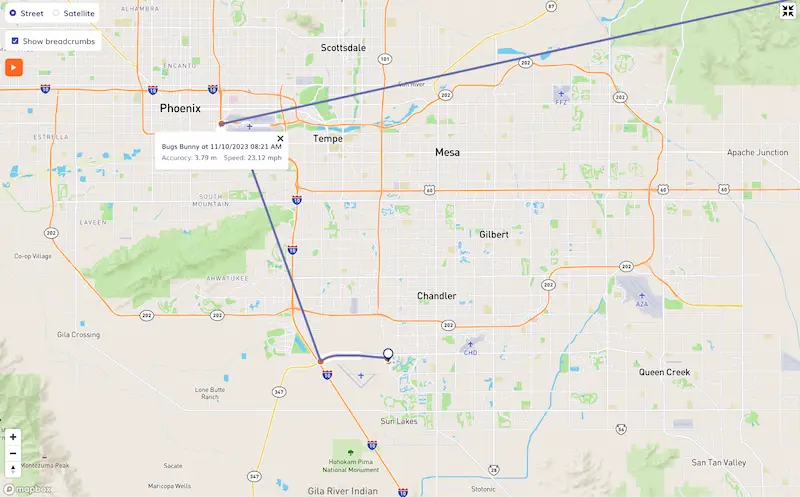
Clicking a breadcrumb shows you a timestamp and the driving speed.
Route Replay gives you a complete picture of an entire route taken from start to finish. Each breadcrumb represents a specific point along the route. Clicking on individual breadcrumbs shows you the exact time the employee was at the location as well as the driving speed.
Together, these tools transform GPS data into something more useful– a verifiable record of time and mileage tied directly to the employee’s time card
Employee access to their own data
Verification works best when both sides can review the same record.
With Timeero, employees can open the mobile app and see the exact data managers use to verify their shifts.
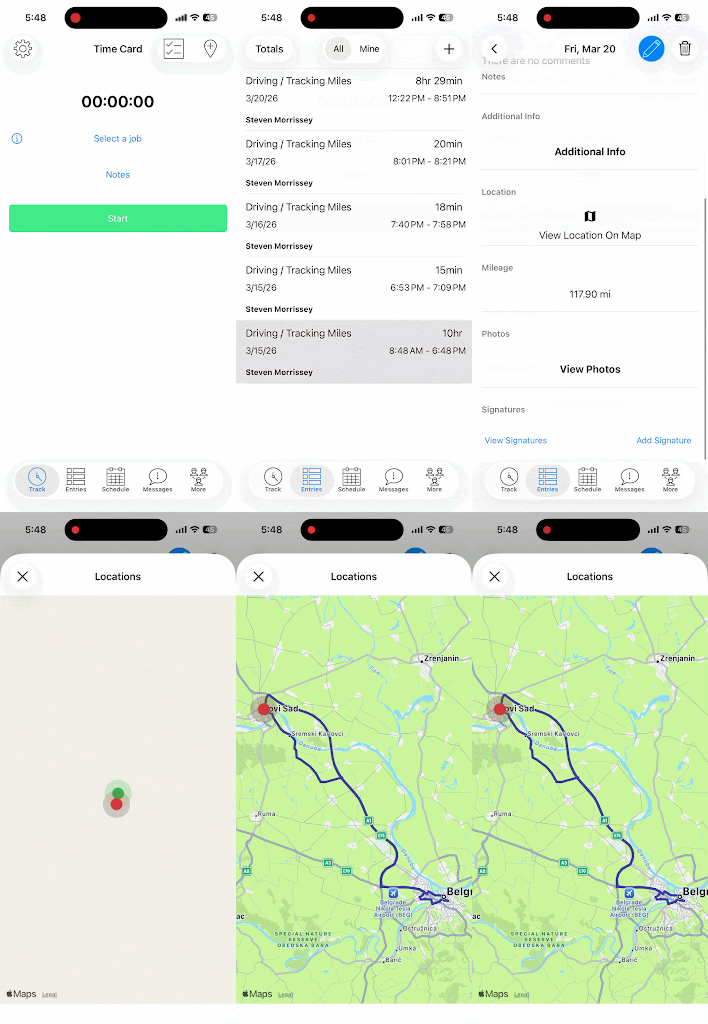
Employees can access all shift details from their timecard entries.
By tapping on a time card, employees can view the details of that shift which allows employees to review their own records before payroll is processed.
If something looks incorrect, it can be addressed early while the details of the shift are still fresh. Managers and employees are both working from the same documented timeline.
Permission controls for managers
Location data is useful for resolving disputes and verifying work activity, but that doesn’t mean everyone in the company needs access to it.
Timeero allows managers to control who can view employee location data by setting role-based permissions inside the system. Access can be limited to the people who actually need the information to do their jobs.
For example:
Supervisors may view job progress and arrival times at work sites
Payroll teams may review timesheets and mileage reports for payroll processing
Operations managers may access reports when investigating disputes or reviewing field activity
By assigning permissions, companies avoid exposing sensitive location data across the entire organization.
Turn workplace disputes into verifiable records
Timeero combines GPS time tracking, mileage tracking, and digital time cards into a single system that documents how work actually happens in the field. Every shift automatically produces a clear timeline showing when employees clocked in, where they traveled, which job sites they visited, and how long they stayed.
If you want to implement a system for GPS tracking for payroll accuracy, resolve disputes faster, and give your team a shared source of truth, try Timeero for yourself.
Still weighing your options before testing out a new software? Read our breakdown on Why You Should Choose Timeero for GPS Tracking to see the top 7 reasons field teams make the switch.
Start your free trial today and see how Timeero helps turn everyday field activity into clear, verifiable records your entire team can trust.
Frequently asked questions (FAQs)
Do employees trust GPS tracking more than managers?
Based on our tracking survey data, yes. We interviewed 1,000 field workers, and 39.1% said they trust GPS tracking over manager observation or customer reports, while only 14% said they trust human judgment more.
The reason is simple– employees feel more confident relying on documented data rather than memories that may differ from person to person.
Can GPS tracking prevent payroll disputes?
GPS tracking can significantly reduce payroll disputes because it automatically documents when and where work happens. Instead of relying on manual timecards or reconstructed timelines, managers can review clock-in times, job-site visits, travel activity, and clock-outs tied to each shift. When questions arise about hours worked or travel time between jobs, the system already contains the information needed to verify the timeline.
Is GPS more reliable than supervisor observation?
Supervisor observation can provide useful context, but it can also be influenced by personal assumptions or incomplete information.
However, GPS tracking records timestamps and location data automatically, creating an objective timeline of events. When questions arise, the data provides a neutral reference point that helps clarify what actually happened.
Does GPS tracking improve fairness?
GPS tracking can improve fairness by ensuring that both employees and managers rely on the same documented record of the workday. When time worked, job-site visits, and travel activity are recorded automatically, employees have clearer proof of the work they performed, and managers gain accurate data to review payroll, mileage reimbursement, and job progress.
How does GPS reduce timecard conflicts?
Timecard conflicts often occur when hours are logged manually or reconstructed after the fact. GPS-enabled time tracking reduces these conflicts by capturing clock-ins, location activity, and shift timelines as they happen.
Ready to put an end to "he said/she said" payroll disputes?
Give your team a shared source of truth they can actually trust.
Emman is a passionate writer with more than 6 years of digital marketing experience under his belt. As a licensed chemical engineer with a passion for writing, he marries the technical with the creative to create engaging copy that converts. He is also a certified #girldad who spends most of his day playing with his three girls when he's not busy writing.




%202.svg)


.png)
.png)



.png)


