PAGA Lawsuit Timeline in California: Why Record Quality Matters More Than You Think
Emman Velos
Last update on:
March 3, 2026 5:14 AM
Published on:
TL;DR
Timelines can vary when you're faced with a California meal and rest break lawsuit. The difference between a six-month resolution and a multi-year dispute comes down to whether your records can prove compliance when someone asks. Timeero helps California employers build complete, defensible records, giving you the clarity and speed that shortens case timelines and strengthens your defense.
When you receive a Private Attorneys General Act (PAGA) claim about missed meal breaks, what’s the first thing that runs through your head? For most California employers, it’s not liability, compliance, or whether the claim has merit. More often than not, it’s “how long is this going to take in court?”
It’s a valid question. After all, time is money, and every second spent in litigation is money you’re not investing back into your business.
Is it going to be a three-month case, or a year-long problem? You need a timeline — something you can put on the calendar, communicate to leadership, and budget for, but the best answer your attorney can give is the dreaded “it depends.”
Stop Guessing, Start Documenting.
See how Timeero’s California-specific tools keep your lawsuit timeline short.
While it may sound like an evasive non-answer, it’s the most honest thing an employment lawyer can tell you about California meal and rest break lawsuits.
There is no standard timeline. Some cases wrap up in six months while others stretch past two years. But you might be surprised to learn that how quick your lawsuit settles won’t be determined by the size of your workforce, the dollar amount of the claim, or even how good your attorney is. It comes down to something more concrete: the state of your records.
If you can prove when breaks happened, how long they lasted, and whether premiums were paid, the process may move more quickly. But if your records are scattered, inconsistent, or require piecing together after the fact, you're looking at a longer road.
The question isn't whether you provided breaks but about whether you can show they happened when someone asks. That difference changes everything.
Why there’s no standard timeline for break lawsuits in California
Every employment attorney in California gets asked the same question: “How long will this take?”, and every one of them wishes they had a better answer.
“We get that question a lot, and I understand it,” said California employment attorney Emilio Rodriguez. “People like closure and [want to know] ‘how long am I going to be in this?’ It’s a hard question to answer because it’s going to come back to ‘how do your records look?’“
The reason there's no fixed timeline is that California meal and rest break lawsuits vary wildly based on circumstances that don't become clear until after the claim is filed. Two companies in the same industry with the same number of employees can face radically different case lengths depending on a handful of operational details.
PAGA claims can scale the timeline problem quickly. According to Rodriguez, a single meal break violation can trigger penalties that apply to every affected employee across the entire workforce under this law.
That means a single missed break for one worker can become a question about company-wide practices. When your records don’t provide clear answers, the scope of discovery expands to match the scope of the claim.
The overall timeline will now depend not on what the law dictates, but on how long it takes to answer the questions the claim raises. The better records you keep, the faster you can give the right answers.
What attorneys look at first when a claim is filed
California employers are trained to focus on building a policy that meets the requirements of the law. But when a meal and rest break claim hits, the first request attorneys make isn’t to view your policy manual or training documentation. It’s to see your time and break records — and that’s what catches most employers off guard.
“Rarely do we see a non-compliant policy. Where we do see risks and liability is in the application and the consistency of that policy,” said Rodriguez.
You can have a perfectly compliant meal and rest break policy that meets every requirement under California law. You can train every supervisor and post every notice. But if your records don’t show that employees actually took their breaks at the right times, your policy won’t protect you.
For Rodriguez, doing the right thing is not the same as proving you did the right thing.
“Those are two different things,” explained Rodriguez. “Employers don't do things on purpose. They don't want to take away the meal break of the employee. But the problem is [having the right record] or document to prove and defend yourself if one of these lawsuits does arise."
Don't risk compliance with inconsistent records. See how much you could save in premium pay and potential PAGA lawsuit settlements when you start tracking breaks with Timeero. Use our free online calculator to see what's at stake.
How record quality directly affects how long a case lasts
Clean, consistent records don’t guarantee a short case. But messy, incomplete records almost always guarantee a long one.
When records are clear and complete, both sides can evaluate the claim quickly. Your attorney can identify which breaks were provided, which weren't, and whether premiums were paid, and the plaintiffs' attorney can easily assess exposure. Settlement discussions can begin with actual data instead of assumptions.
But when records are missing or inconsistent, the process changes. You need time for discovery and depositions, and even more time spent trying to reconstruct what happened on specific days, shifts, and locations. Every gap in your records creates another question that needs an answer before the case can move forward.
Rodriguez explains the impact and how it all unfolds:
“If we don’t have a record at all, or it’s not clear or consistent, then the plaintiff’s attorney [can make] the argument that it is [on the defendant] to prove and show that those meals or rest breaks indeed happened… The only other way that could be done is by asking employees, going through litigation, doing the depositions, [and doing discovery], which is just more time and more costly for the defense.”
Even compliant behavior becomes harder to defend when documentation is weak. You might have a supervisor who remembers that an employee took a break. But without a timestamp, that memory isn't evidence. You might have a payroll system that shows premium pay, but if the system doesn't capture when the premium was triggered, you're left explaining gaps instead of presenting facts.
But how much time will all of this take? Rodriguez offers a rough estimate:
“If you have good records, if we’re lucky, [it could take] half a year. But if you don’t have records, if you’re missing records, or if your records are not legible, it will take a considerable amount of time.”
Half a year versus an indefinite "considerable amount of time." That's the range, and the difference comes down to whether your records can hold up under review.
What faster meal & rest break cases in California have in common
What do “good records” actually look like in practice?
Fast cases don’t happen by accident. When California meal and rest break lawsuits resolve quickly, certain operational patterns emerge:
Exceptions are documented at the time they happen. If a break was missed, late, or interrupted, the reason is noted in the system when it occurs. Supervisors don't rely on memory to explain what happened months later. When a plaintiffs' attorney asks why a break was delayed, there's a timestamped note in the system that says exactly why.
Manual edits are limited and explainable. When adjustments are made to time records, they're logged with a reason and a timestamp. There's no pattern of unexplained changes that raise questions about data integrity. If an edit was made, anyone reviewing the record can see who made it, when, and why.
Records can be produced quickly when requested. The company can pull a full year of break records in days, not weeks. That speed allows attorneys to assess exposure and move toward resolution without lengthy delays. There's no scramble to gather data from multiple systems or track down missing logs.
Faster cases are built on systems that make it easy to show what actually happened, which is where Timeero excels.
Timeero helps employers meet these conditions by standardizing time and break tracking across teams. Instead of managing a patchwork of timecards, spreadsheets, and manual logs, everything is captured in one centralized system.
Within this system, all breaks are timestamped, exceptions are documented, and edits are tracked with clear explanations. And when records are requested, they can be pulled quickly, ready for review.
Are your records ready if a claim happens?
Before a claim lands, ask yourself these questions:
Can you pull a full year of break records in minutes?
Are late breaks and premiums clearly documented?
Can you explain manual edits without relying on memory?
Are records consistent across supervisors and locations?
Do your records show when breaks started and ended, or just clock-in and clock-out times?
If the answer to any of these is "no" or "I'm not sure," your records may not hold up under review. And that uncertainty translates directly into longer timelines when a claim is filed.
Timeero supports that readiness by automating break tracking, documenting exceptions as they occur, and keeping everything in one place. When your attorney asks for records, you can produce them quickly instead of spending weeks piecing together the story.
How Timeero supports faster clarity when break records are reviewed
When it comes to choosing a platform for tracking meal and rest breaks in California, Rodriguez has one piece of advice:
“Know what system you’re using. The software is going to do most of the tracking, [so you need to be able to] trust the software to know that it’s tracking correctly.”
Timeero addresses the single biggest factor that determines how long California meal and rest break cases last: the quality and accessibility of your records. Instead of scrambling to reconstruct what happened months ago, you can pull complete, timestamped records that answer every question a plaintiffs' attorney is likely to ask.
“Software like [Timeero], they’re very helpful because they take a lot of the work off the shoulders of a person,” said Rodriguez.
Here's how Timeero helps employers build the record readiness that leads to faster case resolution:
Outcome-focused record keeping
Most employers track breaks to meet a rule. Timeero is built to help you defend a result.
When a PAGA claim or meal and rest break lawsuit lands on your desk, the question isn’t whether you had a policy. It’s whether your records can answer detailed, specific questions:
When did the break start?
When did it end?
Was it timely under California law?
If it was missed, was premium pay triggered?
Who documented the exception, and when?
Instead of storing time entries and hoping they’re sufficient later, Timeero structures records around what attorneys, auditors, and courts actually examine. That means every break entry is timestamped, every exception can be documented in real time, and every edit leaves a traceable log.
Centralized time and break records in one system
Timeero centralizes all employee time and break data in one system. Everything is captured in the same place, whether you have five five employees or 500, field workers or office staff, multiple locations or a single site.
When your attorney requests a year of break records, you can export them in a usable format without reconciling conflicting logs or chasing down paper trails. That speed matters when you're trying to assess exposure and move toward resolution.
Consistent break tracking across all teams and locations
When break tracking varies by location, shift, or supervisor, it creates gaps that plaintiffs' attorneys exploit. If your San Diego team tracks breaks one way and your Sacramento team does it differently, you've given the opposing side an opening to argue that your practices aren't standardized, which raises questions about company-wide compliance.
Timeero applies the same tracking method across your entire workforce, eliminating the gaps that come from different locations or shifts using different processes. That consistency strengthens your defense by showing that your break practices are uniform, not ad hoc. When records are reviewed, there's no need to explain why one location's data looks different from another's.
Reduced reliance on manual corrections
Manual edits are a red flag in meal break litigation in California. When time records show frequent unexplained adjustments, plaintiffs' attorneys start asking questions:
Why were so many breaks edited after the fact?
Who made the changes?
Were employees actually taking breaks, or were supervisors filling in data to make it look compliant?
Timeero reduces the need for manual corrections by automating break tracking. Employees clock in and out of breaks in real time, while the system captures the data automatically.
If edits are necessary, because an employee forgot to clock out, for example, Timeero creates an audit trail to show exactly who made the change and when. This makes it easier to explain adjustments when records are reviewed.
Clear visibility into when breaks actually occurred
California law doesn't just require that employees take breaks. It requires that they take them at the right time. A break that happens after six hours of work isn't compliant if the law says it should happen before the end of the fifth hour.
If your records only show clock-in and clock-out times without capturing when the break started and ended, you can't prove timing — and that's a problem.
Timeero captures the exact start and end time of every break so your records don't just show that a break happened. They also show when it happened, how long it lasted, and whether it met California's timing requirements.
Easier internal audits before issues escalate
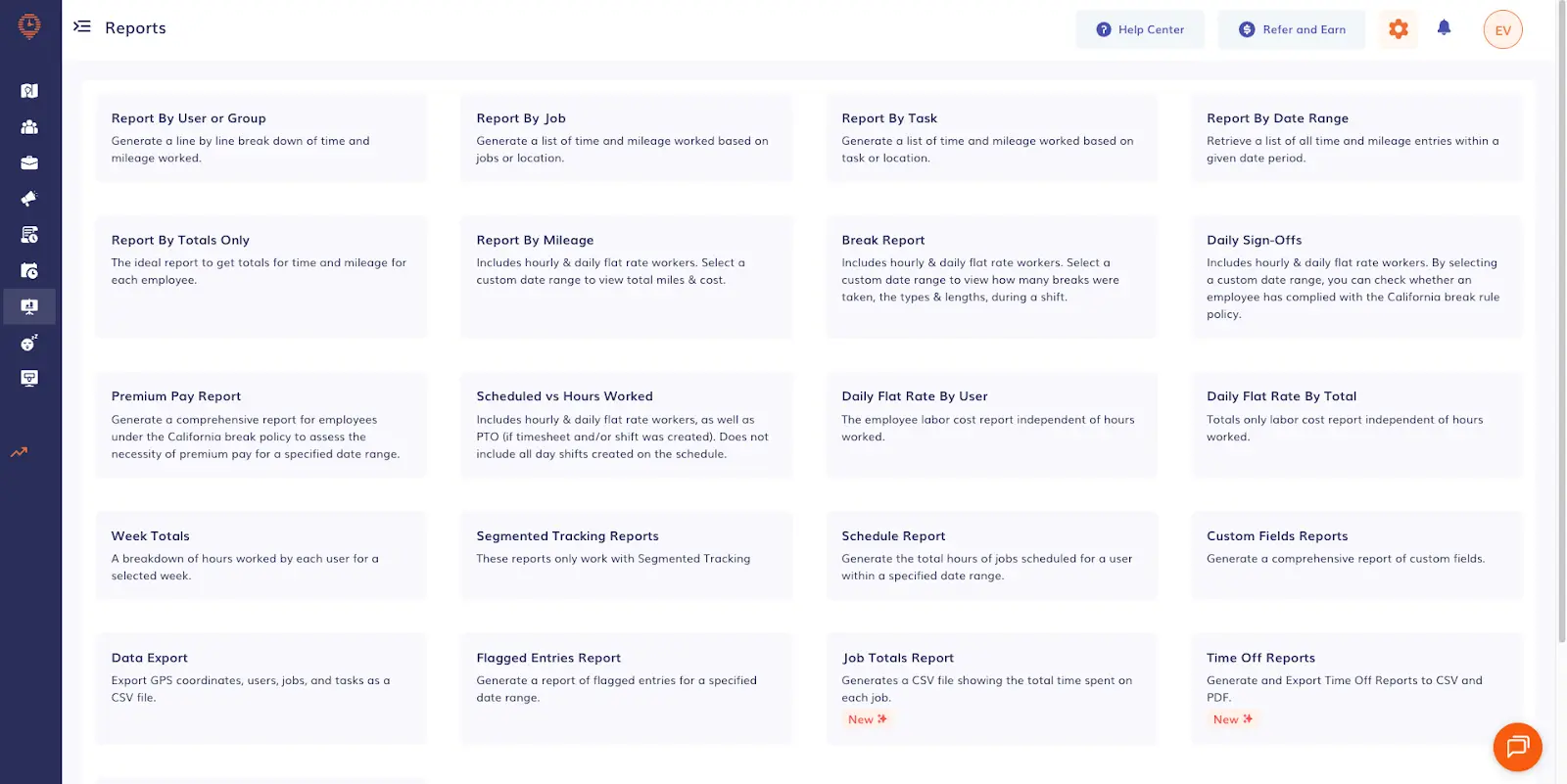
Timeero makes it easy to run regular internal audits of break compliance through its Reports tab, which provides access to multiple report types designed specifically for California break tracking:
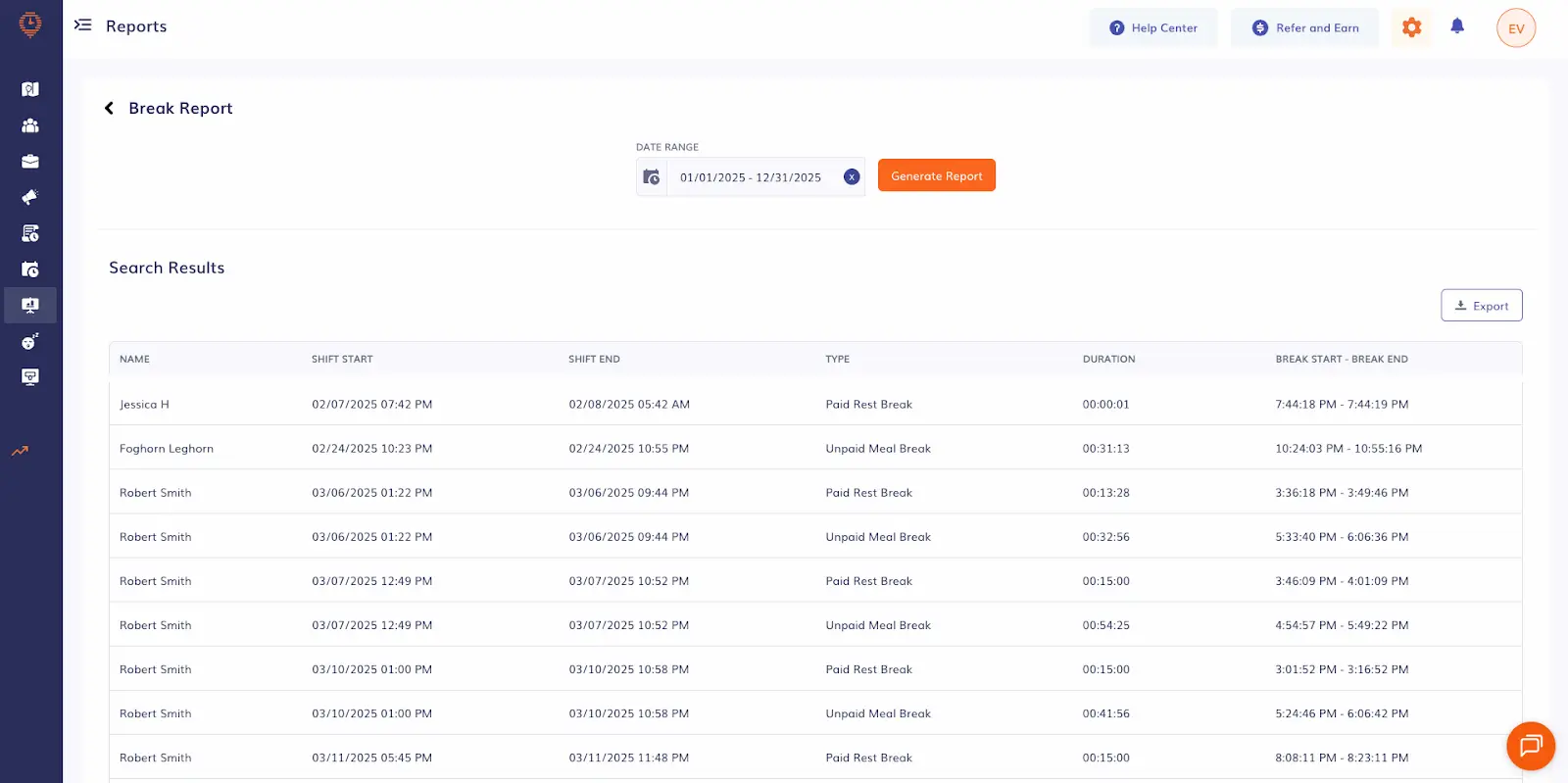
Break Report. Select a custom date range to view detailed information about breaks taken during shifts, including how many breaks occurred, the types of breaks (meal or rest), and their lengths.
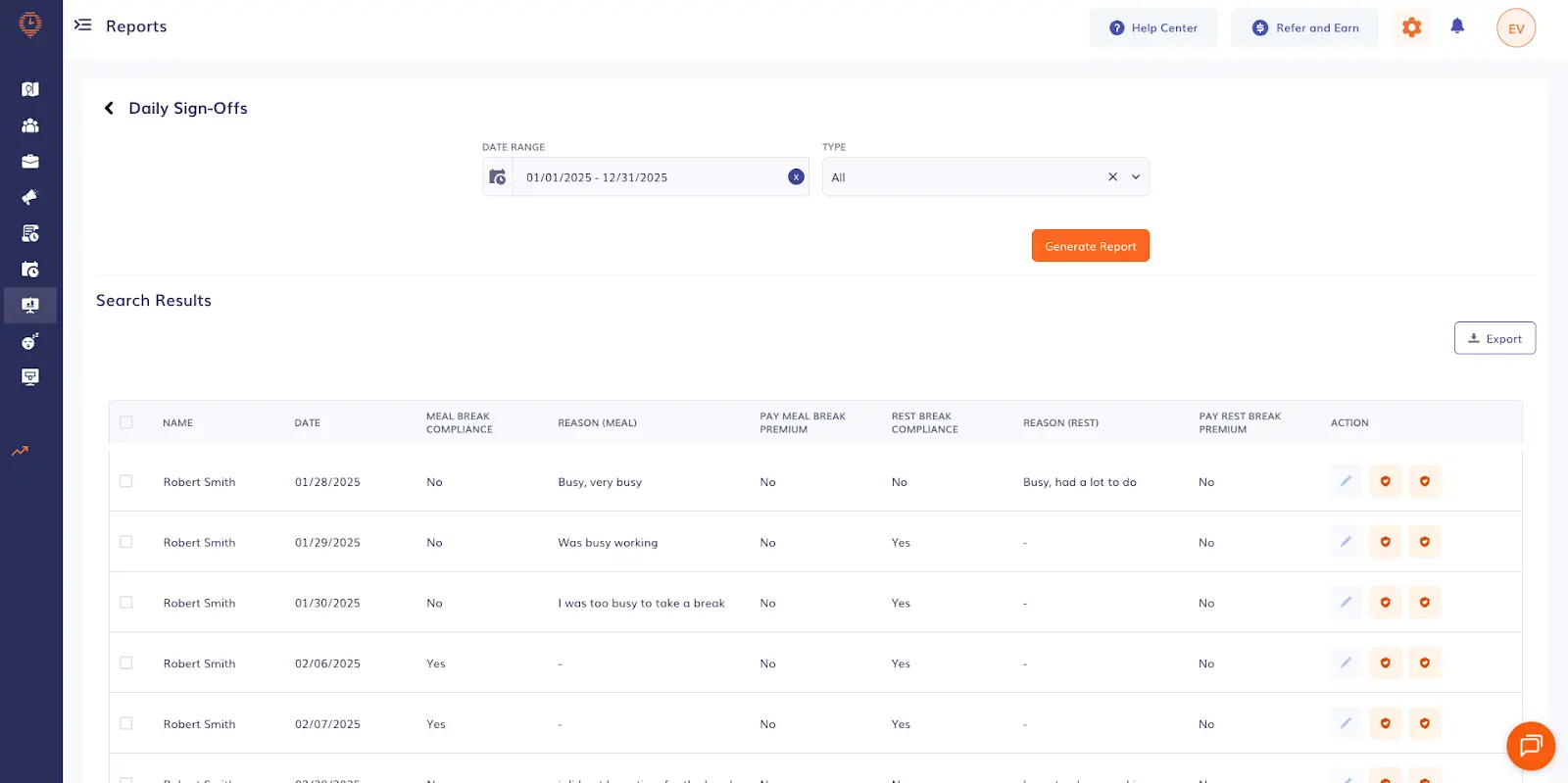
Daily Sign-Offs. Check whether employees have complied with your California break rule policy by selecting a custom date range. You can filter users based on whether they signed the attestation waiver or not, making it easy to identify which employees confirmed their breaks and which flagged exceptions.
Premium Pay Report. Generate a comprehensive report for employees covered under your California break policy to assess whether premium pay is required for a specified date range.
By making audit data accessible and actionable, Timeero shifts your compliance approach from reactive to proactive. Instead of waiting for a claim to review your records, you're now able to regularly monitor compliance and address gaps before they become liabilities.
Faster response when records are requested
When a claim is filed, your attorney needs records quickly. The speed of your response directly affects how fast the case can move forward.
If it takes you weeks to gather data from multiple systems, reconcile conflicting logs, and explain gaps, the case is already slowing down. Plaintiffs' attorneys interpret slow record production as a sign that your documentation is incomplete or disorganized, which increases their confidence in pursuing the claim.
Timeero allows you to pull comprehensive break records in minutes through the Reports tab. When your attorney makes the request, you can choose the type of report you want and export a full year of data complete with timestamped breaks, documented exceptions, premium pay records, and edit logs, in a format that's ready for review.
Break attestation for additional documentation
One of the challenges in defending break claims is that employees sometimes claim they didn't take breaks even when records show they did. Without additional documentation, it becomes a question of credibility, which takes time to resolve through depositions and testimony.
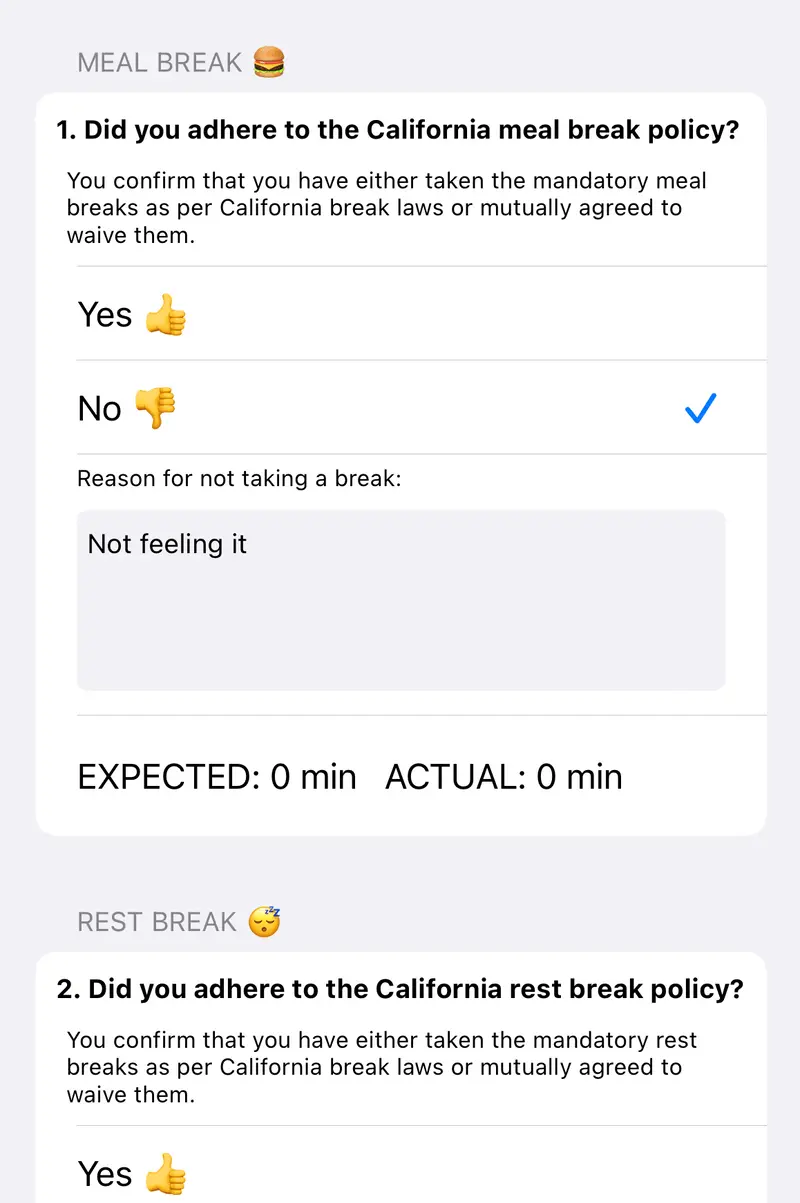
Timeero's Daily Sign-Off forms address this challenge by requiring employees to verify their break compliance at clock-out. When employees end their shift, they're prompted to confirm whether they took their legally required breaks or provide a valid reason for non-compliance.
Employees sign the attestation directly on their mobile devices, creating a timestamped digital signature that's stored with the break record. This creates multiple layers of documentation that support your compliance defense:
Timestamped break record showing the exact start and end time of each break
Break attestation form where employees confirm they took their breaks or state why they didn't
Employee's signature attached to the attestation, captured digitally with a timestamp
If an employee later claims they didn't take a break, you can produce their timestamped signature stating otherwise. Having multiple layers of security reduces ambiguity and makes it harder for plaintiffs' attorneys to argue that breaks weren't provided or that employees were discouraged from taking them.
The attestation also captures instances where breaks weren't taken. If an employee indicates they missed a break, the system requires them to document why, creating a simultaneous record that explains the exception. That real-time documentation is far more defensible than trying to reconstruct reasons months later when a claim is filed.
Break reminders to reduce missed breaks
The best way to avoid meal and rest break litigation is to make sure breaks happen on time in the first place. Missed or late breaks trigger premium pay obligations under California law, and patterns of missed breaks are exactly what plaintiffs' attorneys look for when building PAGA claims.
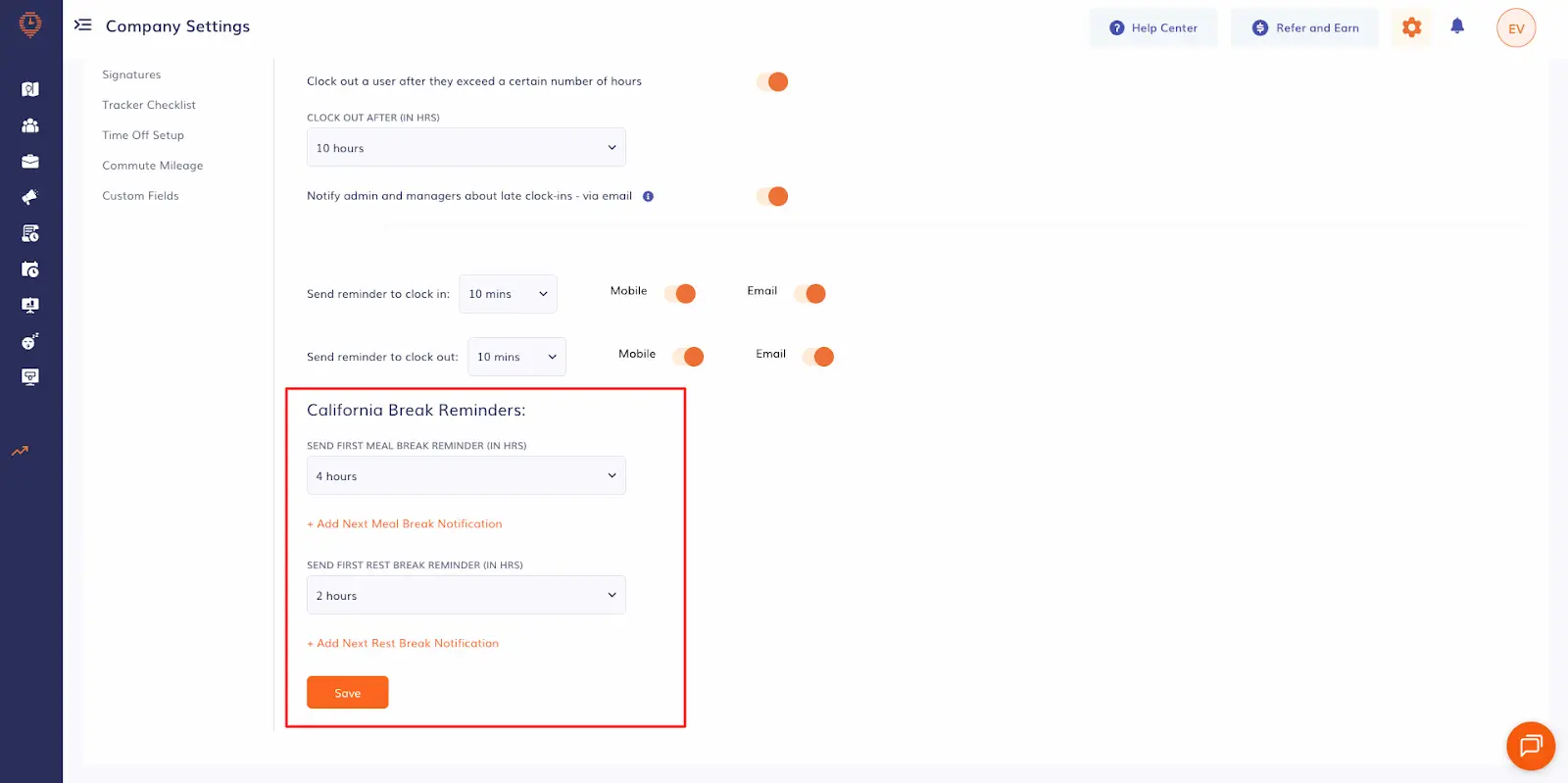
Timeero's automated break reminders prompt employees to take their designated breaks in real time, based on California's specific timing requirements. The reminders are delivered as push notifications to employees' mobile devices, ensuring they receive timely alerts throughout their shift.
Setting up California break reminders is straightforward:
In your Company Settings, navigate to the California Breaks menu to assign which employees are required to follow the California Break Policy.
Under Notifications, you can set the specific time you want the reminder to appear. For example, this can be set to 30 minutes before their legally required break time, giving employees advance notice to wrap up tasks and prepare to clock out.
Once configured, notifications automatically appear on assigned employees' phones based on California's timing requirements for 30-minute meal breaks and 10-minute rest breaks.
Supervisors also receive alerts when breaks are overdue, which allows them to intervene in real time rather than discovering the issue weeks later during payroll review. By proactively prompting break compliance, Timeero reduces the risk of missed or late breaks before they become premium pay obligations or the foundation of a PAGA claim.
The timeline you control starts before a claim is filed
There are no guarantees when it comes to determining a California meal and rest break lawsuit timeline. You can't predict when a claim will arrive or how quickly discovery will move. What you can control is the one factor that determines whether your case resolves in six months or drags on for years: the quality of your records.
Preparations made before claims matter more than reactions after one. By the time a lawsuit is filed, your records are what they are. Timeero is designed to help California employers build the kind of record readiness that shortens case timelines and strengthens your position in compliance audits.
Frequently asked questions (FAQs)
How long do California meal and rest break lawsuits usually take?
A standard PAGA lawsuit timeline doesn’t exist. Some cases can resolve in a matter of months, while others can stretch for years. The length will primarily depend on how quickly both sides can assess the claim based on available records.
If your records are clear and complete, attorneys can move toward resolution faster. But if your records are messy or incomplete, and require reconstruction through depositions and extended discovery, the timeline can expand significantly.
What records matter most in a meal and rest break lawsuit in California?
While having complete time and break records matter, courts want to know whether your records can answer specific questions:
When did the break start?
When did it end?
Was it timely under California law?
If it was missed, was premium pay triggered?
Who documented the exception, and when?
Your records also need to show consistency across all locations and teams. If break records vary by supervisor or site, that inconsistency becomes a liability. Any manual edits should include timestamps and explanations showing who made changes and why.
Do missing or inconsistent records automatically mean a long lawsuit?
Not automatically, but they significantly increase the risk. When records are unclear or incomplete, plaintiffs' attorneys can argue that the burden of proof shifts to the employer to show breaks were actually provided.
Without documentation, the only way to establish what happened is through employee testimony, depositions, and lengthy discovery, all of which extend timelines and raise costs.
So, while missing records don't guarantee you'll lose, they do make it harder to defend compliant behavior and almost always mean the case will take longer to resolve.
Simplify California break compliance with Timeero.
Emman is a passionate writer with more than 6 years of digital marketing experience under his belt. As a licensed chemical engineer with a passion for writing, he marries the technical with the creative to create engaging copy that converts. He is also a certified #girldad who spends most of his day playing with his three girls when he's not busy writing.




%202.svg)


.png)
.png)



.png)


