How To Prevent Break Violations in California Before They Trigger Penalties
Judyann Sonido
Last update on:
September 30, 2026 9:52 AM
Published on:
TL;DR
California break compliance requires consistent execution, not just compliant policies. Employers reduce PAGA risk by standardizing how breaks are recorded, reviewed, and maintained over time. To support this day-to-day consistency, Timeero offers automated break reminders, daily sign-off forms, premium pay calculations, and organized digital records that you can quickly access when questions arise.
If you run a business in California, you probably already have a break policy in place. On paper, everything looks compliant. You have made it clear that breaks are required and stated the timeframe they are to be taken in. But simply having a break policy in place isn’t enough to keep you out of legal trouble.
Think about what actually happens on a busy Tuesday when a job site falls behind schedule, or a client meeting runs long. An employee takes a late lunch here, a short break there. These small inconsistencies may seem harmless until you get hit by a Private Attorneys General Act (PAGA) claim.
Employers don’t intend to violate California’s strict labor laws. However, the risk grows when daily habits drift away from the policy. The employers who avoid meal break violations in California are those who have built systems that make consistent break compliance part of the daily routine, not something they hope will happen.
This article walks you through how to prevent break violations by building repeatable systems, and how automated break tracking solutions like Timeero can support consistent, defensible break tracking across your team.
According to Emilio Rodriguez, a California employment litigator who works with employers in wage-and-hour and PAGA claims across the state, break violations are more about execution than the policy itself.
“Rarely do we see a non-compliant policy,” says Rodriguez.” Where we do see risks and liability is in the application and the consistency of that policy.”
Here’s why relying on your break policy alone to prevent noncompliance often fails:
→ Supervisors interpret rules differently
You oversee three locations, each with a different supervisor. One supervisor sticks closely to the break schedule. Another is more relaxed, often saying, "As long as everyone gets a break, we're fine." Unfortunately, the last location is short-staffed, and breaks get pushed back because there’s no one to cover the shift.
None of these supervisors meant to break the rules. But three different interpretations of the same policy create three different sets of records. In a PAGA claim, an attorney won’t look at your handbook; they’ll see inconsistent records and argue that your company failed to maintain break compliance.
→ Teams grow or move across locations
When you have a small, tight-knit team, it’s easy to look across the room and see who is at lunch. But as your business scales or as teams move between different job sites, visibility disappears. For a real example, see how a seven-location California martial arts school kept consistent break records across every site.
Relying on memory, paper logs, or supervisors to manually clean up timecards at the end of the day is usually where problems start. That’s when late breaks go unnoticed, missed punches get adjusted, and premium pay is forgotten. By the time you realize a new crew in a different city has been skipping their second rest break for the last six months, you’ve already accumulated a massive liability.
→ Paper logs or mixed systems create gaps
Using paper timesheets or a mix of paper and electronic documentation to track employee breaks, leaves room for small mistakes that can turn into bigger problems.
“Sometimes, depending on what your recording method is—and there are several,” explains Rodriguez, “we will see the old punch-card clock. When you still use a piece of paper, you walk up to the wall and you punch in, you punch out. Well, if an employee forgets to do that right, say, one day, then there’s going to be an inconsistency there.”
For example, Geraldine finishes lunch but forgets to record her break time on the paper timesheet she keeps in the company truck.
At the end of the day, she tells her supervisor, “I think I came back around 12:30.”
Her supervisor fills in her timesheet based on this information. It seems minor, but if this situation were to happen to multiple team members on different days, the small gaps would add up quickly and create inconsistent records that raise red flags in a dispute.
→ Small exceptions become routine
Most California break compliance violations start as a one-time thing. For instance, Aaron, your technician, decides to finish a quick installation before clocking out for lunch. Instead of starting his meal break before 1:00 p.m. (his 5-hour mark), he clocks out at 1:30 p.m.
This exception doesn’t seem like a big deal – Aaron isn't complaining, the client is happy, and the job is done. But if this one-time exception becomes Aaron’s standard Tuesday routine, you’ve unknowingly built a pattern of non-compliance that a PAGA attorney can use to weaken your defense.
In California, the timing of breaks is just as legally significant as the break itself. Rodriguez notes that "employers don’t do things on purpose; they don’t want to take away the meal break," but the law doesn't care about your intent.
If the record shows a pattern of late breaks, you owe premium pay for every violation reflected in those records.
→ Records aren’t reviewed regularly
If the only time you look at your timecards is when you’re running payroll, it’s already too late.
A small issue in week 3 could have been fixed with a quick conversation. Instead, no one notices that Jane’s lunch keeps starting 20 minutes late every Thursday. By month 9, her timecards show the same late pattern again and again, and what could have been corrected early now looks like a long-running break compliance problem.
Without a system that flags late or short breaks automatically, you open yourself up to costly lawsuits and fines.
Three simple ways employers can reduce break violations
The good news is you don’t need to rebuild your entire operation to avoid meal break violations in California. By following these three simple fundamentals, you can prevent the risks associated with break tracking:
1. Set clear expectations
A California break compliance policy is only as good as the people implementing it. If your team treats the rules as suggestions that can be ignored when things get busy, your handbook won't save you. Clear expectations close that gap.
👉 Start with written policies that are easy to understand. Spell out when meal and rest breaks must start, and what happens if a break is missed or taken late. Avoid vague language. If the rule is “meal breaks must be taken before the end of the fifth hour,” say that clearly.
👉 Next, focus on supervisor training. Your field managers are the ones making real-time calls when a job runs long, a client adds last-minute work, or a team member asks to push lunch back. Their decisions determine if breaks stay compliant or begin to slip up.
Do not assume your supervisors remember what was covered in onboarding two years ago. Hold regular training to review break rules, walk through real scenarios, and answer questions.
👉 Lastly, set clear timing rules. Keep the language simple and direct so no one has to interpret your policy in the middle of a busy shift.
Instead of saying “30-minute breaks are given for every 5 hours worked,” tell your team, “If you start working at 8:00 a.m., you must begin your lunch before 1:00 p.m. No exceptions.” Including start times in examples within your policy can help employees understand your company’s break rules.
2. Track breaks consistently across teams
If you have three teams tracking breaks in three different ways – some on paper, some via text, and some not at all – you’re creating a discovery nightmare for your legal counsel.
👉 Standardize break tracking across teams. Every employee should record breaks the same way, using the same system. When records are stored in one place and follow the same format, they are easier to review and produce if needed.
👉 Automate break tracking with software built for California employers. Move away from manual entries. GPS tracking solutions like Timeero capture exact timestamps, eliminating guesswork and "rounding" errors that often trigger PAGA claims.
👉 Document exceptions as they happen. If a break is missed or late, don’t ignore it. Document the reason and, if necessary, pay the required California premium pay in that same pay period. This shows good faith and corrective action.
Consistency is what holds up later, which is exactly how one California business kept its break records audit-ready across every location.
3. Conduct regular reviews
As we discussed earlier, issues become expensive when they go unnoticed for months. To avoid meal break violations in California, you must:
👉 Spot-check break records weekly. Don't wait for a lawsuit to look at your data. Set aside time each week to review break timing, missed punches, and premium pay entries. A 20-minute review now can save months of stress later.
👉 Identify patterns early. If you notice Josiah is consistently skipping rest breaks, address it now. Ask him why. Is it the workload? Scheduling? A misunderstanding of the rule? A quick conversation today is easier than explaining a year of late breaks in a deposition.
👉 Address small issues before they grow. As Rodriguez points out, “The better the record, the faster [a claim] is going to be gone.” When you catch and correct errors in real time, your records show consistency and oversight, not months of unresolved gaps.
California Meal & Rest Break Violations: What They Could Cost You
Missed or late breaks can quietly add thousands in premium pay and legal exposure. Use this calculator to estimate what break violations could cost your business—and how much Timeero could help you save.
How Timeero supports consistent CA break compliance
For California companies with field teams, a break policy alone isn’t going to protect you during lawsuits or PAGA claims. You need something stronger to document evidence of employees’ breaks and work hours. This is where Timeero comes in.
Timeero is a break tracking software built to handle the operational complexity California employers face every day. With strict compliance requirements, distributed teams and mobile workforces need a break tracking system that leaves no room for error.
Here’s how Timeero helps ensure consistent policy implementation across teams:
✅ Time and break records stored in one place
Think about the last time someone asked you to pull 30 days’ worth of break records for a specific employee. Did you know immediately where to look? If the answer involves checking a binder, calling a supervisor, or digging through a spreadsheet, that's a problem.
Timeero consolidates time and break data into a single system. No more paper logs in one location and spreadsheets in another.
Timestamped records make California break compliance easier to track across teams and locations.
✅ Breaks captured consistently across teams
Timeero has a built-in California Break Policy rule that you can enable directly from your dashboard. Once activated, you can then assign this rule to applicable employees. From there, employees can start and end their meal and rest breaks the same way they normally do in the app.
The California Break Tracking rule adds an extra layer of protection for you and your whole team.
When an employee clocks out at the end of their shift, a screen appears asking them to confirm whether they took their legally required meal and rest breaks.
Employees can start and end their rest breaks directly in the app, ensuring every break is recorded with an exact timestamp.
They are then prompted to sign the form electronically, which makes the document a legitimate piece of evidence during disputes or audits. Employees assigned to the California break policy rule must fill out the break attestation form, even though their breaks are already logged in the app. To see exactly how this seamless workflow protects your business, explore our interactive demo on mastering California meal break compliance.
That extra step matters more than it might seem. If a PAGA claim ever comes your way, that daily attestation shows a judge or attorney that your company didn't just offer breaks on paper; your employees confirmed, in writing, that the breaks were provided. That's a very different position to be in than relying on a handwritten timesheet.
Timeero sends timely mobile alerts so employees always know when it’s time to step away.
You can also:
Automatic break reminders, which notify employees when it’s time to take their meal break before the 5th hour.
Prevent employees from ending breaks early. If someone tries to clock back in before the required break time, they will receive this message: “You cannot end your break early. Wait till the minimum break time is exceeded before ending your break."
Instead of relying on supervisors to catch late lunches, the system supports compliance automatically. That consistency across teams is what protects you long term.
✅ Timestamped digital records
If you’ve ever had to answer the question, “Can you produce your employees’ meal break records?” you know how stressful that moment can be.
With Timeero’s California Break Tracker, break reports are organized, searchable, and timestamped down to the minute. For example, Matt claims his meal break was cut short. With paper logs, you’re left debating memory. With Timeero, you can pull his break report that shows the exact time he took each meal or rest break, as well as the duration.
Timeero’s Break Report shows the exact start and end times of breaks, as well as break durations.
That kind of documentation is exactly what protects you in a PAGA claim. Instead of trying to piece together what happened six months ago, you can pull a clean, organized report immediately. Employers with consistent, verifiable records are in a much stronger position when a claim lands on their desk. And in many cases, clean documentation is what gets a claim resolved quickly before it escalates further.
✅ Clear visibility into when breaks happen
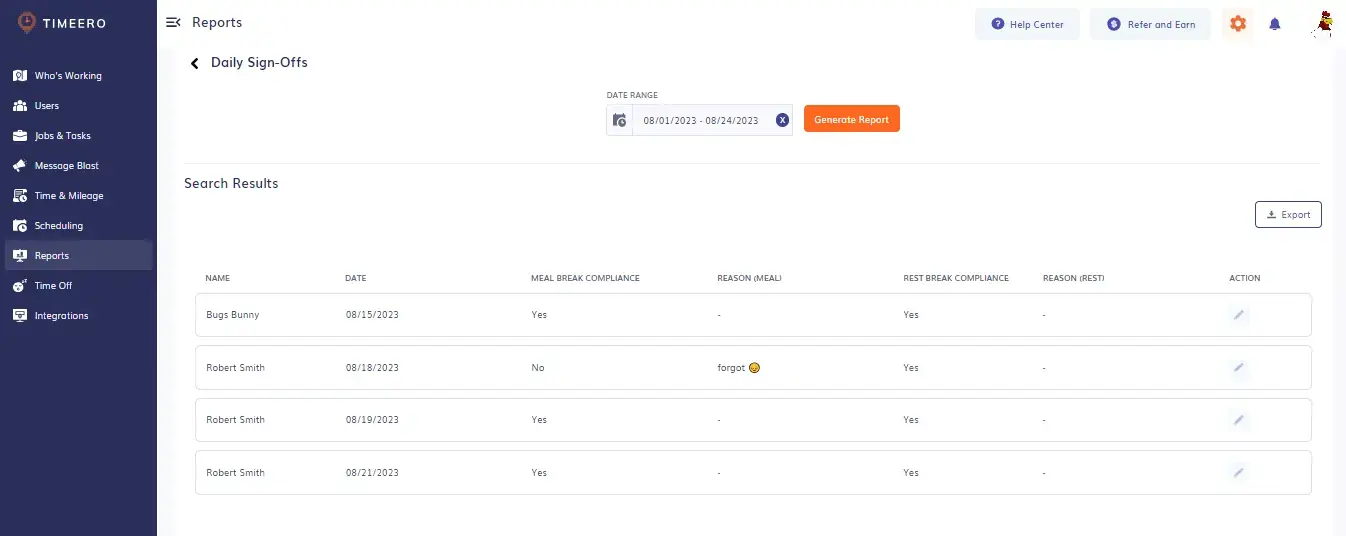
Daily Sign-Off Reports show you who confirmed they took their breaks, as well as who missed a break or took their break late. Combined with actual clock activity, break attestation forms give you the visibility you need into employee breaks.
View employees’ Daily Sign-Off reports to see if required breaks were taken, and why breaks were missed.
✅ Easier internal reviews
Because everything is standardized and digital, a monthly spot check takes minutes rather than half a day. Instead of digging through paper logs or spreadsheets, you can open a report and immediately see where potential issues exist.
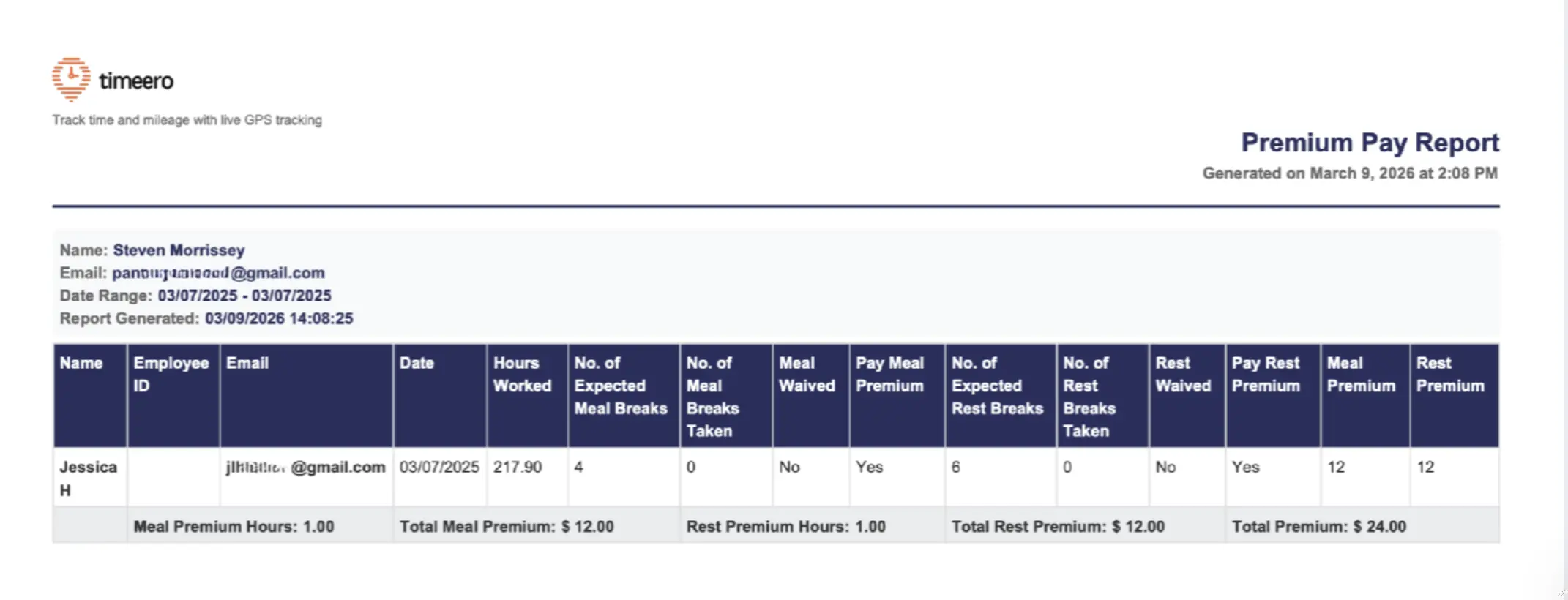
Timeero’s reports make it easy to filter for late meal breaks, short rest breaks, or missed breaks across your team. For example, Timeero’s Premium Pay Report highlights when a violation occurred and calculates the premium pay owed, so you can quickly spot problems and address them before they become larger compliance risks.
The Premium Pay Report highlights missed, late, or short breaks and automatically calculates the premium pay owed.
✅ Faster access to records if needed
Anyone who's dealt with a wage claim knows the first question is always: "Can you produce the records?"
How fast you answer that question matters. With Timeero, you can pull a timestamped, real-time report in seconds. That's a very different position to be in than scrambling through spreadsheets when compliance is on the line.
Turn break compliance into a daily system
A break tracking system built on clear expectations, consistent tracking, and regular review keeps compliance visible before problems escalate.
Timeero is built to support that system, without adding complexity to your day-to-day operations. Automated break reminders keep your team on schedule, daily attestations create a paper trail at every clock-out, and timestamped reports give you immediate access to the records you need. Instead of hoping your team is staying compliant, you’ll have clear, documented records that show exactly what happened each shift.
FAQs
Does Timeero track employees during their meal breaks?
No. Timeero records when the break starts and ends. It does not monitor employee location or activity during the break itself. This keeps you compliant with employee privacy expectations while still maintaining accurate break records.
Does Timeero calculate premium pay for missed breaks?
Yes. Timeero can be configured to flag missed or shortened breaks and calculate the premium pay owed under California law. This helps you stay current on obligations and keeps your payroll records accurate.
Can Timeero help in a wage and hour dispute or PAGA claim?
Timeero gives you organized, timestamped digital records of when breaks were taken, how long they lasted, and any documented exceptions. While Timeero is a tool to support your compliance process — not a legal defense in itself — having clean, consistent records is one of the most important factors in resolving wage and hour disputes. Employers with solid documentation are in a much stronger position than those trying to reconstruct records after the fact.
Judyann is a content specialist with nearly a decade of experience in digital marketing. When she's not building brands and strategies, you'll find her exploring new destinations, embarking on spontaneous adventures, hunting down the best local eats, and spoiling her two fur babies. She believes the best content, like the best trips, comes from curiosity, creativity, and never playing it safe.



.webp)


.webp)

%202.svg)


.png)
.png)

.png)


